A CFO does not need a six-month study to know whether non-rent revenue is leaking. Thirty minutes and six questions are enough. This audit walks a 10,000+ unit operator through the five RevGen leaks and sizes the opportunity at the end, so the move-in and move-out window is no longer a blind spot on the operating statement. The framework is based on the Moved CEO’s RevGen leak map.
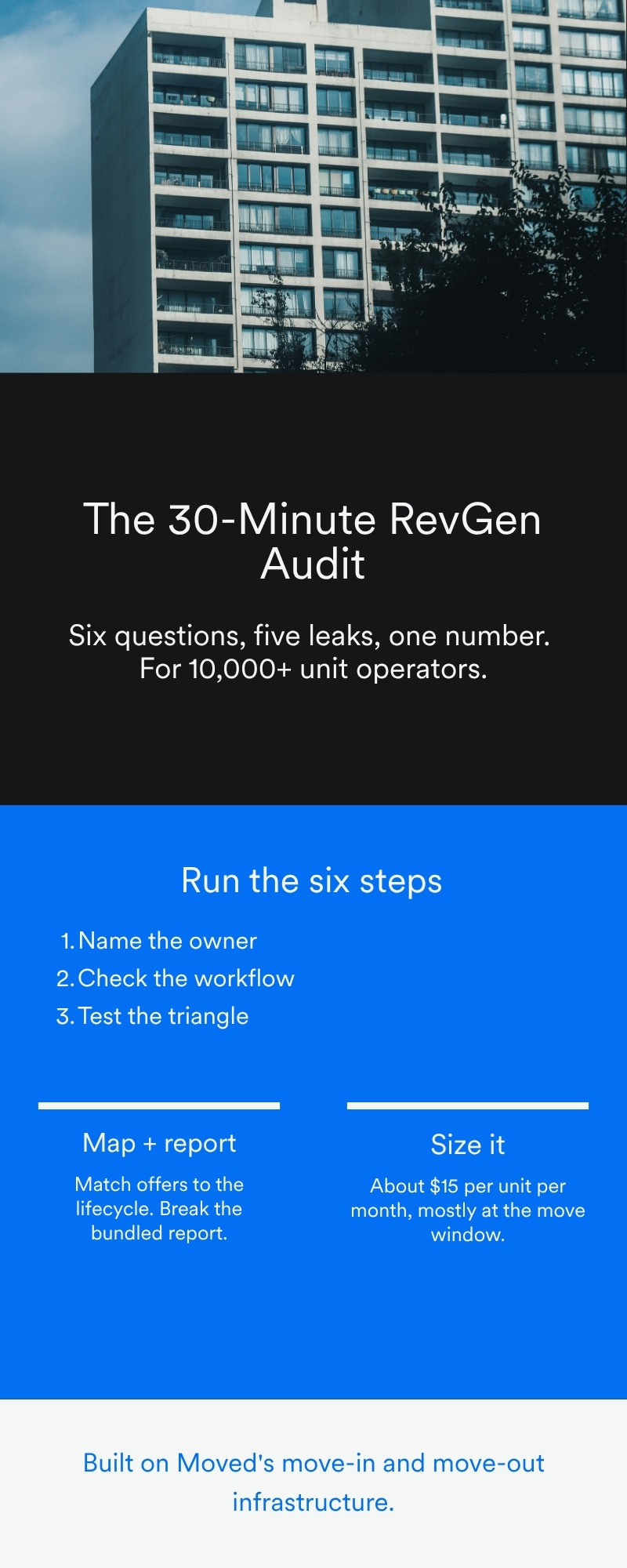
Run the six steps below in order. Each one maps to a leak, and each has a clear pass or fail. For the broader model, see our guide to ancillary revenue in multifamily.
Step 1: Name the owner
Ask who the single named person is whose compensation is tied to the non-rent revenue. If the answer is a committee or a shared responsibility, the ownership leak is open. A clear owner with a target, a dashboard, and the authority to act is a pass.
Step 2: Check the workflow
Ask whether the non-rent offer depends on a leasing agent remembering to make it. If revenue relies on memory during the move-in and move-out rush, the workflow leak is open. An offer embedded in the workflow and default-visible to every resident is a pass.
Step 3: Test the triangle
Take your largest ancillary program and ask whether the resident, the operator, and the partner all win. If anyone is losing, the program is on borrowed time, and the incentive leak is open—a program where all three win is a pass.
Step 4: Map the lifecycle
Ask whether offers are timed to the resident’s intent or broadcast all at once. If the same offer goes out regardless of the moment, the lifecycle leak is open. Offers matched to the application, the move-in and move-out window, living, and renewal are a pass.
Step 5: Break the report
Ask whether non-rent revenue is reported as one bundled “other income” line or as a category-level scorecard. If it is one number, the reporting leak is open. Revenue per unit by category, attach rate, margin by stream, and resident satisfaction impact are a pass.
Step 6: Size the opportunity
Finish by sizing the leaks. The Moved CEO’s RevGen leak map sizes the typically uncaptured non-rent opportunity at roughly $15 per unit per month, most of it concentrated in the move-in and move-out window. Multiply that by the units in the portfolio to see why the audit is worth the thirty minutes. We detail the mechanism in our breakdown of how move-in and move-out workflows became a property management revenue engine and the onboarding mechanics in our ultimate guide to resident onboarding automation.
Reading the results
Any step that fails is a specific, fixable leak with a named owner, a workflow change, a program redesign, a timing fix, or a reporting change behind it. The audit turns a vague sense that non-rent revenue could be improved into a prioritized list of moves, all of which point back to the move-in and move-out window, where the largest opportunity lies.
How Moved fits
Moved is the move-in and move-out infrastructure platform that closes the leaks that the audit surfaces. Traditional tools focus on task tracking and administrative coordination. Moved embeds revenue-generating services, including moving, packing, storage, utilities, internet, and insurance verification, directly into the resident workflow, and returns category-level data to the asset management team. Resident perks, rewards, and partnerships run on Paylode, a Moved company that Moved acquired in November 2025 to advance ancillary revenue automation, per the Moved announcement. The resident-facing experience lives inside the Moved resident experience. Moved is built on flexible commercial structures designed to align with property financial goals.
To run the audit against your own portfolio with our team, book a walkthrough or visit the Moved multifamily product page.
FAQs
What is the 30-Minute RevGen Audit? A six-step checklist that walks a 10,000+ unit operator through the five RevGen leaks and sizes the opportunity, fast enough to run in a single sitting.
What are the six steps? Name the owner, check the workflow, test the triangle, map the lifecycle, break the report, and size the opportunity.
What sizing figure does the audit use? Roughly $15 per unit per month in typically uncaptured non-rent revenue, from the Moved CEO’s RevGen leak map, most of it in the move-in and move-out window.
Who should run it? The CFO or asset management leader, with operations able to answer the workflow and lifecycle questions.
What do I do with a failed step? Each failure maps to a specific fix: an owner, an embedded workflow, a program redesign, a timing change, or a category-level report.
The bottom line
In residential real estate, non-rent revenue is easy to audit and expensive to ignore. Six questions surface the five leaks; the sizing step shows what they are worth; and every answer points back to the move-in and move-out window as the place to start.
For the NOI picture, see our guide to increasing multifamily NOI without raising rent.