A lease renewal letter is the written offer a property sends a resident before the current lease ends. It sets out the renewal terms and rent, the deadline to respond, and how to accept. For a large operator, it also decides whether the unit starts a new lease or a new move-in and move-out cycle.
Across a 10,000+ unit portfolio, renewal letters go out by the thousands each year, often from different site teams on different timelines. This guide covers why the letter matters, when to send it, what to include, a ready-to-use template, and how to run one renewal standard across every property in residential real estate.
Why the renewal letter matters at portfolio scale
Retention is under pressure. Zego’s 2026 Resident Experience Management Report found that average retention fell to 57 percent, down from 60 percent in 2024, while 59 percent of property managers still expect retention to improve.
Each resident who leaves becomes a turn. Turnover has cost about $3,872 per resident, according to an earlier edition of Zego’s report reported by Multifamily Dive, a figure that includes marketing, repairs, concessions, and lost rent.
Filling the unit again often takes an incentive. RealPage found concessions on 15.4 percent of stabilized U.S. apartments in August 2026, with the average discount equal to about 5.7 weeks free on a 12-month lease, according to its August 2026 concessions update.
A renewal letter that arrives late or leaves out what a resident needs to decide makes that turn more likely. A clear, early, and consistent letter supports the resident experience at the moment the resident chooses whether to stay.
The revenue case: every renewal decision is a move decision
A renewal offer ends in one of two outcomes: the resident stays, or a move-out begins. Both outcomes involve services. A resident who renews may need storage, an internet upgrade, or a transfer to a different unit, and a resident who leaves will need movers, packing, and storage within weeks.
That makes the renewal window part of the move-in and move-out revenue workflow. Operators who present services at the renewal decision, and again at notice to vacate, keep that spending inside their own resident flow.
Moved’s newsletter The RevGen Leak Map describes renewal as the point where the resident decides whether to trust the property for another term, and it advises leading with loyalty signals ahead of any upsell. In practice, the renewal letter should open with the offer and the resident’s options, with services presented as optional help.
Loyalty before the offer: Paylode, a Moved company
Loyalty programs shape renewal decisions before the letter arrives. Zego’s 2026 research found that 31 percent of renters would be much more likely to renew if their community offered a renter rewards program.
Paylode is a Moved company. Moved acquired Paylode in November 2025, adding a perks and rewards platform that helps brands increase loyalty and retention through personalized perks and action-based rewards. Paylode’s clients have included Equity Residential and FirstKey Homes.
For renewals, the practical step is to place the perks a resident has earned, and the ones that continue with a new lease, inside the renewal letter itself. The offer then reads as a continuation of value the resident already receives.
When to send a lease renewal letter
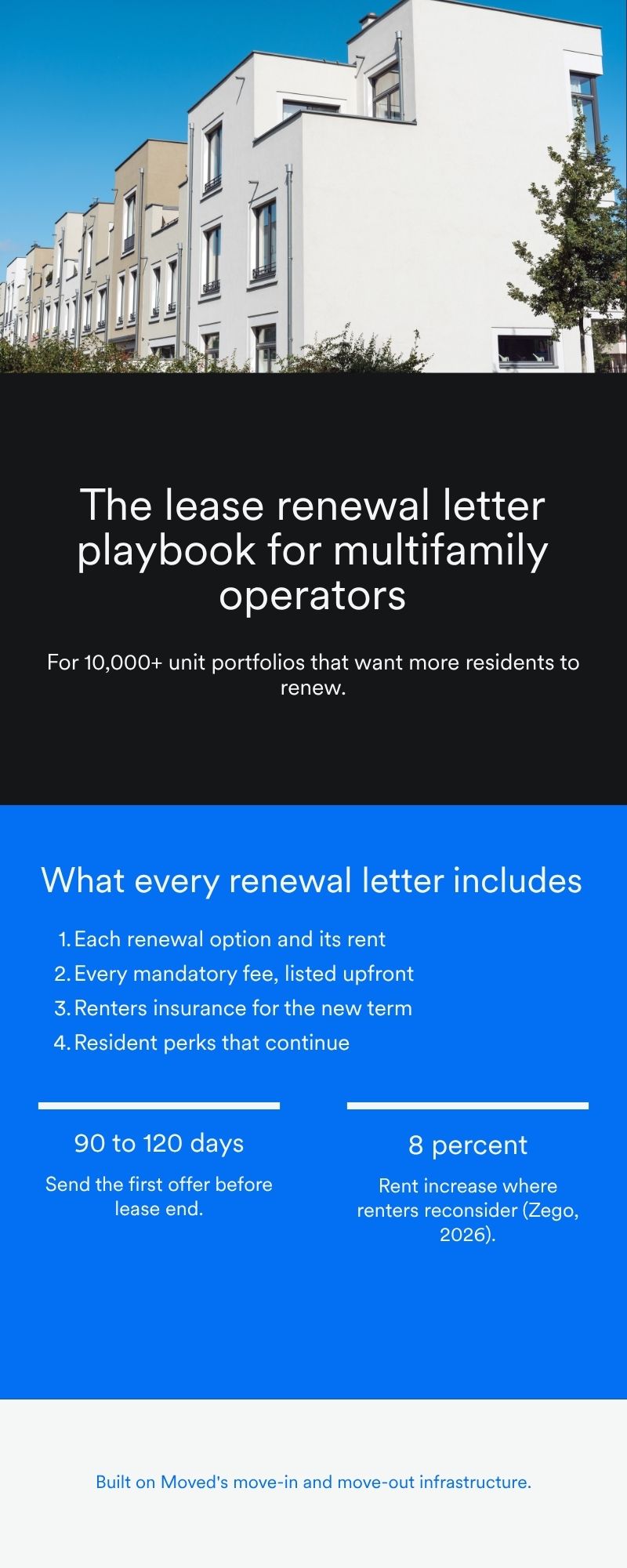
A first offer 90 to 120 days before lease end gives the resident time to decide and gives the property time to plan the turn if the resident leaves. Reminders at fixed intervals keep the decision moving.
| Timing | Step | Purpose |
|---|---|---|
| 90 to 120 days before lease end | Renewal letter with every option | Time to decide, and time to plan the turn |
| 60 days before lease end | Reminder with the response deadline | Keeps the decision on schedule |
| 30 to 45 days before lease end | Final notice of terms, including month-to-month terms | Confirms what happens without a response |
| At notice to vacate | Move-out steps, plus movers, packing, and storage | Starts the move-out with services in place |
| Before the new term | Renters insurance confirmed for the new term | Closes the coverage gap at renewal |
State and local rules can set minimum notice periods for rent changes. In California, for example, Civil Code section 827 requires at least 30 days’ written notice for a rent increase of 10 percent or less on a month-to-month tenancy, and at least 90 days for a larger increase.
Leases and local ordinances can require longer periods. Set the portfolio standard at the longest notice period that applies in any market you operate in, and confirm the requirements with counsel.
What to include in a lease renewal letter
| Section | What it covers | Why it matters |
|---|---|---|
| Resident and unit details | Names, unit number, and the current lease end date | Removes doubt about which lease is renewing |
| Renewal options | Each available term length and its rent | Lets the resident compare terms in one place |
| Rent change and effective date | The new rent and the date it starts | Supports state notice requirements |
| Mandatory fees | Every recurring and one-time charge for the new term | Fee transparency is under federal review |
| Response deadline | The date, the method, and a link to sign | Turns the offer into a decision |
| No-response terms | Month-to-month terms or move-out steps | Prevents disputes at lease end |
| Renters insurance | The requirement to keep coverage active for the new term | Mitigates the financial risk of a lapse |
| Resident perks | Rewards that continue with the new lease | Reinforces the reason to stay |
| Contact | A named team member and the best channel | Gives the resident someone to ask |
Fee disclosure belongs in the letter. The Federal Trade Commission’s advance notice of proposed rulemaking on rental housing fees, published in March 2026, asks about one-time fees charged at the beginning or end of a lease term and about lease renewals specifically.
Moved’s guide to what the FTC rulemaking means for move-in charges covers the same question at the start of a lease. The renewal letter should apply the same standard: every mandatory charge, listed before the resident signs.
Price the renewal with the resident’s threshold in mind. Zego’s 2026 research found that renters begin reconsidering renewal at an average rent increase of 8 percent, with monthly increases of $90 to $150 triggering hesitation.
Lease renewal letter template
Adapt the template below at portfolio level and fill in the bracketed fields for each property. Keep the order, since it follows the order in which a resident makes the decision.
Subject: Your lease renewal options at [Community name]
Hi [Resident first name],
Thank you for living at [Community name]. Your current lease for [unit number] ends on [date], and we would like you to stay. Below are your renewal options and what happens next.
Your renewal options
- [Term length] months at [rent] per month
- [Term length] months at [rent] per month
- Month-to-month at [rent] per month after [date]
Your new rent takes effect on [date]. The mandatory fees for your new term are listed here: [fee list or link].
To renew, choose an option and sign here by [deadline]: [link]. If we have not heard from you by [deadline], [month-to-month terms or move-out steps] will apply.
Before your new term starts, please confirm that your renters insurance stays active with at least [coverage requirement] in liability coverage. You can update your policy details here: [link].
Your resident perks continue with your new lease. You can see your current rewards here: [link].
If you are planning to move, please let us know by [date]. We can help you book movers, packing, and storage, and we will send your move-out steps and inspection details.
If you have any questions, contact [name] at [phone] or [email].
[Community manager name]
[Community name]
Insurance continuity at renewal
A renewal is a checkpoint for renters insurance. Coverage verified at move-in can lapse during the lease, and an uninsured resident-caused loss falls on the property’s own policy or balance sheet.
Ask residents to confirm active coverage for the new term before the renewal is countersigned. Listing the property as an interested party on each policy means the carrier notifies the property if coverage is cancelled or changed, as Moved’s guide to capturing renters insurance requirements at move-in explains.
Running renewals across a 10,000+ unit portfolio
Renewal results vary by property when each site writes its own letter. One standard, applied everywhere, makes results comparable and easier to improve.
- One master renewal letter, owned centrally, with property-level fields for rent options, fees, and contacts.
- Triggered sending at a fixed number of days before lease end, with reminders scheduled automatically.
- Every mandatory fee listed in the offer and reviewed against the FTC fee guidance.
- Renters insurance confirmed before the renewal is countersigned.
- Services offered at the decision point: storage, internet, and unit transfers for residents who stay, and movers, packing, and storage for residents who leave.
- Renewal rate, response time, and reasons for leaving reported by property.
Traditional tools focus on task tracking and administrative coordination. Moved embeds revenue-generating services and insurance verification directly into the workflow, transforming move coordination into structured revenue infrastructure.
Moved is a move infrastructure platform that embeds revenue-generating services, including movers, packing, storage, insurance, utilities, and connectivity, directly into the resident onboarding workflow. It helps property operators increase ancillary income while mitigating compliance risk, and the guide to resident onboarding automation shows how that workflow is built.
For a portfolio view of the same process, see Moved for multifamily operators.
Frequently asked questions
How far in advance should a lease renewal letter be sent?
A practical standard for large portfolios is 90 to 120 days before lease end, with reminders at 60 days and at 30 to 45 days. State and local notice rules can require more time for rent increases.
What should a lease renewal letter include?
The renewal options and rent, the effective date, every mandatory fee, the response deadline and how to accept, and the terms that apply without a response. It should also cover the renters insurance requirement, resident perks, and a named contact.
Can rent increase at renewal?
Yes, subject to the lease, state law, and any local rent regulations. California, for example, requires 30 days’ notice for month-to-month increases of 10 percent or less and 90 days for larger increases.
What is a non-renewal letter?
A non-renewal letter is a notice from either the property or the resident that the lease will end on its current date. It should state the lease end date, the move-out steps, and the inspection details, and residents who are leaving should receive help with booking movers, packing, and storage.
Should a lease renewal letter mention renters insurance?
Yes. Ask the resident to confirm that coverage remains active for the new term, so the property keeps its protection against a resident-caused loss after renewal.
Keep more residents at renewal
The renewal letter is the last standardized message before a resident decides to stay or move. To see how renewal offers, insurance confirmation, and move services run as one move-in and move-out workflow across a 10,000+ unit portfolio, book a walkthrough with the Moved team.