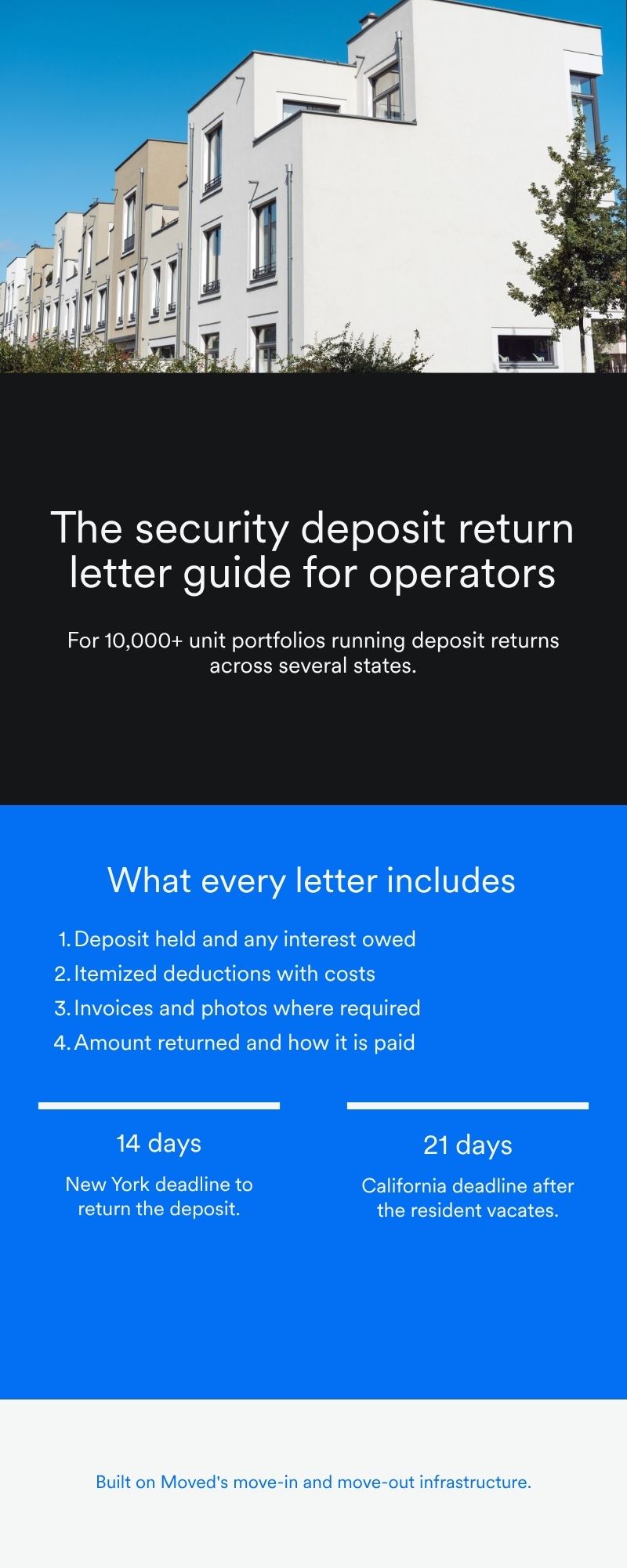
A security deposit return letter is the written statement a property sends a former resident after move-out. It shows the deposit held, each deduction with its reason and cost, and the amount being returned. Most states set a deadline for sending it, and a late or incomplete letter can cost the property the right to keep any of the deposit.
For a 10,000+ unit operator, deposit letters go out from hundreds of properties in several states, each with its own deadline. This guide covers the state rules that shape the letter, what to include, a ready-to-use template, and how to run deposit returns as the last step of a structured move-out in residential real estate.
Why The Deposit Letter Carries So Much Risk
The deposit letter is often the last message a resident receives from the property. If it arrives late, lacks detail, or includes charges the resident did not expect, it can turn a routine move-out into a dispute.
State law sets the penalties. In New York, a landlord who misses the 14-day deadline forfeits any right to retain any portion of the deposit, under General Obligations Law section 7-108. In California, bad faith retention can lead to statutory damages of up to twice the deposit, in addition to actual damages, under Civil Code section 1950.5.
Both states also place the burden of proof on the landlord when the reasonableness of a deduction is disputed. A clear, documented letter is therefore the property’s main defense.
State Deadlines That Shape The Letter
Deadlines and content rules vary by state. The table below shows three large rental markets as worked examples.
| State | Deadline | What the letter must include |
|---|---|---|
| California | 21 calendar days after the resident vacates | An itemized statement of the deposit and its disposition, with copies of invoices or receipts and photos for repair and cleaning deductions, unless those deductions total $125 or less |
| Texas | On or before the 30th day after the resident surrenders the premises | The balance of the deposit, with a written description and itemized list of all deductions |
| New York | Within 14 days after the resident vacates | An itemized statement indicating the basis for the amount retained, with the remaining deposit |
The Texas rules appear in Texas Property Code sections 92.103 and 92.104, which also make an advance notice requirement for the refund effective only if it is underlined or printed in conspicuous bold in the lease.
For a multi-state portfolio, the practical standard is to build one letter that meets the strictest content rule you operate under, and to run a separate deadline clock for each state.
What Every Deduction Must Stand On
All three states bar deductions for ordinary wear and tear. California also bars claims for conditions that existed before the tenancy and limits deductions to the reasonable cost of returning the unit to its condition at move-in.
New York lists what a landlord may retain for: unpaid rent, damage beyond normal wear and tear, unpaid utility charges payable to the landlord under the lease, and the moving and storage of the resident’s belongings. It also bars deductions for damage caused by a prior tenant.
Each deduction should trace back to the move-in and move-out inspection record. Moved’s move-in and move-out inspection checklist covers the room-by-room process and the photo standard that supports each line of the letter.
What To Include In A Security Deposit Return Letter
| Section | What it covers | Why it matters |
|---|---|---|
| Resident and unit details | Names, unit number, lease dates, and move-out date | Starts the state deadline clock on record |
| Deposit held | The original deposit and any interest required by state law | Shows the starting balance |
| Itemized deductions | Each charge, its location in the unit, the work done, and the cost | Meets itemization rules and answers questions before they are asked |
| Supporting documents | Invoices, receipts, and photos where the state requires them | Carries the burden of proof |
| Amount returned | The balance and how it is being paid | Closes the account |
| Amount owed | Any charges above the deposit and how to pay them | Avoids a second dispute later |
| Contact | A named team member for questions | Gives the resident a route other than a complaint or review |
Security Deposit Return Letter Template
Adapt the template below at portfolio level and fill in the bracketed fields for each property and state.
Subject: Your security deposit statement for [Community name], unit [unit number]
Dear [Resident name],
Thank you for living at [Community name]. This letter is your itemized statement for the security deposit on unit [unit number], for the lease that ended on [move-out date].
Deposit held: [amount], plus [interest, if required]
Deductions:
- [Description and location of the item]: [cost]
- [Description and location of the item]: [cost]
Total deductions: [amount]
Amount returned to you: [amount], sent by [payment method] on [date].
Copies of the invoices, receipts, and photos for these deductions are [attached or available at link].
If you have questions about this statement, contact [name] at [phone] or [email] by [date].
[Community manager name]
[Community name]
Where The Deposit Letter Sits In The Move-Out Workflow
The deposit letter depends on steps that happen weeks earlier. The property needs a forwarding address, a pre-move-out inspection offer, and a final inspection with photos before any repairs begin.
Those steps fall in the same window in which the resident is booking movers, packing help, and storage. When the forwarding address is collected through the move flow, the resident also sees moving options at the moment they need them, and the property keeps that service revenue inside its own move-in and move-out revenue workflow.
Moved’s newsletter The RevGen Leak Map describes move-out as a moment where easy transition offers and moving services preserve goodwill. A well-run deposit return is the final part of that transition.
Goodwill At Exit: Paylode, A Moved Company
The way a resident leaves shapes what they say about the community. Paylode is a Moved company. Moved acquired Paylode in November 2025, adding a perks and rewards platform that helps brands increase loyalty and retention through personalized perks and action-based rewards.
For operators, perks earned during a lease are part of the relationship a resident remembers at move-out. A clear deposit statement keeps that relationship intact through the last step.
Fees, Disclosure, And Insurance
Charges that appear for the first time on a deposit letter are a common source of disputes. The Federal Trade Commission’s advance notice of proposed rulemaking on rental housing fees asks about one-time fees charged at the beginning or end of a lease term. Moved’s guide to the FTC rental fee rulemaking covers how to disclose those charges at lease signing.
A deposit also covers only a limited amount of damage. A resident-caused loss beyond that amount falls to insurance, which is why renters insurance verification belongs at move-in. Moved’s guide to capturing renters insurance requirements at move-in explains the process.
Running Deposit Returns Across A 10,000+ Unit Portfolio
- One deposit letter template, with state-specific fields for deadlines, interest, and supporting documents.
- A deadline clock for each state that starts on the move-out date.
- Forwarding address collected at notice to vacate, alongside movers, packing, and storage options.
- Pre-move-out inspection offers sent automatically, with photos stored against each unit.
- Every deduction linked to an inspection line, a photo, and an invoice.
- Disputes, average days to return, and deduction rates reported by property.
Traditional tools focus on task tracking and administrative coordination. Moved embeds revenue-generating services and insurance verification directly into the workflow, transforming move coordination into structured revenue infrastructure.
Moved is a move infrastructure platform that embeds revenue-generating services, including movers, packing, storage, insurance, utilities, and connectivity, directly into the resident onboarding workflow. It helps property operators increase ancillary income while mitigating compliance risk, and the guide to resident onboarding automation shows how that workflow is built.
For residents, one clear process from notice to deposit return is part of the resident experience. For operators, Moved for multifamily operators shows how the same process runs across a portfolio.
Frequently Asked Questions
What is a security deposit return letter?
It is the itemized statement a property sends a former resident after move-out, showing the deposit held, each deduction, and the amount returned.
How long does a landlord have to return a security deposit?
It depends on the state. California allows 21 calendar days, Texas allows 30 days, and New York allows 14 days.
Can a landlord deduct for normal wear and tear?
No. California, Texas, and New York all bar deductions for ordinary wear and tear.
Does a security deposit letter need receipts?
In California, the statement must include invoices or receipts and photos for repair and cleaning deductions unless they total $125 or less. Other states set their own rules, so check each one.
What happens if the deposit letter is late?
Penalties vary by state. In New York, a landlord who misses the 14-day deadline forfeits the right to retain any portion of the deposit.
Close Every Move-Out Cleanly
The deposit letter is the last document in a resident’s move-out. To see how notice, inspections, moving services, and insurance verification run as one move-in and move-out workflow across a 10,000+ unit portfolio, book a walkthrough with the Moved team.