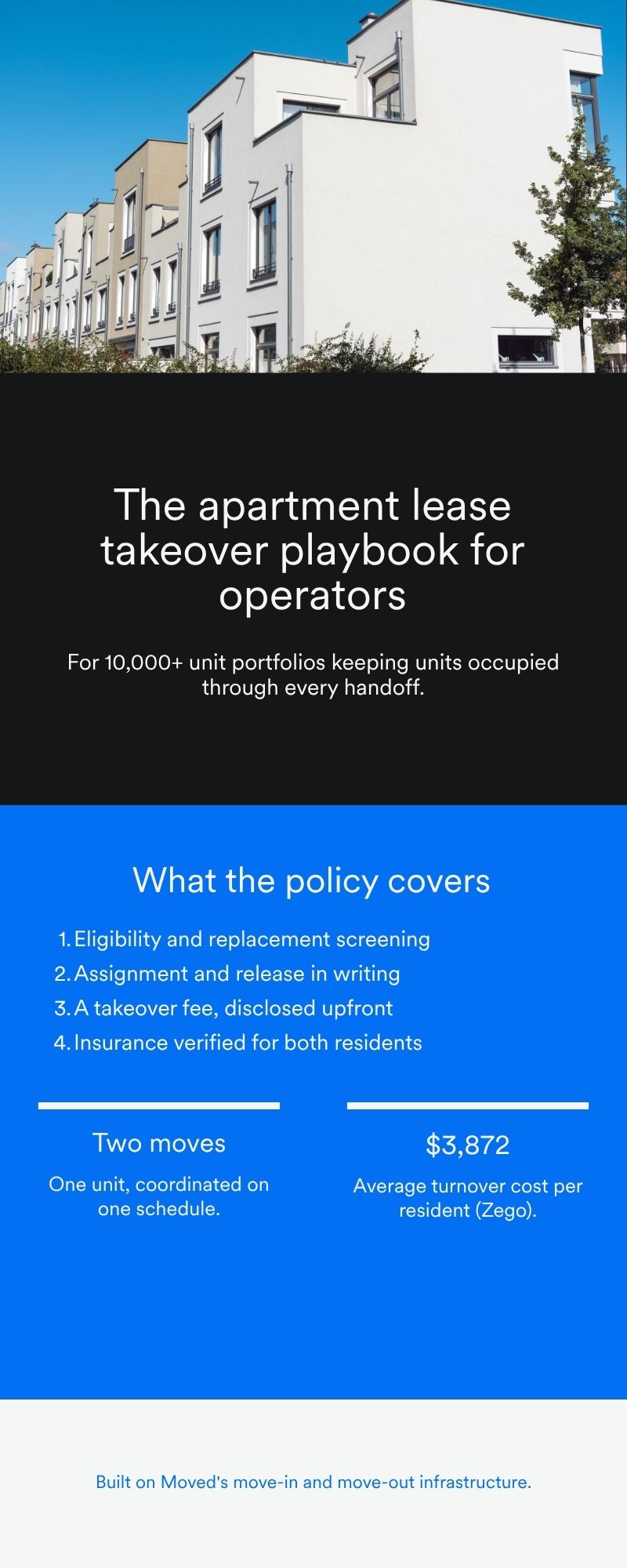
An apartment lease takeover is an arrangement in which a new, approved resident assumes the remaining term of a current resident’s lease, and the original resident moves out. For the operator, it replaces a vacancy with a screened resident, so the unit stays occupied. A clear policy sets who qualifies, how the new resident is approved, what it costs, and how both moves are coordinated.
For a 10,000+ unit portfolio, lease takeover requests grow alongside relocations and household changes. This guide explains how a takeover differs from a sublease or an early termination, why operators benefit from a written policy, and how to run each takeover as a coordinated move-out and move-in in residential real estate.
Lease Takeover, Sublease, And Early Termination Compared
Residents often use these terms interchangeably. They carry different obligations for the operator.
| Arrangement | Who holds the lease | Original resident’s liability | Operator role |
|---|---|---|---|
| Lease takeover (assignment) | The new resident assumes the lease | Usually released once the operator approves the assignment in writing | Screens and approves the new resident |
| Sublease | The original resident keeps the lease and rents to a subtenant | Remains liable for the lease | Consents to the subtenant |
| Early termination | The lease ends early | Pays the termination fee or rent under the lease | Re-lets the unit to a new applicant |
| Transfer | The resident signs a new lease for another unit | Moves to the new lease | Matches the resident to available inventory |
State law sets the boundaries. In Texas, a tenant may not rent the leasehold to another person during the lease term without the landlord’s prior consent, under Texas Property Code section 91.005.
New York goes further. Under Real Property Law section 226-b, a tenant may not assign a lease without the owner’s written consent, but if the owner unreasonably withholds consent, the owner must release the tenant from the lease on request with 30 days’ notice. In buildings with four or more units, tenants also have a right to sublease with the landlord’s consent, which may not be unreasonably withheld, and the original tenant remains liable during a sublease.
Why Operators Benefit From A Lease Takeover Policy
A takeover keeps the unit occupied. Every early exit that ends in a vacancy becomes a turn, and turnover has cost about $3,872 per resident, according to an earlier edition of Zego’s Resident Experience Management Report reported by Multifamily Dive.
A vacant unit may also need an incentive to lease. RealPage found concessions on 15.4 percent of stabilized U.S. apartments in August 2026, averaging about 5.7 weeks free on a 12-month lease, according to its August 2026 concessions update. A takeover candidate assumes the existing lease at its current rent.
Without a policy, residents look for replacements on their own, often through informal listings, and site teams decide case by case. A written policy keeps screening consistent and puts the operator in control of who moves in.
The Revenue Case: One Takeover, Two Moves
A lease takeover creates two moves on the same unit within days. The outgoing resident needs movers, packing, and often storage. The incoming resident needs movers, utilities and internet set up before key handoff, and renters insurance in place.
Both moves belong in the move-in and move-out revenue workflow. When the operator coordinates both moves, the services each resident books stay inside the property’s own resident flow, and the handoff between residents happens on one schedule.
Keeping Residents In The Portfolio: Paylode, A Moved Company
Some takeover requests come from residents who would stay if they had another option. Zego’s 2026 Resident Experience Management Report found that 31 percent of renters would be much more likely to renew if their community offered a renter rewards program, and that average retention fell to 57 percent.
Paylode is a Moved company. Moved acquired Paylode in November 2025, adding a perks and rewards platform that helps brands increase loyalty and retention through personalized perks and action-based rewards. Paylode’s clients have included Equity Residential and FirstKey Homes.
Before approving a takeover, check whether the resident’s need can be met with a move to another unit under an apartment transfer policy. For new residents who arrive through a takeover, perks from day one give them a reason to renew when the assumed lease ends.
What A Lease Takeover Policy Should Include
| Policy element | What to decide | Why it matters |
|---|---|---|
| Eligibility | Good standing, no open balance, and the minimum remaining lease term | Keeps the policy fair and predictable |
| Replacement screening | The same written criteria used for every new applicant | Keeps approvals consistent and defensible |
| Lease documentation | A written assignment and release, or a new lease for the remaining term | Defines who is liable and from what date |
| Takeover fee | Amount, what it covers, and when it is due | Must be disclosed before the resident commits |
| Security deposits | The outgoing deposit settled after inspection, and a new deposit from the incoming resident | Keeps each resident’s deposit tied to their own tenancy |
| Inspection between residents | A move-out inspection with photos before the new resident moves in | Separates damage between the two tenancies |
| Insurance | Outgoing coverage active to key return, and incoming coverage verified before key handoff | Closes the coverage gap between residents |
| Move timing | A handoff date, cleaning window, and key return time | Limits days the unit sits empty |
The inspection between residents follows the same standard as any move-out. Moved’s move-in and move-out inspection checklist covers the room-by-room process and photo standard.
Setting And Disclosing A Takeover Fee
A takeover fee should reflect the real work: screening, lease documentation, the inspection, and the turn between residents. State the fee in the lease or the takeover policy, and confirm it in writing before the resident commits.
Fee transparency is under federal review. The Federal Trade Commission’s advance notice of proposed rulemaking on rental housing fees asks about one-time fees charged at the beginning or end of a lease term. Moved’s guide to the FTC rental fee rulemaking explains how to disclose charges cleanly.
How To Run A Lease Takeover, Step By Step
- Receive the request in writing and confirm the resident meets the eligibility rules.
- Check whether a transfer within the portfolio would meet the resident’s need.
- Collect the replacement’s application and screen it against the standard criteria.
- Issue the assignment and release, or a new lease for the remaining term, with every fee listed.
- Set the handoff date, and offer movers, packing, and storage to the outgoing resident.
- Inspect the unit with photos after the outgoing resident leaves and settle their deposit under state law.
- Collect the incoming deposit, verify renters insurance, and schedule utilities and internet for the new resident.
- Complete the move-in inspection and hand over keys.
Insurance And Financial Risk During The Handoff
A takeover has two coverage gaps. The outgoing resident may cancel renters insurance early, and the incoming resident may arrive without a policy. An uninsured resident-caused loss in either window falls on the property’s own policy or balance sheet.
Make both checks part of the handoff: outgoing coverage confirmed through key return, and incoming coverage verified before keys are released. Moved’s guide to capturing renters insurance requirements at move-in explains how to verify coverage and get notice of cancellations.
Running Lease Takeovers Across A 10,000+ Unit Portfolio
- One takeover policy, with state-specific rules for assignment, subletting, and deposits.
- One application and screening standard for replacement residents.
- Transfers offered before a takeover is approved.
- Both moves scheduled on one timeline, with services offered to each resident.
- Insurance verified for both residents at the handoff.
- Takeover volume, approval rate, and days vacant between residents reported by property.
Traditional tools focus on task tracking and administrative coordination. Moved embeds revenue-generating services and insurance verification directly into the workflow, transforming move coordination into structured revenue infrastructure.
Moved is a move infrastructure platform that embeds revenue-generating services, including movers, packing, storage, insurance, utilities, and connectivity, directly into the resident onboarding workflow. It helps property operators increase ancillary income while mitigating compliance risk, and the guide to resident onboarding automation shows how that workflow is built.
For both residents, one coordinated handoff is part of the resident experience. For operators, Moved for multifamily operators shows how the same process runs across a portfolio.
Frequently Asked Questions
What is a lease takeover?
A lease takeover is an arrangement in which a new, approved resident assumes the remaining term of a current resident’s lease, and the original resident moves out.
How does a lease takeover work?
The current resident requests a takeover, the replacement applies and is screened, and the operator signs an assignment and release or a new lease. The outgoing resident moves out, the unit is inspected, and the new resident moves in.
What is the difference between a lease takeover and a sublease?
In a lease takeover, the new resident assumes the lease and the original resident is usually released. In a sublease, the original resident keeps the lease and remains liable for it.
Can a landlord refuse a lease takeover?
Usually, yes, since most leases and state laws require the landlord’s consent. Some states limit refusals; in New York, if an owner unreasonably withholds consent to an assignment, the tenant can ask to be released from the lease.
Is there a fee for a lease takeover?
Many operators charge a fee to cover screening, documentation, and the turn between residents. The fee should be stated in the lease or policy and disclosed before the resident commits.
Keep The Unit Occupied Through Every Handoff
A lease takeover replaces a vacancy with a screened resident, provided both moves are coordinated. To see how takeovers, insurance verification, and move services run as one move-in and move-out workflow across a 10,000+ unit portfolio, book a walkthrough with the Moved team.