A notice to enter is a written notice from the property telling a resident that staff or vendors will enter the apartment, when, and why. Several states use 24 hours as the baseline, but the required notice, the allowed hours, and the permitted reasons differ by state. For multifamily operators, entry notices matter most at move-out, when showings, pre-move-out inspections, and make-ready scoping all need access to an occupied unit.
Across a 10,000+ unit portfolio, thousands of entries a year depend on a notice that is correct, timely, and documented. This guide covers the entry rules in four states, what every notice should include, a template, and how to schedule entries inside a structured move-in and move-out process in residential real estate.
Why Entry Notices Matter Most During Move-Out
The weeks between a notice to vacate and the move-out date are when a property most needs access. Leasing wants to show the unit, maintenance wants to scope the turn, and in California the resident can request a pre-move-out inspection.
That window is getting busier. Zego’s 2026 Resident Experience Management Report found that average retention fell to 57 percent, down from 60 percent in 2024, which means more move-outs and more entries into occupied units.
Every day a unit sits empty adds cost. Turnover has cost about $3,872 per resident, according to an earlier Zego report covered by Multifamily Dive, including lost rent, so a compliant showing before move-out can shorten the vacancy that follows.
Entry Notice Rules In Four States
The table below summarizes the notice rules in California, Washington, Oregon, and Florida. Local ordinances and lease terms can add requirements, so confirm the rule for each property.
| State | Notice required | Timing and limits |
|---|---|---|
| California | Reasonable written notice, with 24 hours presumed reasonable, or 6 days if mailed (Civil Code section 1954) | Entry during normal business hours, and the notice must state the date, approximate time, and purpose |
| Washington | At least 2 days’ written notice, or 1 day to show the unit to prospective tenants or buyers (RCW 59.18.150) | Entry at reasonable times, and the notice must give the date and time or time window and a phone number for objections |
| Oregon | At least 24 hours’ actual notice (ORS 90.322) | Entry at reasonable times, and the resident may deny consent after notice, though not unreasonably |
| Florida | At least 24 hours’ notice for repairs (Fla. Stat. 83.53) | Repair entries between 7:30 a.m. and 8:00 p.m., and the resident may not unreasonably withhold consent for other purposes |
California
Under California Civil Code section 1954, a landlord may enter for listed reasons, including repairs, agreed services, showing the unit to prospective tenants or buyers, and the pre-move-out inspection described in section 1950.5. The written notice can be delivered personally, left with a suitable person, or left at the entry door, and it must include the date, approximate time, and purpose.
For a sale, notice may be given orally if the resident was told in writing within the prior 120 days that the property is for sale, and the person entering must leave written evidence of the entry. No notice is required in an emergency, when the resident consents at the time of entry, or after the resident has surrendered or abandoned the unit.
For the pre-move-out inspection, Civil Code section 1950.5 requires at least 48 hours’ written notice of the date and time, unless both parties waive it in writing.
Washington
RCW 59.18.150 requires at least two days’ written notice except in an emergency or when notice is impracticable. If the notice gives a window, it must state the earliest and latest possible times of entry.
The resident may not unreasonably withhold consent to a showing with at least one day’s notice, but the landlord may not excessively exhibit the unit. A party who keeps violating the section after written notice of a violation can be liable for up to $100 for each later violation, and the prevailing party may recover costs and attorneys’ fees.
Oregon
ORS 90.322 requires at least 24 hours’ actual notice for most entries, and entry only at reasonable times. After an emergency entry in the resident’s absence, the landlord must give actual notice within 24 hours describing the entry.
A written repair request from the resident allows entry for those repairs without further notice, generally for seven days. An unlawful or unreasonable entry can entitle the resident to actual damages of at least one month’s rent.
Florida
Florida Statutes section 83.53 defines reasonable notice for repairs as at least 24 hours, with entry between 7:30 a.m. and 8:00 p.m. For showings and inspections, the landlord may enter with the resident’s consent, in an emergency, when the resident unreasonably withholds consent, or during an extended absence described in the statute.
What To Include In A Notice To Enter
- The resident’s name and unit address.
- The date of the notice and how it was delivered.
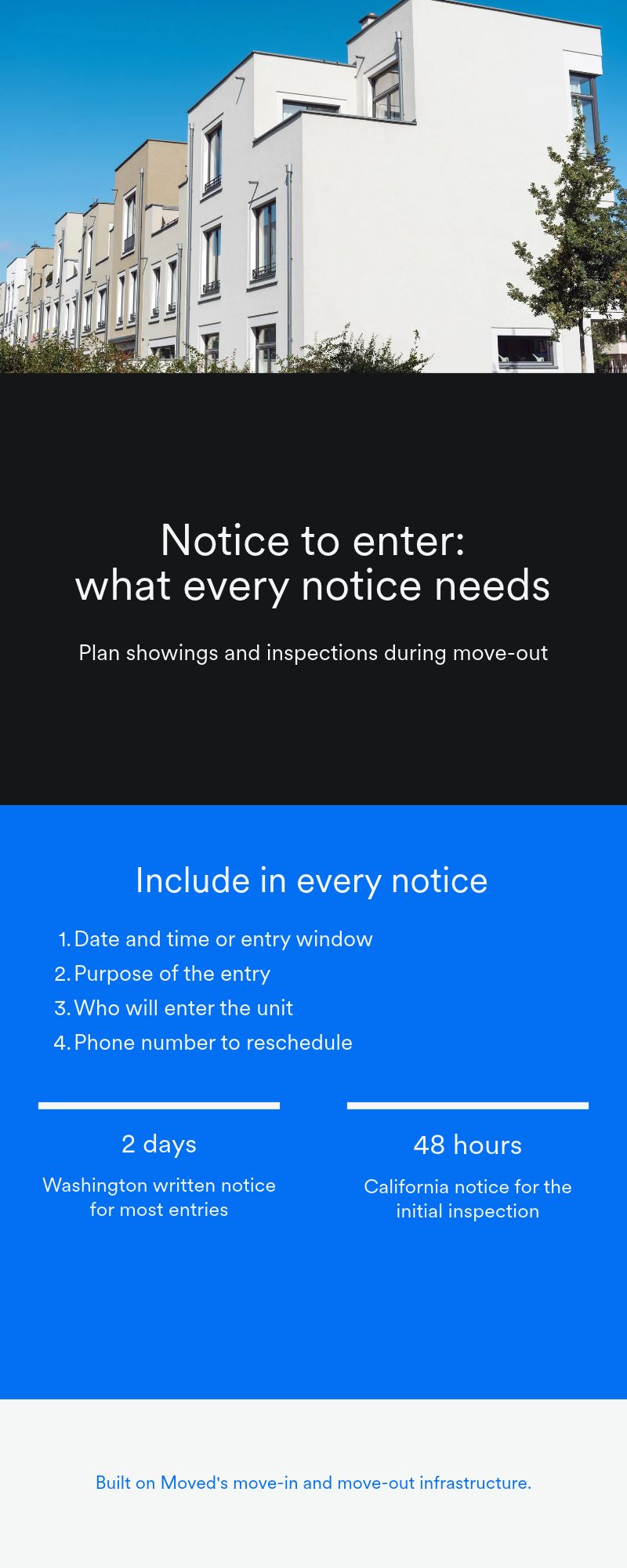
- The date and time of entry, or a window with the earliest and latest times.
- The purpose, such as a showing, a pre-move-out inspection, or a repair.
- Who will enter, such as leasing staff, maintenance, or a named vendor.
- A phone number to ask questions or request a new time.
Use the longest notice period among the states in your portfolio as the default. A two-day written notice delivered by hand or posted at the door meets the 24-hour rules above and Washington’s general rule, which reduces errors across properties.
Notice To Enter Template
Adapt this template to each state and city, and have counsel approve the final version before it is used.
[Date of notice] | Delivered by [method]
Dear [Resident name],
This notice is to let you know that [staff or vendor] will enter [unit address] on [date] between [earliest time] and [latest time] for the following purpose: [showing, pre-move-out inspection, repair].
You do not need to be present. If you have questions or would like to request a different time, please call [phone number].
Thank you, [Name, title, community name]
Scheduling Entries During The Notice To Vacate Window
- When notice to vacate is received, confirm the move-out date and the resident’s preferred contact method.
- Offer the pre-move-out inspection, where the state provides one, and schedule it with the required notice.
- Group showings into set windows so the resident receives fewer notices.
- Combine make-ready scoping with the inspection where possible.
- Log every notice, entry, and resident request in the unit record.
Moved’s guide to the 60-day notice to vacate window explains how to use those weeks, and the apartment make-ready checklist shows what maintenance should look for during a scoping visit.
Common Entry Notice Mistakes
- Using a 24-hour notice in a state that requires two days.
- Giving a window without the earliest and latest entry times in a state that requires them.
- Entering outside the permitted hours.
- Scheduling so many showings that the resident’s use of the unit is disrupted.
- Leaving no record of when and how the notice was delivered.
The Revenue Case: The Entry Schedule Is A Move-Out Schedule
An entry notice during the move-out window tells the property, and the resident, that the move is real and near. That is the right moment to offer movers, packing, and storage.
The move-in and move-out revenue workflow sends move services with the inspection confirmation, so the resident plans the move and the inspection together. A resident with a booked mover is more likely to leave on schedule, which keeps showings and the next move-in on track.
Moved’s analysis of resident-side turn delay shows how unplanned move-outs push back the make-ready, which is the delay a coordinated entry schedule is meant to prevent.
Respect Builds Renewals: Paylode, a Moved Company
How a property handles entry affects how residents feel about renewing. Notices that are clear, early, and limited show respect for the resident’s home.
Paylode is a Moved company. Moved acquired Paylode in November 2025, adding a perks and rewards platform that helps brands increase loyalty and retention through personalized perks and action-based rewards. Zego’s 2026 report found that 31 percent of renters would be much more likely to renew if their community offered a renter rewards program.
Rewards and respectful access work together. Both give residents who are undecided a reason to stay.
Disclosure And Insurance
Any charge connected to entry, such as a lockout or missed-appointment fee, should be disclosed in the lease and in advertising. The Federal Trade Commission’s advance notice of proposed rulemaking on rental housing fees asks how such fees are presented, and Moved’s guide to the FTC rental fee rulemaking covers how to present every charge in one place.
Vendors who enter units should carry their own insurance, and residents should keep theirs in force through move-out. Moved’s guide to capturing renters insurance requirements at move-in explains how to verify resident coverage.
Running Entry Notices Across A 10,000+ Unit Portfolio
- One notice template per state, with the required notice period, hours, and content built in.
- A portfolio default that meets the longest notice period among your states.
- Showings grouped into set windows during each notice to vacate period.
- Pre-move-out inspections offered and scheduled automatically where the state provides them.
- Every notice, entry, and reschedule request logged in the unit record.
- Entry complaints and missed appointments reported by property.
Traditional tools focus on task tracking and administrative coordination. Moved embeds revenue-generating services and insurance verification directly into the workflow, transforming move coordination into structured revenue infrastructure.
Moved is a move infrastructure platform that embeds revenue-generating services, including movers, packing, storage, insurance, utilities, and connectivity, directly into the resident onboarding workflow. It helps property operators increase ancillary income while mitigating compliance risk, and the guide to resident onboarding automation shows how that workflow is built.
For residents, respectful access is part of the resident experience. For operators, Moved for multifamily operators shows how the same process runs across a portfolio.
Frequently Asked Questions
How much notice does a landlord need to give before entering?
It depends on the state. California presumes 24 hours’ written notice is reasonable, Oregon requires 24 hours’ actual notice, and Washington requires at least two days’ written notice for most entries.
Can a landlord enter without notice?
In an emergency, all four states covered here allow entry without advance notice. California also allows entry without notice when the resident consents at the time or has surrendered the unit.
Can a landlord show an apartment while the resident still lives there?
Yes, with proper notice. Washington requires at least one day’s notice for showings, and California allows entry to show the unit to prospective tenants or buyers with reasonable written notice.
What should a 24-hour notice to enter include?
It should include the date and time or time window of entry, the purpose, and who will enter. Washington also requires a phone number the resident can call to object or reschedule.
What hours can a landlord enter?
California limits most entries to normal business hours, Florida limits repair entries to 7:30 a.m. through 8:00 p.m., and Washington and Oregon require reasonable times.
Make Every Entry Count Toward The Next Move-In
A compliant entry notice protects the resident’s home and the property’s schedule. To see how entry scheduling, move services, and onboarding run as one move-in and move-out workflow across a 10,000+ unit portfolio, book a walkthrough with the Moved team.