For two decades, the default multifamily playbook for NOI growth was simple: raise rents, hold expenses flat, refinance into the appreciation, repeat. The playbook still works in pockets, but it does not work everywhere, and it definitely does not work the way it did in 2021 and 2022.
In 2026, NOI growth has to come from sources other than rent escalations. Insurance is up. Payroll is up. Property tax assessments are catching up to boom-era values. Rent growth, in most markets, is not.
Below are the five operational drivers 10,000+ unit operators are actually pulling in 2026 to grow NOI without raising rent. These are operational changes that produce within a quarter and continue to produce through the full hold period, which is more than a 6% rent year can claim once concessions and turnover are netted out.
Why did pushing rents harder stop working
Yardi Matrix’s December 2025 report showed national multifamily rent growth at 0% year-over-year in Q4 2025, the weakest performance since the global financial crisis. Several Sun Belt metros posted negative same-store growth, with Austin at -5.2%, Phoenix at -4.1%, and Las Vegas at -2.5%, per the Multi-Housing News National Multifamily Report for November 2025. Concessions returned to four to six weeks of free rent in many primary, supply-heavy markets, according to ApartmentIQ’s Q1 2025 analysis, and Yield Pro reported some operators offering six to eight weeks of free rent in the most pressured submarkets.
At the same time:
• Property insurance premiums increased 14% from 2021 to 2022, 22% from 2022 to 2023, and 45% from 2023 to 2024, per NAA’s Premium Pulse research, with average annual cost per unit rising from $502 in 2021 to $777 in 2024.
• Property tax assessments are catching up to peak appraisal values, with examples such as Indianapolis multifamily assessments adding $2 billion in new assessed value for the 2025 tax year, and Tennessee reappraisal cycles exerting similar pressure.
• Payroll for on-site teams grew by roughly 6.1% year-over-year through 2024, per RealPage’s 2Q25 opex moderation analysis, and remains elevated above the pre-pandemic decade average.
• Utility costs, particularly water and sewer, rose 5.1% year-over-year, per the RealPage 2Q25 dataset, and overall multifamily operating expenses remain nearly 40% above pre-pandemic levels.
That combination is textbook NOI compression. Top-line growth has slowed. Bottom-line costs have not. The historical reflex of “push rents harder” runs into resident affordability ceilings, regulatory caps in select markets, and concession blowback when the push becomes too aggressive.
The operators still growing NOI are the ones quietly building the operational and revenue infrastructure to grow income while cutting waste.
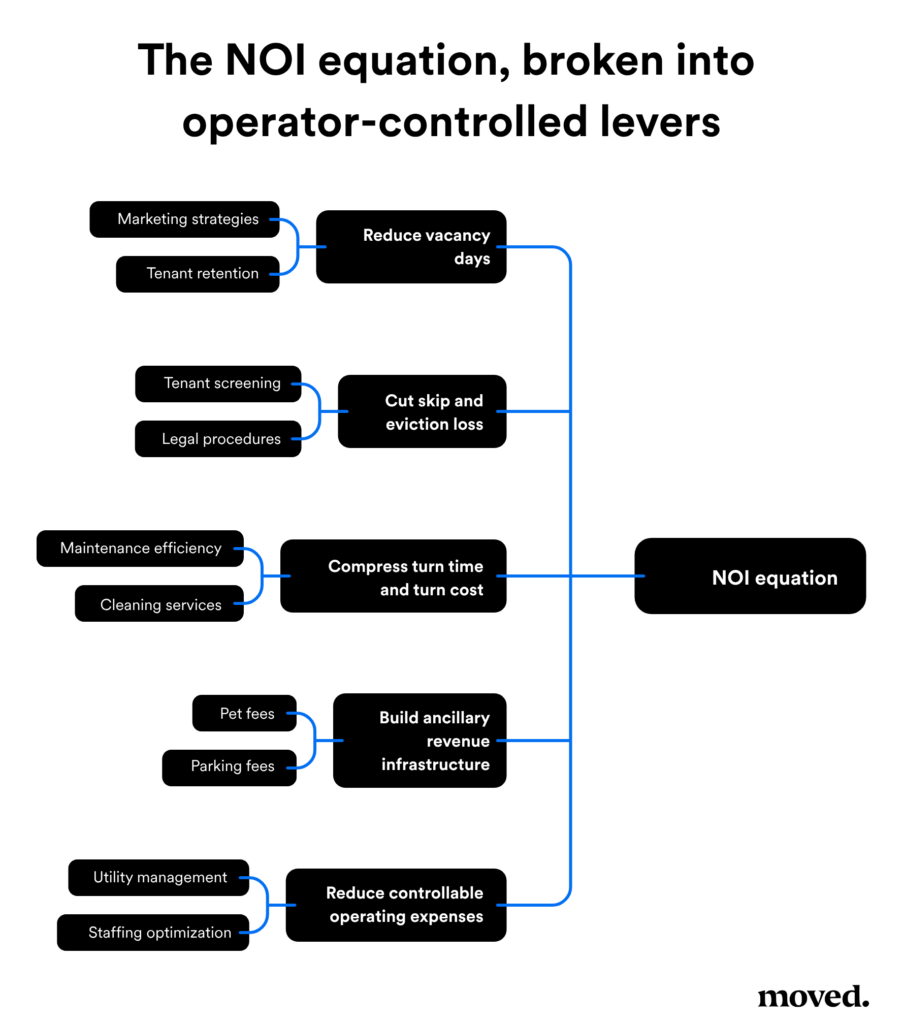
The NOI equation, broken into operator-controlled inputs
NOI is gross potential income, minus vacancy and concessions, plus other income, minus operating expenses. That is the formula. The interesting question is which terms an operator actually controls.
Five operational drivers are worth focusing on:
1. Reduce vacancy days
2. Cut skip-and-eviction loss
3. Compress the turn time and the turn cost
4. Build an ancillary revenue infrastructure
5. Reduce controllable operating expenses
Each moves NOI without touching rent. The compounding effect, when several move at once, is what separates portfolios that hit pro forma from portfolios that miss.
1. Reduce vacancy days
Every day a unit sits vacant is a day of lost rent that never comes back. For a $ 2,000-per-month unit, that is roughly $66 per day. Cut average vacancy from 18 days to 10 days across a 10,000-unit portfolio with 50% annual turnover, per NMHC quick facts data, and that is about $2.6M in recovered revenue, captured on the vacancy line rather than the rent line.
The biggest drivers of vacancy days are slow turn time, friction in the move-in and move-out process (residents leaving early or arriving late), lease-up gaps from a poor renewal cadence, and tour-to-lease conversion that loses prospects to faster competitors.
Move-in and move-out automation attacks the second of those directly. When the move-in and move-out process runs through a single, modern platform that handles task orchestration, communications, and service activation, residents tend to vacate on time and arrive on time, which collapses the gap days that quietly kill NOI.
2. Cut skip-and-eviction loss
Skip-and-eviction loss is one of the most under-reported NOI drains in multifamily. It includes unpaid rent at vacate, the cost of the eviction itself, legal fees, the cost of unit restoration beyond normal wear and tear, and additional vacancy days while the case is resolved.
A reasonable industry estimate, based on research published in the Taylor & Francis multifamily eviction studies and operator reporting through NAA industry coverage, is that 1 to 3% of gross rent in market-rate garden communities is lost to skip-and-eviction each year. On a $240M GPI book (10,000 units at an average rent of $2,000), that is $2.4M to $7.2M per year.
Most of that loss is set in motion at move-in. Residents who skip or get evicted are disproportionately the ones whose application screening was thin, whose insurance was never verified, or whose first 30 days were rocky enough that they checked out emotionally before they checked out physically. Tightening the front door (application screening, insurance verification, and a clean first 30 days) measurably lowers this number.
3. Compress turn time and turn cost
The average turn cost for market-rate multifamily ranges from $1,500 to $3,500 per unit for most operators, with nearly one in five reporting turn costs above $3,500, according to the NAA survey of property management firms cited in Multi-Housing News. Multifamily Dive reports the broader industry average sits near $3,872 per resident, with extensive make-readies running $8,000 to $15,000 or more. Average turn duration runs roughly 14 days, per the same source.
Both numbers change when the move-in and move-out workflow runs as a structured process rather than as a back-and-forth among the leasing office, maintenance, and the resident. Specifically:
- A pre-vacate inspection, scheduled and completed digitally, surfaces resident-caused damage early, keeping it on the resident’s deposit ledger rather than on the property’s CapEx line.
- A clean checklist with verified completion reduces the “what is the unit going to look like when we get in there” lottery.
- Coordinated key returns and access to cut the dead days between vacating and turning the unit.
Compressing turn time by three days across a 10,000-unit portfolio, turning 50% of units per year, recovers roughly $1M in NOI, depending on rent.
4. Build ancillary revenue infrastructure
Ancillary income at well-run properties accounts for 6 to 12% of gross potential income, per NMHC’s industry benchmarks dataset, and the highest-margin category sits within the move-in and move-out lifecycle: movers, packing, storage, utilities, insurance, and connectivity. We covered this in detail in our breakdown of ancillary revenue in multifamily.
For an NOI-focused conversation, the relevant point is that ancillary revenue flows nearly 100% to the bottom line. Unlike rent, where operating expenses scale with income, partnership-based ancillary revenue carries minimal incremental cost. A dollar of ancillary income is closer to a dollar of NOI than a dollar of rent is.
That makes ancillary infrastructure one of the highest-margin investments an operator can make at the portfolio level.
5. Reduce controllable operating expenses
Insurance and property taxes are not really controllable. Payroll, contract services, utility recovery, and turn cost are.
The biggest wins come from centralizing vendor contracts across the portfolio rather than negotiating per property, tightening utility recovery through RUBS or sub-metering programs run by providers like Conservice so the property is not subsidizing resident water and trash, centralizing leasing and call-center functions where geography allows, and reducing turn vendor labor through standardized scopes and digital quality control.
These are the slowest-moving drivers, but they compound the longest. A 50 basis point reduction in the operating expense ratio, held over five years, often outweighs any single revenue driver in IRR terms.
The compounding effect of optimizing the move-in and move-out lifecycle
Here is the case to make to any operator looking for the single highest-impact investment in NOI: the move-in and move-out lifecycle is the meeting point for four of the five drivers above.
It cuts vacancy days. It reduces skip-and-eviction loss because insurance is verified, and the first 30 days are smoother, so residents actually move on time. It compresses turn time. It is the highest-margin place to capture ancillary revenue.
That is why the same answer keeps surfacing. Most operators treat move-in and move-out as an operational chore, a checklist to administer, a key to hand over. The operators outperforming on NOI in 2026 treat it as revenue infrastructure with risk-mitigation properties baked in.
For a deeper walkthrough of how that infrastructure works, see our piece on how property managers automate the resident move-in and move-out process, or browse the Moved residents experience to see what it looks like from the resident’s side.
A worked example at 10,000, 20,000, and 25,000 units
Conservative assumptions:
• 50% annual turnover, per NMHC Apartment Industry Quick Facts
• $2,000 average rent
• $80 per move event in capturable partnership revenue across services (toward the lower end of typical)
• 4 days of vacancy reduction from move-in and move-out optimization
• 0.5% reduction in skip-and-eviction loss
10,000-unit portfolio:
• 5,000 lease cycles per year × $80 = $400,000 partnership revenue
• 5,000 cycles × 4 days × $66 = $1,320,000 recovered vacancy
• 0.5% × $240M GPI = $1,200,000 skip-and-eviction reduction
• Total annual NOI lift: roughly $2.92M
20,000-unit portfolio:
• 10,000 lease cycles × $80 = $800,000
• 10,000 cycles × 4 days × $66 = $2,640,000
• 0.5% × $480M GPI = $2,400,000
• Total annual NOI lift: roughly $5.84M
25,000-unit portfolio:
• 12,500 lease cycles × $80 = $1,000,000
• 12,500 cycles × 4 days × $66 = $3,300,000
• 0.5% × $600M GPI = $3,000,000
• Total annual NOI lift: roughly $7.3M
Capped at a market multifamily cap rate of 5.5%, the asset value created from this single category of operational work ranges from roughly $53M at the 10,000-unit level to $133M+ at the 25,000-unit level, without a rent increase, a renovation, or a single new headcount.
These are illustrative numbers and depend on asset class, geography, and existing baseline performance. The order of magnitude is real, and it scales with portfolio size.
What this looks like at the asset management layer
The operators who actually capture this NOI at the portfolio level treat it as an asset management initiative rather than a property management one. The distinction matters.
A property manager looking at NOI sees a daily operating problem. An asset manager looking at the same NOI sees a portfolio infrastructure question: do I have the systems in place to ensure every property in the book captures the same upside, or am I dependent on which on-site team happens to care?
Infrastructure for moving residents, ancillary revenue programs, and standardized move-in and move-out workflows is an asset to asset management. They live above any single property and stay consistent throughout the book. The centralization wave already underway in multifamily (80% of third-party managers are centralizing operations, per Funnel Leasing’s 2025 research) extends naturally to the move-in and move-out lifecycle.
For a portfolio-level conversation about how this fits into your asset management plan, reach out to our team or see the Moved multifamily overview.
FAQs
What is the fastest way to increase multifamily NOI without raising rent?
The fastest meaningful gains come from reducing vacancy days and capturing ancillary revenue associated with moves. Both move within a single quarter once the right move-in and move-out infrastructure is in place. Expense-side work takes longer to compound.
How much NOI can a 10,000-unit portfolio realistically gain by optimizing move-in and move-out workflows?
Under conservative assumptions ($80 partnership revenue per move event, 4 days of recovered vacancy, 0.5% reduction in skip-and-eviction loss), a 10,000-unit portfolio can typically expect $2.5M to $3.5M of annual NOI lift. The number is higher in higher-rent markets and at higher turnover rates.
Is ancillary revenue the same as NOI?
No, but it is one of the highest-flow-through inputs to NOI. Partnership-based ancillary revenue carries minimal incremental cost, so most of every dollar of ancillary income lands in NOI. Compare that to rent, where higher rent often comes with higher concessions, higher turn costs, and higher delinquency.
Does cutting expenses actually compete with growing revenue in terms of its impact on NOI?
Over short horizons, revenue growth wins. Over multi-year holds, expense discipline often wins because the savings compound. Operators outperforming through full cycles do both.
What is the biggest mistake operators make when trying to grow NOI without rent increases?
Treating it as a series of one-off projects rather than building durable infrastructure. A pilot program at one property does not change the portfolio number: standardized move-in and move-out workflows run across the portfolio.
The bottom line
NOI growth in multifamily without rent increases is an operational and infrastructural question. The single highest-impact place to invest sits in the move-in and move-out lifecycle, where vacancy, ancillary revenue, skip-and-eviction loss, and resident experience all converge.
For a deeper look at the revenue side, see our breakdown of how move-in and move-out workflows became a property management revenue engine.
If you want to model this out for your specific portfolio, book a conversation with our team, and we will work through the numbers with you.