A holdover tenant is a resident who stays in a unit after the lease or the agreed move-out date has ended, without a new agreement. For an operator, a holdover blocks the next resident’s move-in, delays the turn, and raises legal questions about rent. Most holdovers start with a move that fell through, which makes prevention a move coordination problem as much as a legal one.
Across a 10,000+ unit portfolio, even a few holdovers each month can disrupt pre-leased units and new residents’ moves. This guide covers what the law says about holdovers, why they happen, how to prevent them, and how to respond when one occurs in residential real estate.
What The Law Says About Holdover Tenants
State law decides what happens when a resident stays past the end of a lease, and accepting rent often changes the outcome.
| State | Rule | Source |
|---|---|---|
| California | If the resident stays and the landlord accepts rent, the parties are presumed to have renewed on the same terms for up to one month when rent is paid monthly | Civil Code section 1945 |
| New York | Holding over does not by itself create a new term; if the landlord accepts rent after the term ends, a month-to-month tenancy begins the next day unless agreed otherwise | Real Property Law section 232-c |
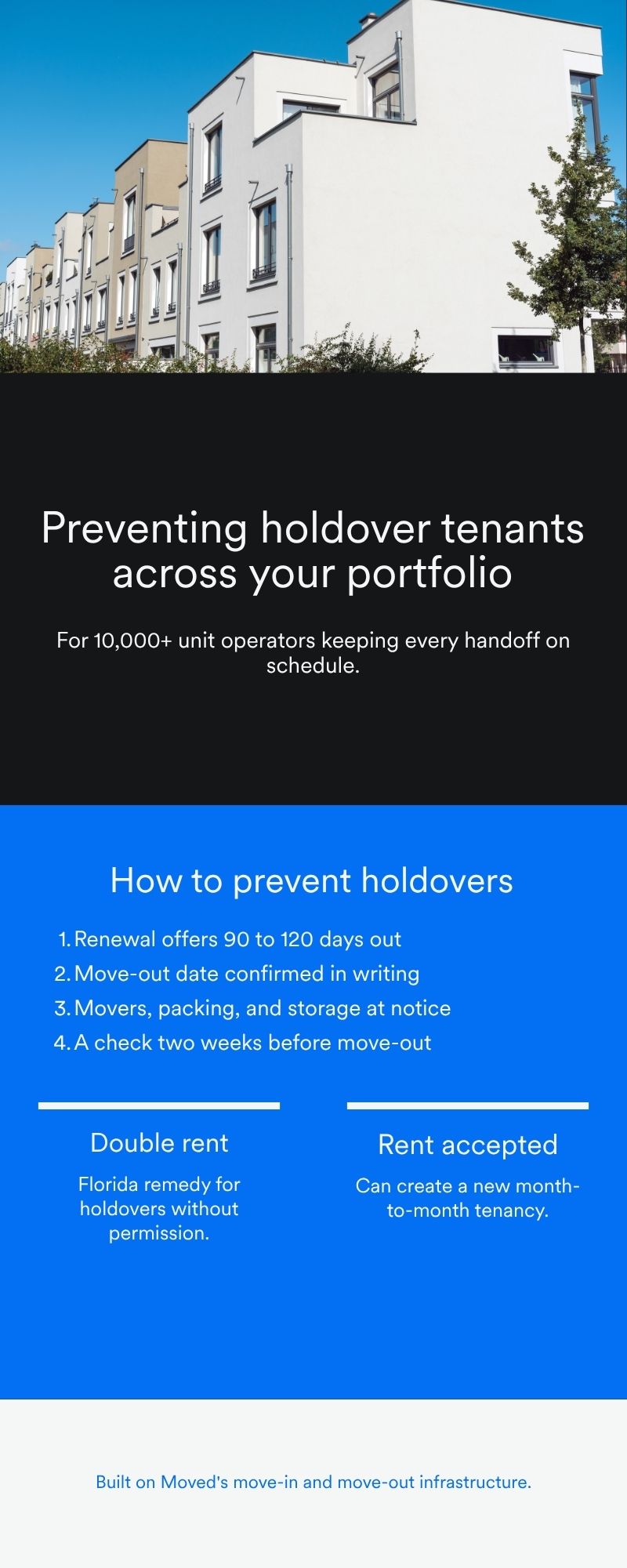
| Florida | If a resident holds over without the landlord’s permission, the landlord may recover possession and double the rent due for the period the resident refuses to leave | Florida Statutes section 83.58 |
The practical point for site teams is that processing a rent payment after a lease ends can create a new tenancy. Every property needs a clear instruction on when to accept, hold, or return a payment from a resident who has stayed past the end date.
Why Holdovers Happen
Most residents who hold over did not plan to. The common causes are practical:
- The movers fell through or were booked too late.
- The new home is not ready on the planned date.
- The resident has nowhere to keep belongings between homes.
- The resident did not know the exact move-out date or time.
- A renewal conversation stalled, and the lease expired without a decision.
Each of these has an operational fix. A confirmed move-out date, booked movers, and a storage option for the gap between homes remove most of the reasons a resident stays.
The Cost Of A Holdover
A holdover delays the turn and the next resident’s move-in. Turnover has cost about $3,872 per resident, according to an earlier edition of Zego’s Resident Experience Management Report reported by Multifamily Dive, a figure that includes repairs and lost rent, and every day of holdover pushes those costs later.
The incoming resident may need a delayed move-in, temporary housing, or a credit to stay committed. RealPage found concessions on 15.4 percent of stabilized U.S. apartments in August 2026, according to its August 2026 concessions update, which shows how competitive it can be to secure a replacement resident.
A holdover also affects the site team. Staff time goes to calls, rescheduling, and legal steps, and the turn crew cannot start work until the unit is empty.
The Revenue Case: Prevention Runs Through The Move
The best defense against a holdover is a move that is booked and confirmed. When a resident gives notice, presenting movers, packing, and storage the same day lets them book before the busy end-of-month dates fill up.
That puts holdover prevention inside the move-in and move-out revenue workflow. Moved’s newsletter The RevGen Leak Map describes move-out as a moment where easy transition offers and moving services preserve goodwill. Storage is especially useful, since it gives a resident whose new home is not ready a place for their belongings, so they can leave on time.
Moved’s guide to a moving concierge service explains how operators coordinate these services for residents.
Retention Before A Holdover: Paylode, A Moved Company
Some holdovers come from residents who wanted to stay but never received or answered a renewal offer. Zego’s 2026 Resident Experience Management Report found that 31 percent of renters would be much more likely to renew if their community offered a renter rewards program.
Paylode is a Moved company. Moved acquired Paylode in November 2025, adding a perks and rewards platform that helps brands increase loyalty and retention through personalized perks and action-based rewards.
Sending renewal offers early and on a fixed schedule turns an uncertain lease end into a decision. Moved’s lease renewal letter template sets out the timing and the terms that apply without a response.
How To Prevent Holdovers, Step By Step
- Send renewal offers 90 to 120 days before lease end, with the terms that apply if the resident does not respond.
- When notice to vacate arrives, confirm the move-out date and time in writing.
- Offer movers, packing, and storage in the same message.
- Check in two weeks before move-out to confirm the movers are booked and the new address is ready.
- Schedule the pre-move-out inspection and the key return time.
- Flag any resident without a confirmed move for a call from the site team.
How To Respond When a Resident Holds Over
- Contact the resident on the first day to understand the reason and the expected move date.
- Decide, with counsel, whether to accept rent, offer a short written extension, or begin the legal process.
- Put any agreement in writing, including the new date and the rent for the extra days.
- Tell the incoming resident immediately and confirm their options.
- Keep renters insurance verification active until keys are returned.
- Follow state law for any removal, and never use self-help measures such as changing locks or removing belongings.
The steps after the resident leaves follow the standard move-out process. Moved’s move-in and move-out inspection checklist covers the final inspection and photo record.
Insurance And Fee Disclosure During A Holdover
A resident who stays past the lease end may also let renters insurance lapse. An uninsured resident-caused loss during that time falls on the property’s own policy or balance sheet. Moved’s guide to capturing renters insurance requirements explains how to get notice when a policy is cancelled.
Any holdover rent or fee should be stated in the lease. The Federal Trade Commission’s advance notice of proposed rulemaking on rental housing fees asks about one-time fees charged at the beginning or end of a lease term, and Moved’s guide to the FTC rental fee rulemaking explains how to disclose them.
Managing holdover risk Across A 10,000+ Unit Portfolio
- One holdover policy, with state-specific rules on accepting rent and holdover charges.
- Site teams trained on what to do with a payment received after a lease ends.
- Renewal offers and move-out confirmations sent on fixed schedules.
- Movers, packing, and storage offered the day notice arrives.
- A two-week pre-move-out check for every scheduled move-out.
- Holdover count, days held over, and affected move-ins reported by property.
Traditional tools focus on task tracking and administrative coordination. Moved embeds revenue-generating services and insurance verification directly into the workflow, transforming move coordination into structured revenue infrastructure.
Moved is a move infrastructure platform that embeds revenue-generating services, including movers, packing, storage, insurance, utilities, and connectivity, directly into the resident onboarding workflow. It helps property operators increase ancillary income while mitigating compliance risk, and the guide to resident onboarding automation shows how that workflow is built.
For both the departing and the incoming resident, an on-time handoff is part of the resident experience. For operators, Moved for multifamily operators shows how the same process runs across a portfolio.
Frequently Asked Questions
What is a holdover tenant?
A holdover tenant is a resident who stays in a unit after the lease or agreed move-out date has ended, without a new agreement with the property.
What happens if a landlord accepts rent from a holdover tenant?
In many states it creates a new tenancy. In California and New York, accepting rent after a lease ends generally results in a month-to-month tenancy unless the parties agree otherwise.
Can a landlord charge double rent to a holdover tenant?
Some states allow it, and others set different rules. Florida, for example, lets a landlord recover double the rent for the period a resident holds over without permission.
How can operators prevent holdovers?
Send renewal offers early, confirm move-out dates in writing, offer movers, packing, and storage when notice arrives, and check two weeks before move-out that the resident’s move is booked.
What is the difference between a holdover tenant and a month-to-month tenant?
A holdover tenant stays without an agreement. A month-to-month tenant has an agreement, written or created by law, that renews each month until either side gives notice.
Keep Every Handoff On Schedule
A booked, confirmed move is the simplest holdover prevention. To see how renewal offers, move-out confirmations, moving services, and insurance verification run as one move-in and move-out workflow across a 10,000+ unit portfolio, book a walkthrough with the Moved team.