Prorated rent is the partial rent a resident pays for the days they occupy a unit when a lease starts or ends partway through a month. The property divides the monthly rent into a daily rate and charges only for the days of occupancy. For operators, the calculation method, the dates it uses, and how it is shown on the first or final statement decide whether the charge is accepted or disputed.
Across a 10,000+ unit portfolio, thousands of move-ins and move-outs each year fall mid-month. This guide covers the common ways to calculate prorated rent, worked examples, the legal points that apply at move-out, and how to run proration as one standard inside a structured move-in and move-out process in residential real estate.
Why Proration Needs One Portfolio Standard
When each property calculates proration its own way, two residents with the same rent and the same move-in date can receive different first statements. That inconsistency turns a routine charge into a question for the leasing office, at the moment a new resident is forming a first impression.
Proration also interacts with pricing. RealPage found concessions on 15.4 percent of stabilized U.S. apartments in August 2026, with the average discount equal to about 5.7 weeks free on a 12-month lease, according to its August 2026 concessions update. When a concession and a prorated first month apply together, the resident needs to see how each one changes what they owe.
Three Common Ways To Calculate Prorated Rent
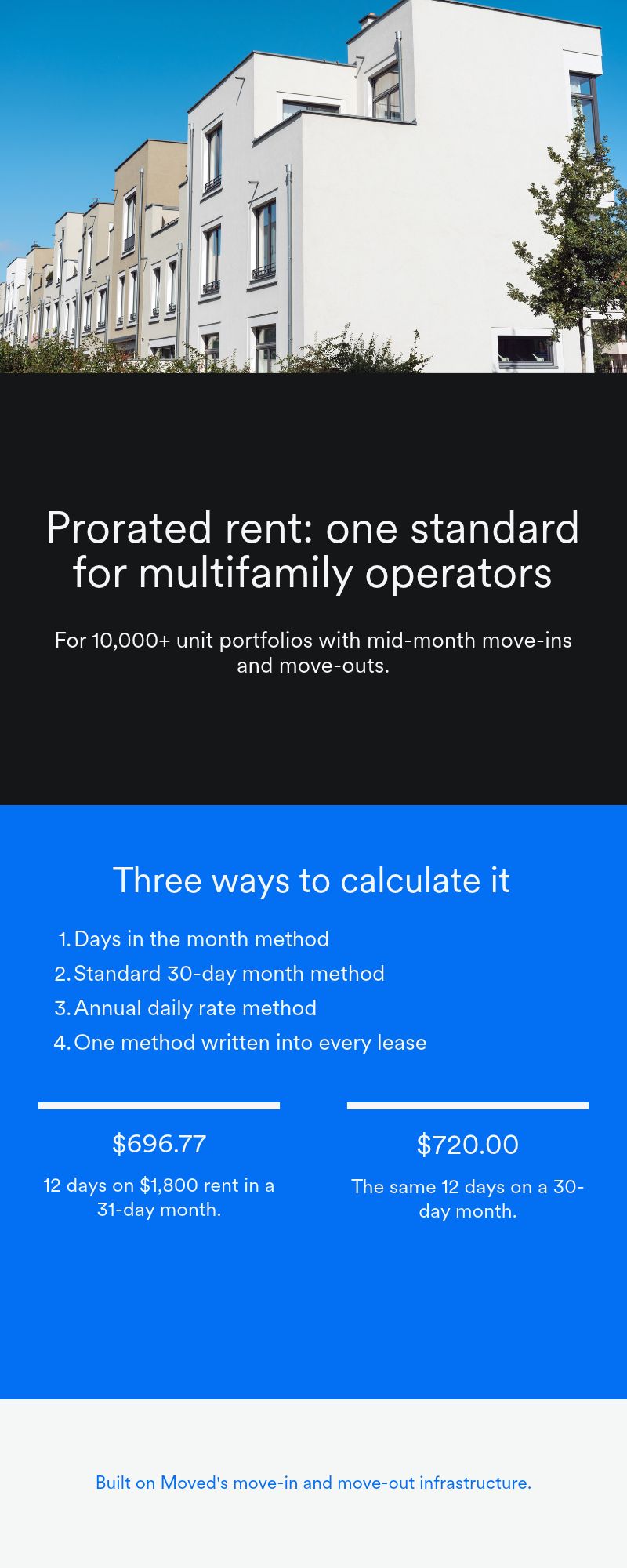
Most operators use one of three methods. Each produces a slightly different daily rate, so the method should be written into the lease and applied the same way at every property.
| Method | Daily rate formula | Daily rate on $1,800 rent | When it is used |
|---|---|---|---|
| Days in the month | Monthly rent divided by the number of days in that month | $58.06 in a 31-day month | Charges exactly for the month the resident moves in |
| Standard 30-day month | Monthly rent divided by 30 | $60.00 in any month | Keeps the daily rate the same all year |
| Annual daily rate | Monthly rent times 12, divided by 365 | $59.18 in any month | Spreads the year’s rent evenly across every day |
Worked Examples At Move-In And Move-Out
The examples below use a monthly rent of $1,800. They show how the method changes the amount even when the dates are the same.
| Scenario | Days charged | Days in the month | Standard 30-day month | Annual daily rate |
|---|---|---|---|---|
| Move-in on the 20th of a 31-day month | 12 days, the 20th through the 31st | $696.77 | $720.00 | $710.14 |
| Move-out on the 10th of a 30-day month | 10 days, the 1st through the 10th | $600.00 | $600.00 | $591.78 |
Two decisions matter as much as the formula. The first is whether the move-in day and the move-out day both count as occupied days. The second is whether a resident who moves in late in the month pays the partial month and the following full month together at lease signing, which some operators require when the move-in falls in the last days of a month.
Proration At Move-Out And What The Law Says
At move-out, proration usually applies when a tenancy ends on a date that does not match a rent period. In Texas, if a month-to-month tenancy ends on a day that does not correspond to the beginning or end of a rent-paying period, the tenant is liable for rent only up to the date of termination, under Texas Property Code section 91.001.
Federal law requires proration in one common case. When a servicemember ends a lease under the Servicemembers Civil Relief Act, 50 U.S.C. section 3955, unpaid rent for the period before the effective termination date is paid on a prorated basis, and rent paid in advance for the period after termination must be refunded within 30 days.
Proration at move-out then flows into the final account. Any prorated rent owed or refunded belongs on the itemized deposit statement, which Moved’s security deposit return letter template sets out line by line.
Common Proration Mistakes To Avoid
Most proration disputes trace back to a handful of errors, and each one has a simple fix in the lease or the move-in summary.
- Using a different method at each property, so the same dates produce different charges.
- Counting the move-in day at one property and excluding it at another.
- Showing the prorated amount inside a single total, so the resident cannot see how it was calculated.
- Prorating rent while charging a full month of other recurring fees without saying so in the lease.
- Changing the move-in date after the lease is signed without recalculating the first statement.
The Revenue Case: The Move-In Date Drives Every Service
The proration date is the move-in date, and the move-in date is when the resident needs movers, packing, storage, utilities, internet, and renters insurance in place. Confirming the date for proration is the natural point to present those services in one flow.
That puts proration inside the move-in and move-out revenue workflow. Utility activation follows the same date, and Moved’s guide to apartment utilities at move-in explains why service should be live before keys are released.
At move-out, the same applies in reverse. A confirmed move-out date sets the final proration and the window in which the resident books movers, packing, and storage.
First Statements And Resident Perks: Paylode, A Moved Company
The first statement is one of the earliest financial messages a resident receives. A clear prorated charge, explained before move-in, keeps that message routine.
Paylode is a Moved company. Moved acquired Paylode in November 2025, adding a perks and rewards platform that helps brands increase loyalty and retention through personalized perks and action-based rewards. Introducing perks in the same move-in message as the prorated charge gives a new resident something of value alongside the first bill.
Disclosure And Insurance At Move-In
Prorated rent is part of the total a resident pays at move-in, alongside deposits and any mandatory fees. The Federal Trade Commission’s advance notice of proposed rulemaking on rental housing fees asks about fees charged at the beginning or end of a lease term. Moved’s guide to the FTC rental fee rulemaking covers how to present every move-in charge in one place.
The proration start date is also the date renters insurance coverage should begin. Moved’s guide to capturing renters insurance requirements at move-in explains how to confirm coverage before keys are released.
Running Proration Across A 10,000+ Unit Portfolio
- One proration method, written into every lease and applied at every property.
- A clear rule on whether move-in and move-out days count as occupied days.
- A late-month rule that states when the partial month and the next full month are due together.
- Prorated rent shown as its own line on the move-in summary and the final account.
- Move-in and move-out dates confirmed in writing, with services offered in the same message.
- Proration disputes and corrections reported by property.
Traditional tools focus on task tracking and administrative coordination. Moved embeds revenue-generating services and insurance verification directly into the workflow, transforming move coordination into structured revenue infrastructure.
Moved is a move infrastructure platform that embeds revenue-generating services, including movers, packing, storage, insurance, utilities, and connectivity, directly into the resident onboarding workflow. It helps property operators increase ancillary income while mitigating compliance risk, and the guide to resident onboarding automation shows how that workflow is built.
For residents, a clear first statement is part of the resident experience. For operators, Moved for multifamily operators shows how the same process runs across a portfolio.
Frequently Asked Questions
What is prorated rent?
Prorated rent is the partial rent charged for the days a resident occupies a unit when a lease starts or ends partway through a month.
How do you calculate prorated rent?
Divide the monthly rent into a daily rate, then multiply by the number of days occupied. The daily rate can be based on the days in that month, a standard 30-day month, or an annual rate of 12 months divided by 365 days.
Does the move-in day count toward prorated rent?
In most leases, yes. The lease should state whether the move-in day and the move-out day each count as occupied days.
When is prorated rent due?
Usually at lease signing or move-in. Some operators collect the partial month and the next full month together when the move-in falls late in the month.
Is prorated rent required at move-out?
It depends on the lease and state law. Texas, for example, limits a month-to-month tenant’s rent to the termination date when it falls mid-period, and federal law requires proration when a servicemember ends a lease under the Servicemembers Civil Relief Act.
Make Every First Statement Clear
A consistent proration method keeps first and final statements routine across every property. To see how move-in dates, insurance verification, and move services run as one move-in and move-out workflow across a 10,000+ unit portfolio, book a walkthrough with the Moved team.