An apartment make-ready checklist is the list of inspections, repairs, cleaning, and safety checks a maintenance team completes to prepare a vacant unit for the next resident. It starts when the previous resident returns possession and ends when the unit passes a final quality check and is released for move-in. For operators, a standard checklist is what makes turn time and turn quality predictable across properties.
Across a 10,000+ unit portfolio, make-ready work runs every day of the year. This guide sets out a make-ready checklist by stage, the legal checks that belong in it, how to run a make-ready board, and how to connect each turn to a structured move-in and move-out process in residential real estate.
Why Make-Ready Speed And Quality Both Matter
Every vacant day costs rent, and every defect left behind costs goodwill. Turnover has cost about $3,872 per resident, according to an earlier edition of Zego’s Resident Experience Management Report reported by Multifamily Dive, a figure that includes repairs and lost rent.
Retention is also under pressure. Zego’s 2026 Resident Experience Management Report found that average retention fell to 57 percent, down from 60 percent in 2024, so each new resident’s first impression of the unit carries more weight.
A fast turn that leaves defects behind trades vacancy days for a poor first week. The checklist has to cover both, with a target ready date and a quality standard the unit must meet before release.
Make-Ready Starts Before The Resident Leaves
The best turns are planned during the notice period. A pre-move-out inspection identifies repairs and parts early, and a confirmed move-out date lets the team book vendors before the unit is empty.
In California, Civil Code section 1950.5 requires landlords to tell residents they may request an initial inspection before move-out. It also requires photographs of the unit after possession is returned, before any repairs or cleaning that will be deducted from the deposit, and again after that work is done.
For tenancies that began on or after July 1, 2025, the same section requires photographs immediately before or at the start of the tenancy. California operators should therefore time the final make-ready photos for just before the new resident moves in.
The days between notice and the moment maintenance takes possession are covered in Moved’s analysis of resident-side turn delay. Sending residents the move-out cleaning checklist at notice can also reduce the cleaning left for the crew.
The Make-Ready Checklist By Stage
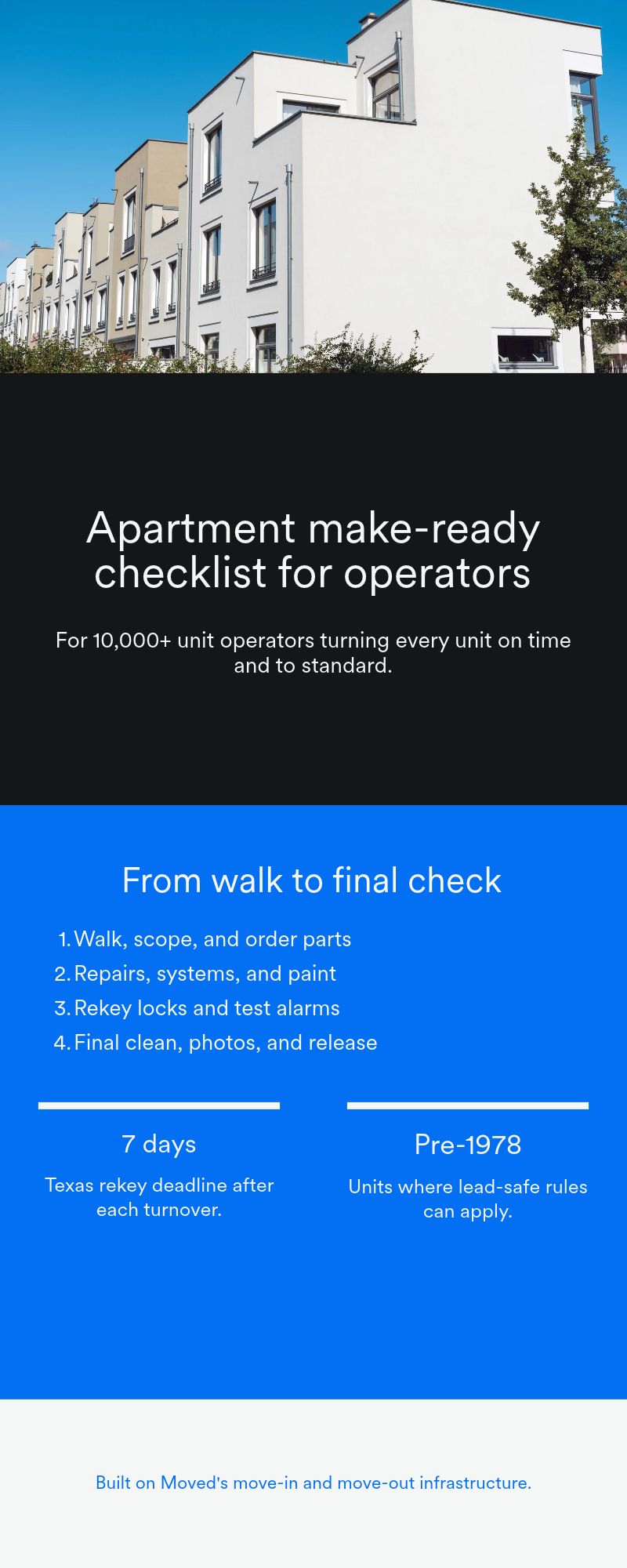
The checklist below runs in order, and each stage has a clear finish line, so the board shows exactly where every unit stands.
| Stage | What to check | Done when |
|---|---|---|
| 1. Walk and scope | Compare the unit with its move-in condition record, photograph every room, and list repairs and parts | Work orders and parts orders are complete |
| 2. Trash-out and left-behind items | Remove trash, and log, store, and give notice for any belongings as state law requires | The unit is empty and any stored items are recorded |
| 3. Repairs | Doors, locks, windows, blinds, walls, flooring, fixtures, and cabinets | Every work order is closed |
| 4. Systems and appliances | Heating and cooling, water heater, plumbing, electrical, and each appliance | All systems run and every appliance works |
| 5. Paint and surfaces | Touch-up or full paint, caulk, countertops, and floors | Surfaces are finished and dry |
| 6. Safety and security | Smoke and carbon monoxide alarms tested, locks rekeyed, and access devices reset | Alarms pass and new keys are issued |
| 7. Final clean | Kitchen, bathrooms, floors, windows, and fixtures | The unit meets the cleaning standard |
| 8. Final quality check and photos | Walk the unit against the checklist and photograph each room | The unit is released for move-in |
The walk in stage 1 compares against the condition record described in Moved’s move-in and move-out inspection checklist. Belongings found in stage 2 follow the state rules covered in Moved’s guide to tenant abandoned property.
Legal Checks That Belong In Every Make-Ready Checklist
Some make-ready steps are required by law, so they should be written into the checklist and never skipped on a rushed turn.
In Texas, a security device operated by a key, card, or combination must be rekeyed at the landlord’s expense no later than the seventh day after each tenant turnover date, under Texas Property Code section 92.156. Section 92.258 of the same chapter requires the landlord to confirm that the smoke alarm is in good working order at the beginning of the tenant’s possession by testing it.
In housing built before 1978, painting and repairs can disturb lead-based paint. EPA’s Renovation, Repair and Painting Rule requires property managers either to become a Lead-Safe Certified Firm or to hire one for maintenance, repair, or painting that could disturb lead-based paint, according to EPA’s guidance for property managers.
EPA’s frequent questions on the RRP Rule describe minor repair and maintenance as activities that disturb six square feet or less of interior painted surface, or twenty square feet or less of exterior painted surface. Work beyond those amounts can fall under the rule’s requirements, so pre-1978 units need a lead-safe step in the paint stage.
Before a new resident signs a lease for most pre-1978 housing, federal law also requires the lead hazard pamphlet, any known information and records on lead-based paint, and a Lead Warning Statement, according to EPA’s real estate disclosure guidance. Make-ready is the right point to confirm those documents are ready for the next lease.
How To Run A Make-Ready Board
A make-ready board is the shared view of every vacant and on-notice unit, its stage, and its target ready date. It replaces scattered notes with one list that leasing and maintenance teams both use.
- Unit number, unit type, and the scope of the turn.
- Move-out date and the date possession was returned.
- Next move-in date, if the unit is already leased.
- Current stage from the checklist and any open work orders.
- Vendor dates for paint, flooring, and cleaning.
- Target ready date and final quality check status.
The most useful column is the next move-in date. When it is visible, the team works first on the units where a resident is waiting.
Common Make-Ready Mistakes To Avoid
Each of these mistakes either adds vacancy days or sends a new resident into a unit that is not ready.
- Starting the walk days after possession is returned.
- Waiting for the walk to order common parts, so repairs sit until deliveries arrive.
- Skipping the rekey or the alarm test when a turn is rushed.
- Painting in pre-1978 units without confirming lead-safe practices.
- Releasing a unit without a final walk and photos.
- Leaving utilities off, so the unit is dark and cold when the next resident arrives.
Utility timing is easy to miss because it sits outside maintenance. Moved’s guide to apartment utilities at move-in explains why service should be live before keys are released.
The Revenue Case: The Ready Date Drives Every Service
The ready date is the earliest date the next resident can move in, and that date is when the resident needs movers, packing, storage, utilities, internet, and renters insurance in place. A reliable ready date lets the move-in flow present those services with a confirmed date attached.
That connects make-ready to the move-in and move-out revenue workflow. When maintenance and leasing share one ready date, the resident books services once and does not have to rebook when a turn slips.
At move-out, the outgoing resident’s confirmed date is what starts the turn. It is also the date that resident books movers, packing, and storage, so the same confirmation serves both the turn plan and the resident’s move.
First Impressions And Retention: Paylode, A Moved Company
The first week in a unit shapes how a resident judges the community. A unit that is clean, safe, and fully working on day one avoids the early service requests that start a tenancy on the wrong foot.
Paylode is a Moved company. Moved acquired Paylode in November 2025, adding a perks and rewards platform that helps brands increase loyalty and retention through personalized perks and action-based rewards. The same Zego report found that 31 percent of renters would be much more likely to renew if their community offered a renter rewards program.
A well-prepared unit and perks introduced at move-in work together. One removes reasons to leave, and the other adds reasons to stay.
Disclosure And Insurance At Move-In
Charges tied to unit condition, such as cleaning or repair deductions at move-out and any fees at move-in, should be stated in the lease. The Federal Trade Commission’s advance notice of proposed rulemaking on rental housing fees asks about fees charged at the beginning or end of a lease term, and Moved’s guide to the FTC rental fee rulemaking covers how to present every move-in charge in one place.
The ready date is also the date renters insurance coverage should begin. Moved’s guide to capturing renters insurance requirements at move-in explains how to confirm coverage before keys are released.
Running Make-Ready Across A 10,000+ Unit Portfolio
- One make-ready checklist, with state-specific steps for rekeying, alarm testing, and lead-safe work.
- A make-ready board at every property, with the next move-in date on each unit.
- Photos at the walk, after repairs, and at the final check, stored with the unit record.
- Target turn times set by unit type and scope of work.
- Vendor schedules booked as soon as the move-out date is confirmed.
- Turn time, reopened work orders, and first-month service requests reported by property.
Traditional tools focus on task tracking and administrative coordination. Moved embeds revenue-generating services and insurance verification directly into the workflow, transforming move coordination into structured revenue infrastructure.
Moved is a move infrastructure platform that embeds revenue-generating services, including movers, packing, storage, insurance, utilities, and connectivity, directly into the resident onboarding workflow. It helps property operators increase ancillary income while mitigating compliance risk, and the guide to resident onboarding automation shows how that workflow is built.
For residents, a unit that is ready on day one is part of the resident experience. For operators, Moved for multifamily operators shows how the same process runs across a portfolio.
Frequently Asked Questions
What is a make-ready checklist?
A make-ready checklist is the list of inspections, repairs, cleaning, and safety checks completed to prepare a vacant apartment for the next resident. It runs from the walk after move-out to the final quality check before move-in.
What does make-ready mean in apartments?
Make-ready is the work of turning a vacant unit so that it is ready to lease and occupy. It covers repairs, paint, cleaning, systems checks, and security steps such as rekeying.
How long should an apartment make-ready take?
It depends on the scope of work. A turn with cleaning and touch-up paint takes far less time than one with new flooring or cabinets, so set target times by scope and track actual turn time by property.
What is a make-ready board?
A make-ready board is a shared list of every vacant and on-notice unit, showing its stage, open work orders, vendor dates, and target ready date. Leasing and maintenance teams use it to prioritize units with a resident waiting.
Do locks have to be changed between tenants?
Some states require it. In Texas, keyed, card, or combination security devices must be rekeyed by the landlord no later than the seventh day after each tenant turnover date, and where state law is silent, the portfolio policy should still say whether locks are rekeyed at every turn.
Make Every Turn Predictable
A standard make-ready checklist keeps turn time predictable and new residents confident from the first day. To see how ready dates, insurance verification, and move services run as one move-in and move-out workflow across a 10,000+ unit portfolio, book a walkthrough with the Moved team.