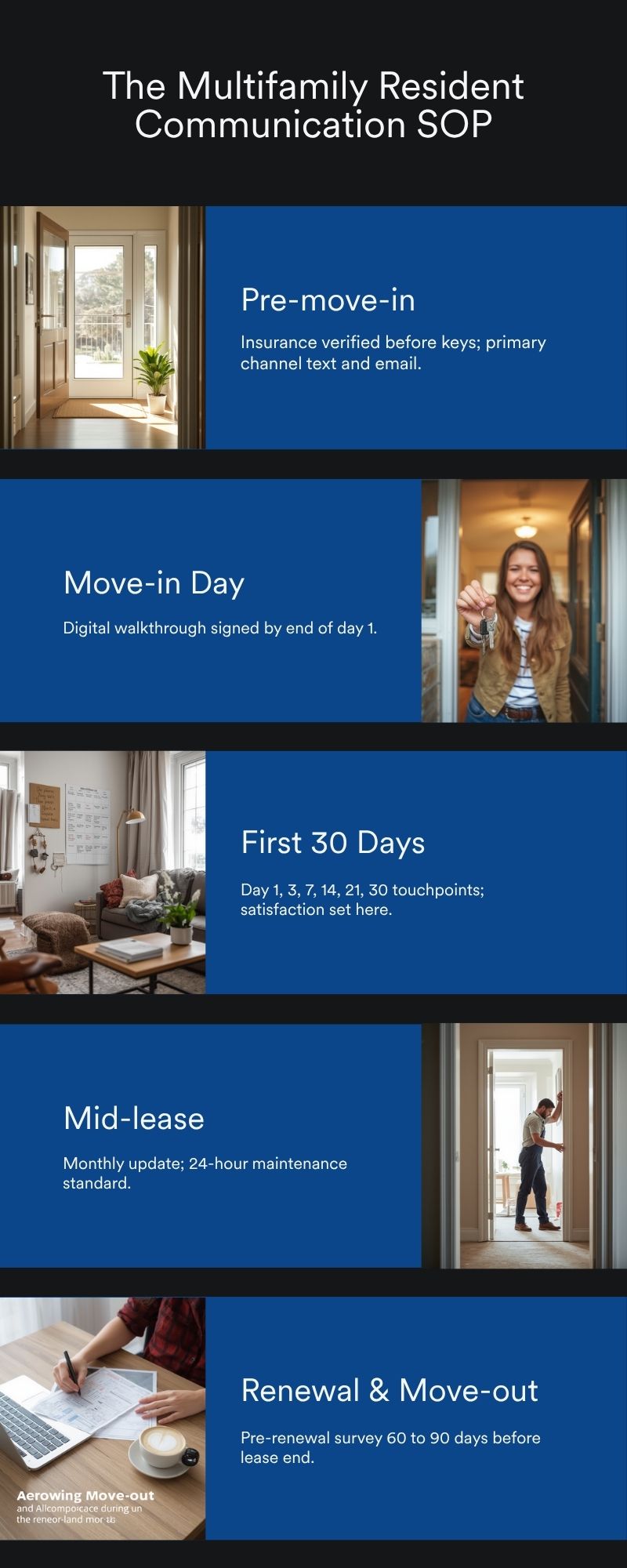
The RevGen Triangle: How to Test Whether an Ancillary Program Will Survive

Every 10,000+ unit operator has launched an ancillary program that looked strong in the deck and quietly faded six months later. The move-in and move-out window is full of these: a parking push, a pet program, an insurance partnership that started well and then stalled. The RevGen Triangle is the test that predicts, before launch, whether a program will compound or fade. The framing comes from the Moved CEO’s RevGen leak map.

This guide lays out the three-party test that every non-rent revenue program must pass, and why the move-in and move-out window is where it applies most. For the broader model, see our guide to ancillary revenue in multifamily.

Why do good programs stall

The usual explanation for a stalled program is that the offer was weak. That is rarely the real reason. Most programs stall because they were built to work for one party at the expense of another. A program that extracts value from residents to book short-term revenue starts fine, but then erodes retention and brand. A program that asks a partner to carry uneconomic acquisition costs loses the partner. A program that adds operator margin but creates friction for residents converts once and never again.

A program built for extraction stalls. A program built for alignment compounds. That is the whole test.

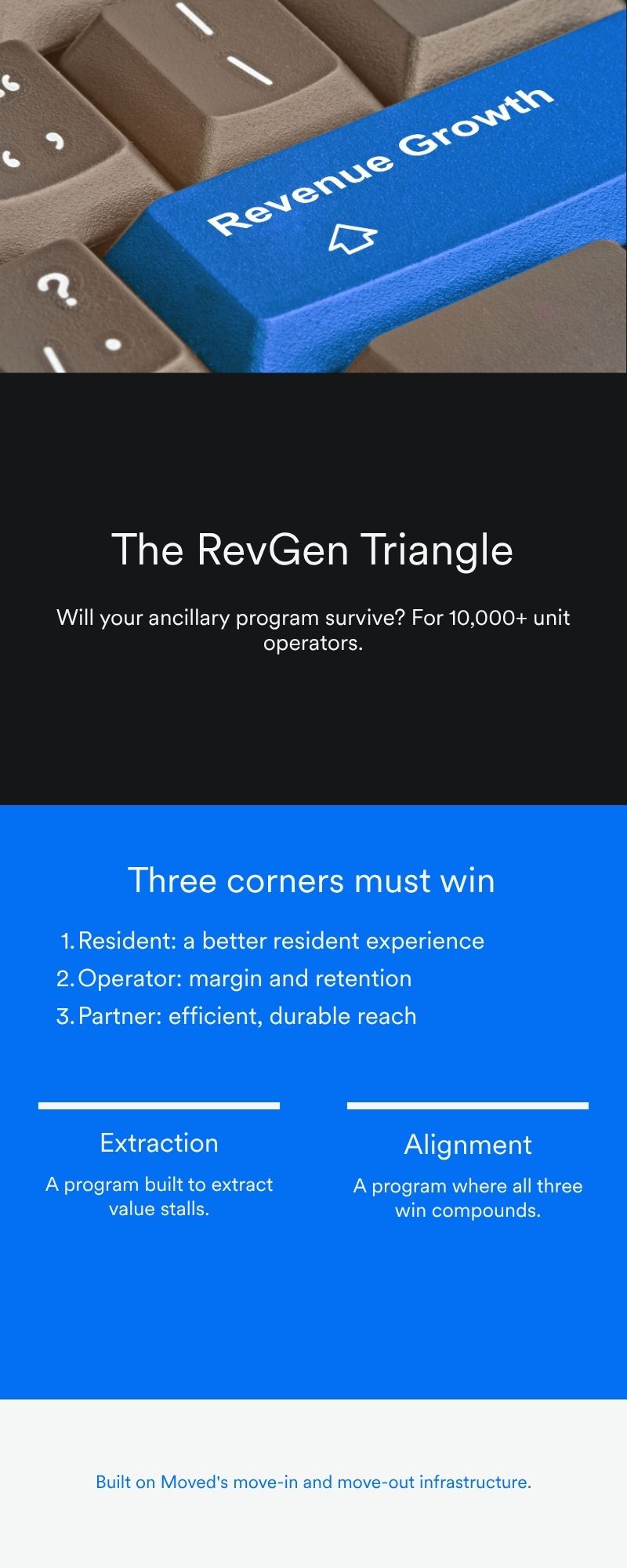
The three corners of the triangle

A non-rent revenue program that grows reliably has to work for three parties simultaneously. When any one corner is losing, the program is on borrowed time, even when the early numbers look acceptable.

The resident has to win.

The resident has to get real convenience, control, savings, or a measurably better resident experience. If the offer lands as friction or as a fee dressed up as a service, residents route around it, conversion falls, and the program reads as weak when the problem was alignment.

The operator has to win.

The operator has to get margin, retention, and brand reinforcement. Revenue that damages the resident relationship is not a win, as it shows up later in lower renewals. The best programs add margin and strengthen the resident experience in the same motion.

The partner has to win.

The service partner has to get efficient acquisition and durable scale. A partner network is a business in its own right, and a program that is uneconomic for the partner will not be supported for long. Durable partner economics are what keep the offer live across the portfolio.
The three corners of the triangle

Where to apply the triangle: the move-in and move-out window

The triangle is sharpest during the move-in and move-out window because all three parties have the most to gain at once. The resident is actively deciding on movers, packing, storage, utilities, internet, and insurance, and wants those decisions made easily. The operator captures the highest-intent, highest-margin revenue in the resident lifecycle. The partner reaches a ready buyer at the exact moment of need. When a program is designed so that all three win in that window, it compounds across every move. We walk through the mechanism in our breakdown of how move-in and move-out workflows became a property management revenue engine and the onboarding mechanics in our ultimate guide to resident onboarding automation.

How Moved fits

Moved is the move-in and move-out infrastructure platform built so all three corners of the triangle win. Traditional tools focus on task tracking and administrative coordination. Moved embeds revenue-generating services, including movers, packing, storage, utilities, internet, and insurance verification, directly into the resident workflow, giving the resident a better experience, the operator margin and retention, and the partner efficient reach at the moment of intent. Resident perks, rewards, and partnerships run on Paylode, a Moved company that Moved acquired in November 2025 to advance ancillary revenue automation, per the Moved announcement. The resident-facing experience lives inside the Moved resident experience. Moved is built on flexible commercial structures designed to align with property financial goals.

To pressure-test your own programs against the triangle, book a walkthrough with our team or visit the Moved multifamily product page.

FAQs

What is the RevGen Triangle?
It is a three-party test for whether an ancillary program will survive. The resident, the operator, and the partner all have to win. If anyone loses, the program is on borrowed time.

Why do ancillary programs fail even when the offer is good?
Because they are built to work for one party at the expense of another. Extraction stalls, alignment compounds.

How does the resident win?
Through real convenience, control, savings, or a measurably better resident experience, not a fee dressed up as a service.

Why apply the triangle at the move-in and move-out window?
Because that is where all three parties gain the most at once, making aligned programs compound with every move.

What is the single most common failure?
Designing for operator margin while creating friction for the resident, which converts once and erodes retention afterward.

The bottom line

In residential real estate, the programs that outperform on non-rent revenue are the ones that pass the triangle before launch. Design so that the resident, the operator, and the partner all win during the move-in and move-out window, and the program compounds rather than fades.

For the NOI picture, see our guide to increasing multifamily NOI without raising rent.

The Workflow Leak: Why Revenue That Depends on a Leasing Agent’s Memory Is Already Broken

At a 10,000+-unit operator, the move-in and move-out moment is where the highest-intent, highest-margin resident revenue is concentrated, and it is also where that revenue quietly leaks. The second leak in the RevGen system is the workflow leak: any non-rent revenue that depends on a leasing agent remembering to offer something during the busiest days of the resident lifecycle is already broken. The framing comes from the Moved CEO’s RevGen leak map.

This guide covers why memory-based revenue fails at portfolio scale, what it costs, and the embedded-workflow model that closes the gap across the move-in and move-out window. For the broader operating model, see our guide to ancillary revenue in multifamily.

Why revenue tied to memory fails at scale

Picture the move-in day at a busy lease-up. A leasing agent is handling keys, paperwork, questions, and three other residents at once. Somewhere in that rush, the agent is also supposed to remember to mention movers, renters insurance, utility setup, and internet. When the day is calm, some of it happens. When the day is busy, which is most days, it does not.

That is the workflow leak. The offer exists, the demand exists, and the resident is actively making these decisions, but the revenue depends on a person remembering to surface it at exactly the right moment. Across a portfolio of 10,000+ units and hundreds of staff, attachment rates swing wildly from property to property for no reason other than who was working that day.

The cost sits next to the leak.

The same manual coordination that leaks revenue also inflates cost. Apartment turnover runs close to $3,872 per resident, per Multifamily Dive’s reporting on Zego’s resident experience research, and a National Apartment Association survey found most operators put turn costs between $1,500 and $3,500 per unit, with nearly one in five above $3,500, per Multi-Housing News. The move-in and move-out window that drives those costs is the same window where non-rent revenue is captured or lost. Fixing the workflow addresses both at once.

Centralization raises the bar.

Operators are centralizing operations, with Funnel Leasing finding that 80% of third-party multifamily managers are centralizing. A centralized team cannot rely on hundreds of individual agents each remembering a script. It needs the offer built into a standardized workflow that runs the same way at every property, every move.

The fix: embed the offer in the workflow

A revenue system makes the offer default-visible within the workflow the resident is already moving through, timed to the moment of the move, with digital purchase flows and lifecycle-triggered prompts. Automation does more than lift revenue. It stabilizes the number so it does not reset every time a team member turns over.

  • The move-in and move-out checklist presents movers, packing, storage, utilities, internet, and insurance at the moment the resident is deciding, not whenever an agent remembers.
  • Every resident sees the same offer at the same step, so the attached rates no longer depend on individual staff members.
  • The data flows back to the asset management team by property, stream, attach rate, and margin, so that the numbers can be managed.

This is the practical heart of Moved’s positioning, and we walk through the mechanism in our breakdown of how move-in and move-out workflows became a property management revenue engine, as well as in our ultimate guide to resident onboarding automation, which covers the onboarding mechanics.

The Workflow Leak: Why Revenue That Depends on a Leasing Agent's Memory Is Already Broken

What it captures at portfolio scale

Closing the workflow leak turns an inconsistent, staff-dependent number into a reliable one. The Moved CEO’s RevGen leak map sizes the typically uncaptured non-rent opportunity at roughly $15 per unit per month, much of it concentrated in the move window that the workflow leak leaves on the table. Risk drops too, because insurance verification and documentation become part of the same standardized flow rather than another thing someone has to remember.

How Moved fits

Moved is the move-in and move-out infrastructure platform that closes the workflow leak. Traditional tools focus on task tracking and administrative coordination. Moved embeds revenue-generating services, including movers, packing, storage, utilities, internet, and insurance verification, directly into the resident workflow, so the offer no longer depends on memory. Resident perks, rewards, and partnerships run on Paylode, a Moved company that Moved acquired in November 2025 to advance ancillary revenue automation, per the Moved announcement. The property management system remains the system of record, and the resident-facing experience lives inside the Moved resident experience. Moved is built on flexible commercial structures designed to align with property financial goals.

To see the embedded workflow run at portfolio scale, book a walkthrough with our team or visit the Moved multifamily product page.

FAQs

What is the workflow leak in RevGen? It is non-rent revenue that depends on a leasing agent remembering to offer a service during the move-in and move-out window. Because memory is unreliable at scale, the revenue leaks.

Why does memory-based revenue fail at 10,000+ units? With hundreds of staff and constant turnover, attachment rates swing from property to property based on who is working. A standardized, embedded workflow removes that dependency.

How does embedding the offer help? It makes the right offer default-visible at the right moment for every resident, so revenue is captured consistently and does not reset when a team member leaves.

Does closing the workflow leak also reduce cost? Yes. The move-in and move-out window that leaks revenue is the same one that drives turnover cost, so a standardized workflow improves both.

Who owns the workflow leak fix? The asset management and operations layer sets the standard, on-site teams execute it, and the platform ensures consistency across the portfolio.

The bottom line

In residential real estate, revenue that depends on a person remembering to offer it is already broken. Embedding the move-in and move-out offer into a standardized workflow turns an inconsistent, staff-dependent number into a reliable, managed stream. It lowers the cost of the same window.

For the reporting half of the problem, see our guide to increasing multifamily NOI without raising rent.
The Lifecycle Map: Why the Right Offer at the Wrong Moment Is Worth Less Than No Offer at All

At a 10,000+ unit operator, resident intent is not constant. The same non-rent offer that converts at move-in falls flat during the quiet middle of a lease, and an offer pushed at the wrong moment does more than miss. It teaches residents to tune out the channel. The fourth leak in the RevGen system is the lifecycle leak: the right offer at the wrong moment is worth less than no offer at all. The framing comes from the Moved CEO’s RevGen leak map.

This guide lays out the resident lifecycle map, why timing beats offer volume, and why the move-in and move-out window carries the highest-margin revenue in the entire lifecycle. For the broader model, see our guide to ancillary revenue in multifamily.

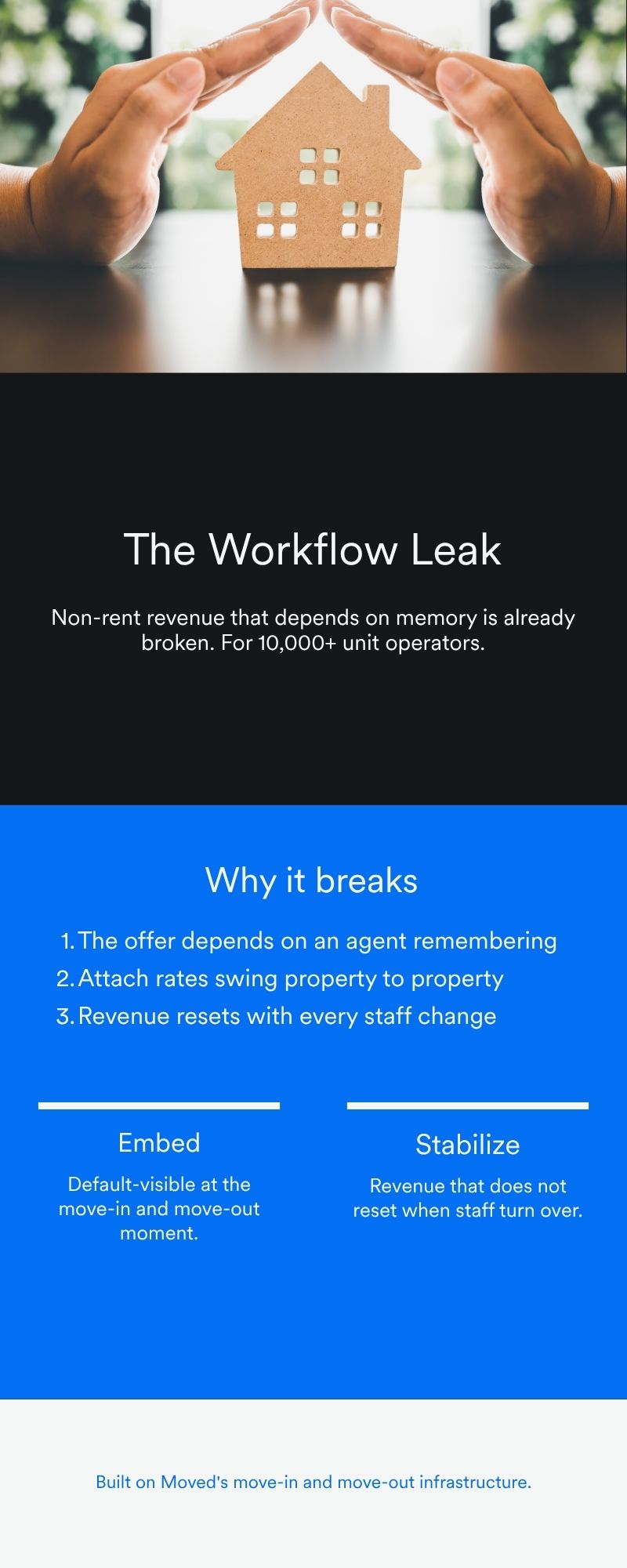
Intent moves through the lifecycle.

A resident’s willingness to act on an offer fluctuates throughout the lease. Treating the entire lease as a single, undifferentiated audience is why so many ancillary pushes underperform. A revenue system presents the right offer at the right moment, rather than broadcasting every offer all the time.

Application: reduce friction

At application, the resident wants the path to their new home made simple. Friction-reducing services and a clear, guided onboarding start building trust and set up everything that follows.

Move-in and move-out: logistics and time-sensitive services

The move-in and move-out window is peak intent. The resident is actively deciding about movers, packing, storage, utilities, internet, and insurance inside a narrow, time-sensitive window. This is where the highest-margin, highest-conversion revenue in the lifecycle sits, because the resident is buying, not browsing.

Living: convenience and recurring offers

During tenancy, intent settles. This is the moment for convenience and recurring offers that fit daily life, not for high-pressure logistics offers that no longer apply.

Renewal: loyalty and rewards

At renewal, the right motion is loyalty and rewards that reinforce the resident experience and support retention, which is exactly where perks and redemption programs belong.

Intent moves through the lifecycle.

Why timing beats offer volume

Most operators assume that more non-rent revenue requires more offers. In practice, the primary driver is timing and placement within the resident journey. Residents convert when they are already completing the task, under a time constraint, and prefer convenience over comparison. Present the same offer outside that moment and conversion collapses, while the constant noise trains residents to ignore the channel. The Moved CEO’s RevGen leak map sizes the typically uncaptured non-rent opportunity at roughly $15 per unit per month, with most of it concentrated in the move-in and move-out window, where intent peaks. We walk through the mechanism in our breakdown of how move-in and move-out workflows became a property management revenue engine and the onboarding mechanics in our ultimate guide to resident onboarding automation.

The move-in and move-out window is the anchor.

Because the move-in and move-out window is where intent, margin, and timing converge, it is the natural anchor for a lifecycle-aware revenue system. Get that window right, and the rest of the lifecycle becomes a series of well-timed, lighter-touch offers rather than a constant broadcast. Risk mitigation rides along because insurance verification and documentation happen inside the same well-timed flow.

How Moved fits

Moved is the move-in and move-out infrastructure platform that times each offer to the lifecycle stage. Traditional tools focus on task tracking and administrative coordination. Moved embeds revenue-generating services, including movers, packing, storage, utilities, internet, and insurance verification, directly into the resident workflow and presents them at the moment of peak intent rather than all at once. Resident perks, rewards, and partnerships run on Paylode. This Moved company Moved acquired in November 2025 to advance ancillary revenue automation, per the Moved announcement, which is what makes the renewal and loyalty stage work. The resident-facing experience lives inside the Moved resident experience. Moved is built on flexible commercial structures designed to align with property financial goals.

To map your own offers to the resident lifecycle, book a walkthrough with our team or visit the Moved multifamily product page.

FAQs

What is the lifecycle leak in RevGen? It is non-rent revenue lost to bad timing. The right offer presented at the wrong lifecycle moment converts poorly and trains residents to ignore the channel.

What are the stages of the resident lifecycle map? Application, the move-in and move-out window, living, and renewal, each with a different resident intent and a different right offer.

Why is the move-in and move-out window the highest-value stage? Because intent, margin, and timing all peak there, when residents are actively buying movers, storage, utilities, internet, and insurance.

Why does timing beat offer volume? Because residents convert when they are already completing the task under time pressure. Outside that moment, more offers lead to lower conversion and erode attention.

Where do loyalty and rewards fit? At renewal, reinforcing the resident experience supports retention rather than pushing logistics offers that no longer apply.

The bottom line

In residential real estate, non-rent revenue is a timing discipline. Map each offer to the resident’s intent across application, move-in and move-out window, living, and renewal; anchor the system on the move-in and move-out window, where intent peaks, and the same offers convert far better than a constant broadcast ever could.

For the NOI picture, see our guide to increasing multifamily NOI without raising rent.

The Ownership Leak: Who at Your Operator Actually Owns Non-Rent Revenue?

Ask a 10,000+-unit operator who owns the rent number, and the answer comes back in one sentence, with a name, a target, and a dashboard to back it up. Ask who owns the non-rent revenue number, and the room goes quiet. That silence is the first and most expensive leak in the RevGen system, and it is the one from which every other leak flows. The framing comes from the Moved CEO’s RevGen leak map.

This article is about the ownership leak: why non-rent revenue drifts when no single person is accountable for it, and the accountability model that closes the gap at portfolio scale. It has quietly become one of the defining performance questions in residential real estate.

The diagnostic question

Start with one question at your own operator. Who is the single named person whose compensation is tied to non-rent revenue?

If the answer is a committee, a shared responsibility, or a task that lives across leasing, operations, and finance without a clear owner, the number is already leaking. Revenue that belongs to everyone belongs to no one. Rent has an owner because the industry decided decades ago that it needed one. Non-rent revenue has become material enough to warrant the same, and most operators have not made that decision yet.

Why unowned revenue drifts

Non-rent revenue drifts for a structural reason. It is not a single line that one team manages. It is a portfolio of streams, parking, pet rent, storage, utilities, insurance, and the partnership income that concentrates in the move-in and move-out window, each touched by a different team at a different moment. When no one owns the total, each stream gets partial attention from a team whose primary job is something else.

The result is predictable. Programs launch and quietly fade. Attach rates plateau. The move-related revenue that falls within the move-in and move-out window goes uncaptured because no one is accountable for it. And because the number sits inside a bundled “other income” line, the drift never shows up as a miss. The economics category is included in our guide to ancillary revenue in multifamily.

The accountability model that closes the leak

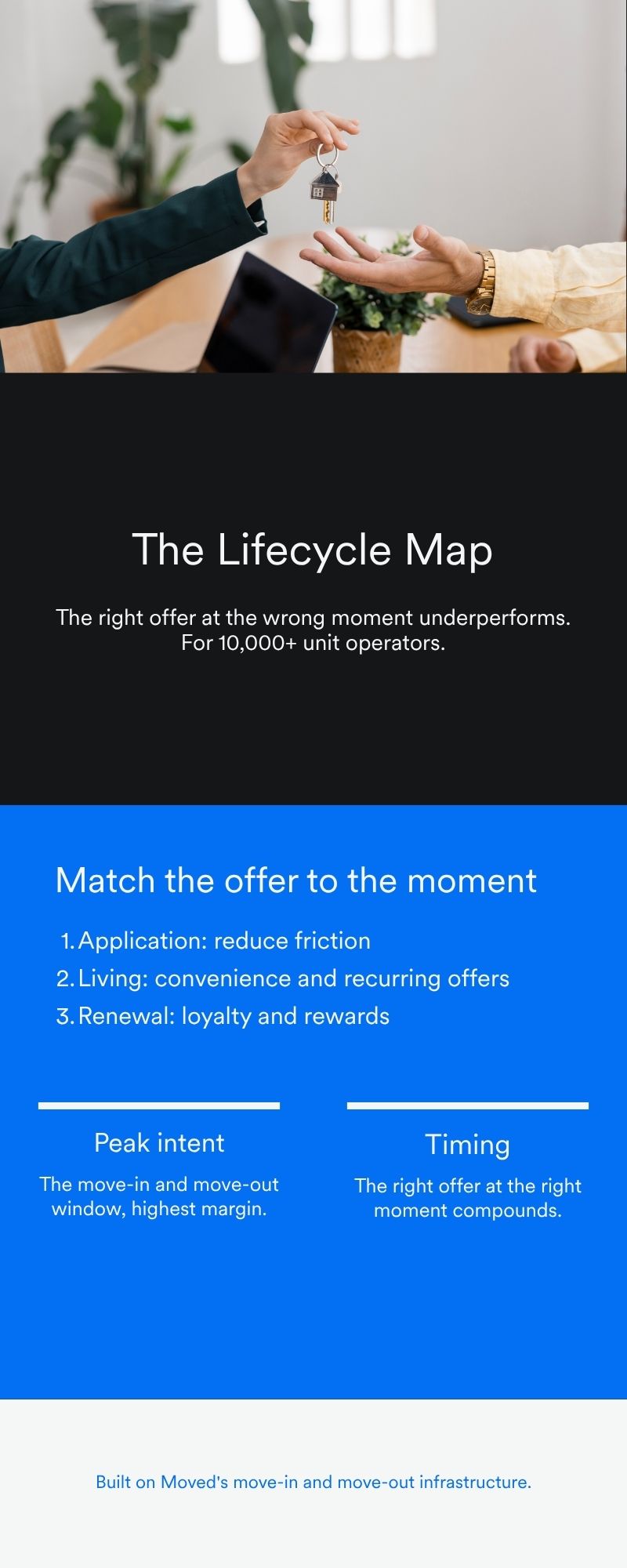
Closing the ownership leak takes five things, in order.

A named owner. One person carries the non-rent revenue number across the portfolio, and a committee cannot own it. The role can sit in asset management, operations, or a dedicated ancillary revenue function, but it has to be a person with a name.

A target. The owner carries a specific non-rent revenue target, sets the rent target, and reports on the same cadence.

A dashboard. The owner has a category-level view of non-rent revenue by property, stream, attach rate, and margin, rather than a single bundled number that hides where revenue is and is not being captured.

Authority to act. The owner can change pricing, launch or retire a program, and reallocate effort across streams without routing every decision through three other teams. Accountability without authority is only a title.

Compensation tied to the result. The owner’s compensation moves with the number. This is the step most operators skip, and it is the one that turns the number from a report into a result.

When those five are in place, the other RevGen leaks become fixable because someone is now accountable for fixing them.

The Ownership Leak Who Owns Non-Rent Revenue

Where should the owner start

The highest-return place for a new non-rent revenue owner to start is the move-in and move-out window. It is where the largest uncaptured revenue sits, where resident intent peaks, and where a standardized workflow can lift the number fastest across the portfolio. The Moved CEO’s RevGen leak map sizes the typically uncaptured non-rent opportunity at roughly $15 per unit per month, much of it concentrated in that window. We walk through the mechanism in our breakdown of how move-in and move-out workflows became a property management revenue engine, the onboarding mechanics in our ultimate guide to resident onboarding automation, and the NOI argument in our guide to increasing multifamily NOI without raising rent.
How Moved fits

Moved gives the non-rent revenue owner the infrastructure and the reporting to do the job. It is the move-in and move-out infrastructure platform that runs the resident-facing experience, captures move-related revenue, and returns it to the owner as category-level data by property, stream, attach rate, and margin. Traditional tools focus on task tracking and administrative coordination. Moved embeds revenue-generating services, including moving, packing, storage, utilities, internet, and insurance, directly into the workflow. Resident perks, rewards, and partnerships run on Paylode, a Moved company that Moved acquired in November 2025 to advance ancillary revenue automation, per the Moved announcement. For the owner, that turns the move window from an unowned leak into a measured, managed stream. Moved is built on flexible commercial structures designed to align with property financial goals.

To give your non-rent revenue owner the data and the workflow, book a walkthrough with our team or visit the Moved multifamily product page.

FAQs

What is the ownership leak in RevGen? It is the gap that opens when no single person is accountable for the non-rent revenue number. Revenue that belongs to everyone belongs to no one, so it drifts.

Who should own non-rent revenue at a 10,000+-unit operator? A single named person, in asset management, operations, or a dedicated ancillary revenue function, with a target, a dashboard, the authority to act, and compensation tied to the result.

Why does unowned non-rent revenue underperform? Because it is a portfolio of streams touched by different teams at different moments, and without a single owner, each stream gets partial attention from a team whose main job is something else.

Where should a new non-rent revenue owner start? The move-in and move-out window, where the largest uncaptured revenue sits, and a standardized workflow can lift the number fastest.

What is the one step operators skip? Tying the owner’s compensation to the number. It is the step that turns a report into a result.

The bottom line

The ownership leak is the first leak in the RevGen system, as all other leaks flow from it. Name an owner, give them a target, a dashboard, the authority to act, and compensation tied to the result, and point them first at the move-in and move-out window. That is how non-rent revenue stops drifting and starts compounding. For the resident view, browse the Moved resident experience.

How PMS Platforms Add Move-In and Move-Out Automation Without Building It Themselves

Every property management system serving multifamily is hearing the same request from its largest customers. The 10,000+ unit operators want move-in and move-out automation: the resident-facing workflow that orchestrates movers, packing, storage, utilities, internet, and insurance verification through the days around every lease start and end. The question for the platform is not whether to offer it. The question is whether to build it or partner for it.

This guide lays out why the build-versus-partner decision usually lands on partner, what building the move-in and move-out layer actually costs a platform, and how a platform instead adds the capability through integration. We cover the broader revenue model in our guide to ancillary revenue in multifamily.

Why are operators asking for it?

The demand is structural. Across residential real estate, the move-in and move-out window is where the highest-intent, highest-margin resident revenue concentrates, and it is also where the resident experience is made or lost. Operators running at 10,000+ units want that window automated and consistent across the portfolio, and they increasingly expect their property management system to deliver it. We walk through the mechanism in our breakdown of how move-in and move-out workflows became a revenue engine for property management.

Operators are also centralizing operations, which raises the bar for what the core platform has to support. Research from Funnel Leasing found that 80% of third-party multifamily managers are centralizing operations, and centralized teams need a standardized move workflow they can run from one place rather than on a property-by-property basis.

What does building the move-in and move-out layer actually cost a platform?

Building the move layer in-house looks straightforward until the platform team scopes it. The move-in and move-out workflow is not one feature. It is a resident-facing experience, a partner network spanning movers, storage, utilities, and insurance, a verification and compliance layer, and an ancillary revenue engine, all of which must remain current as partners, carriers, and utility providers change.

Three costs make building the wrong call for most platforms.

The first is focus. The property management system is the system of record for leasing, accounting, and operations. Every engineering cycle spent building and maintaining a mover and utility partner network is a cycle not spent on the core platform.

The second is the partner network itself. The value of the move layer is the breadth and quality of the service partners behind it, and assembling and maintaining that network is a business in its own right, separate from building software.

The third is time. Operators want the capability now, and a multi-quarter internal build ships long after the customer asked for it.

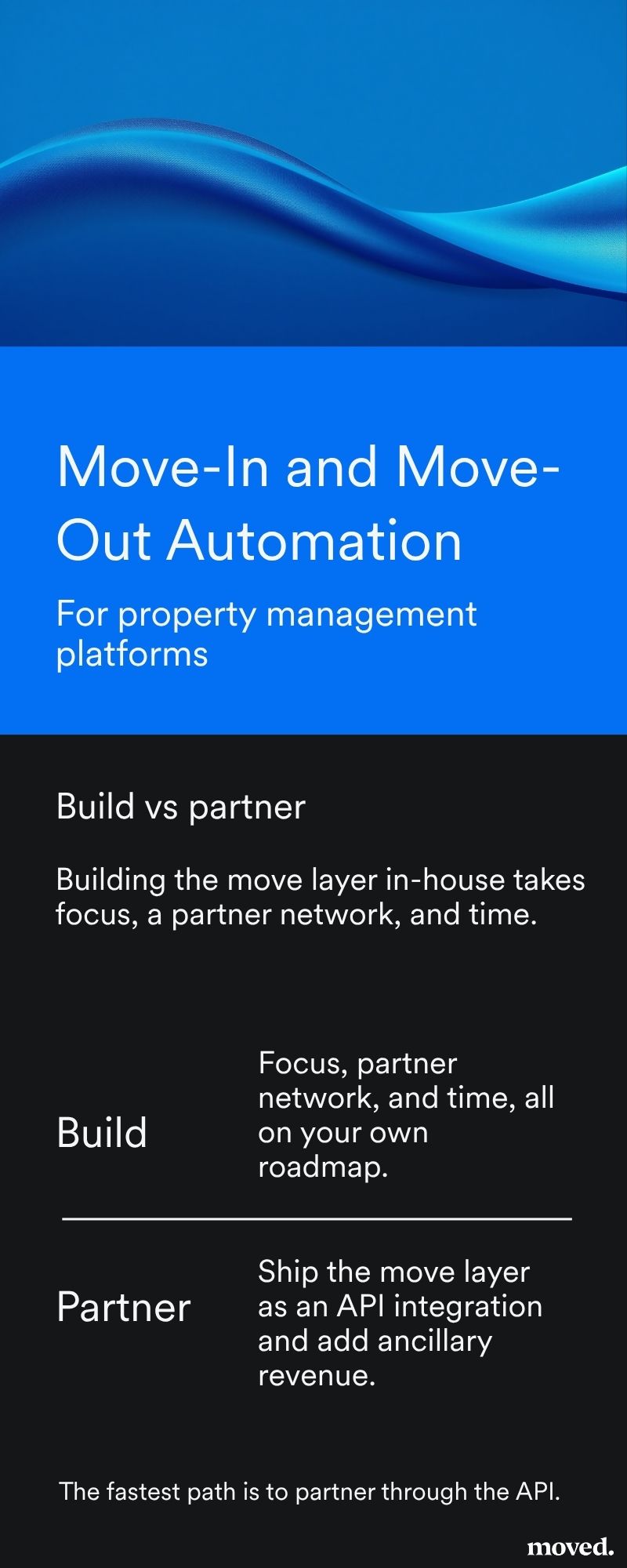
The partner path: integrate the move layer through the API

The faster path is to add the move-in and move-out layer through integration. A dedicated move infrastructure platform runs the resident-facing experience and the partner network and connects to the property management system via API, so data flows both ways. The operator gets the automation; the platform keeps its focus on the system of record; and the capability ships in a fraction of the time it would take for an internal build.

This is the same open-ecosystem pattern that platforms already support for other specialized workflows. We detail the specific integration approach in our piece on how PMS platforms like Yardi can integrate resident move-in and move-out automation.

What the platform gets from partnering

Partnering for the move layer gives the platform three things at once. It answers the customer request quickly with a resident experience that is already built and maintained. It adds an ancillary revenue stream tied to the move window without the platform having to build the partner network. And it keeps the platform’s engineering focused on the core system of record while the specialized workflow stays current on someone else’s roadmap.

The framing of how move-window revenue converts to operator NOI and asset value appears in the Moved CEO’s RevGen newsletter, on the third pillar of residential real estate, and in the RevGen leak map.

Building it in-house costs

How Moved fits

Moved is the move-in and move-out infrastructure platform that integrates with the property management system through the API. Traditional tools focus on task tracking and administrative coordination. Moved embeds revenue-generating services, including moving, packing, storage, utilities, internet, and insurance verification, directly into the resident workflow, and returns the compliance and ancillary revenue data to the platform and the operator. Resident perks, rewards, and partnerships run on Paylode, a Moved company that Moved acquired in November 2025 to advance ancillary revenue automation, per the Moved announcement. For a platform, that means the move layer ships as an integration rather than a multi-quarter build, and the resident-facing experience lives inside the Moved resident experience. Moved is built on flexible commercial structures designed to align with the platform’s and the property’s financial goals.

To see how the integration works, book a walkthrough with our team or visit the Moved multifamily product page.

FAQs

Why do operators want move-in and move-out automation from their property management system? Because the move window is where the highest-intent resident revenue and the sharpest experience moments concentrate, and centralized operators want it standardized across the portfolio.

Why is building the move layer in-house usually the wrong call for a platform? Because it is not one feature. It is a resident experience, a partner network, a compliance layer, and a revenue engine that all have to stay current, which pulls engineering focus away from the core system of record and ships long after the customer has asked.

What does the partner path look like? A dedicated move infrastructure platform runs the resident experience and the partner network and connects to the property management system through the API, so the capability ships as an integration.

Does partnering add revenue for the platform? Yes. It adds an ancillary revenue stream tied to the move-in and move-out window without the platform building the partner network itself.

Does the platform remain the system of record? Yes. The property management system remains the system of record. The move layer integrates on top and returns data both ways.

The bottom line

The 10,000+ unit operators are asking their property management systems for move-in and move-out automation, and the fastest, most focused way to deliver it is to partner rather than build it in-house. Integrating a dedicated move layer via the API delivers the capability quickly, adds an ancillary revenue stream, and keeps the platform’s engineering focused on the core system of record.

For the full operator playbook, see our ultimate guide to resident onboarding automation.

A Compliance-First Move-In and Move-Out Workflow for Affordable Housing

For affordable housing operators, in a corner of residential real estate with the tightest compliance rules, the move-in and move-out moment is where financial and regulatory risk is concentrated. A single missing income certification, an out-of-date file, or an unverified renters insurance policy at lease execution can surface later as an audit finding, and at 10,000+ unit scale, that risk multiplies across every property in the portfolio. We cover the broader revenue model in our guide to ancillary revenue in multifamily.

This guide lays out the compliance-first move-in and move-out workflow that LIHTC and HUD-funded operators apply across the portfolio, with the certification gates, documentation standards, and verification checkpoints that keep the file audit-ready from the first day of the lease.

The Compliance-First Move-In and Move-Out Workflow

Why does the move-in and move-out moment carry the compliance risk?

At an affordable housing operator, the compliance obligation begins before the resident receives keys. Income eligibility must be certified at initial occupancy, and the file must include documentation proving it. Housing finance agencies inspect LIHTC properties on a defined cadence, reviewing at least 20% of a project’s low-income units and re-checking income certification at least once every three years, with the first review due by the end of the second calendar year after the last building is placed in service, per the IRS regulations summarized by the National Low Income Housing Coalition.

The exposure is personal for the compliance team. When a file is incomplete at move-in, the operator carries the finding, and the after-the-fact fix is far more expensive than getting it right at the front door. The move-in and move-out workflow is the one place where every certification, signature, and verification can be captured in a fixed sequence rather than reconstructed under audit pressure.

The problem: compliance documentation lives in too many places

Most affordable housing operators run move-in and move-out through a mix of the property management system, paper files, email threads, and on-site memory. That fragmentation is the root of most audit findings, and it is also where ancillary revenue quietly leaks, because the moved services residents are already buying happen outside the operator’s system.

  • Income certifications get completed but not consistently filed against the resident record.d
  • Renters insurance is collected at some properties and skipped at others
  • Recertification deadlines drift because no single system tracks them
  • The move-out file rarely closes with the same rigor with which the move-in file opens

Two properties in the same portfolio can run the same program and produce opposite audit outcomes, purely because one captured the documentation in a workflow and the other left it to individual staff.

The solution: a standardized workflow with compliance gates

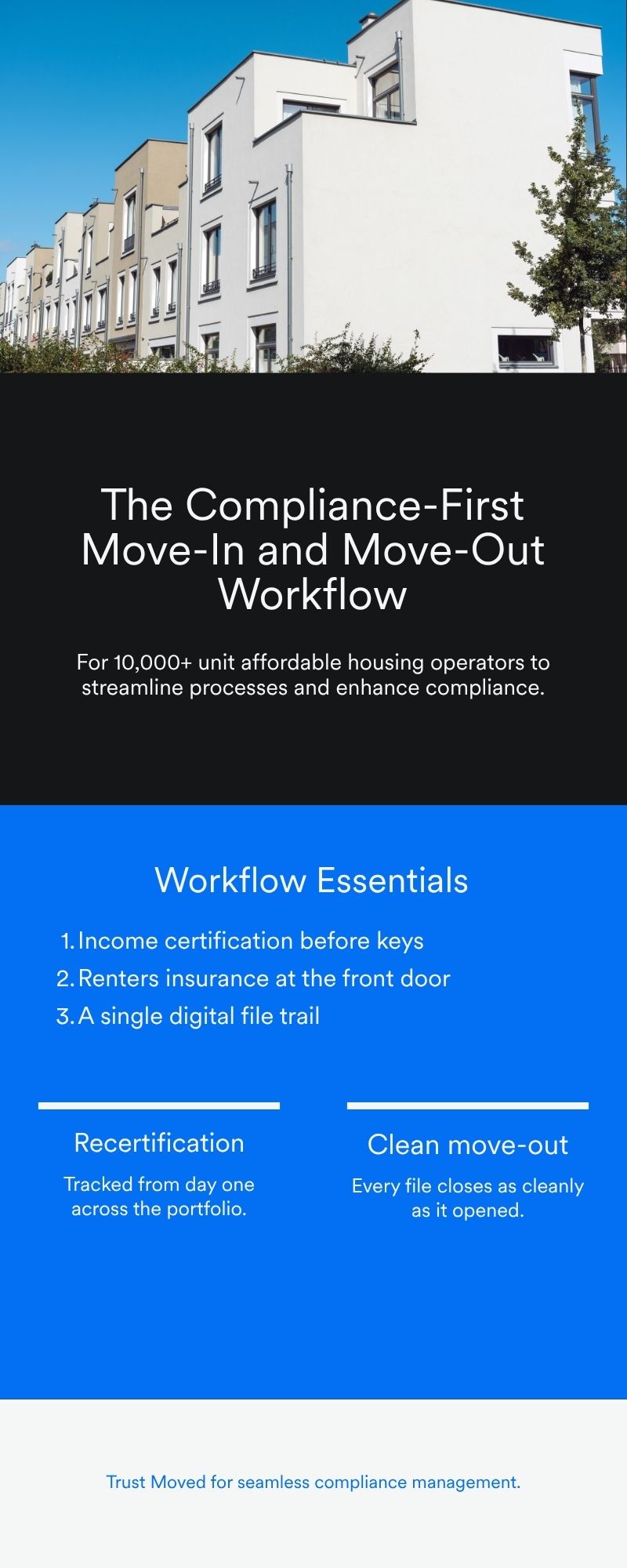
A compliance-first move-in and move-out workflow places the certification and verification steps as hard gates that cannot be skipped. It embeds the revenue-generating move services, movers, packing, storage, utilities, internet, and insurance into the same flow. The standard below is the minimum viable version for a 10,000+ unit operator.

Gate 1: Income certification verified before keys

The initial income certification is completed, reviewed, and filed against the resident’s record before keys are released. The workflow will not advance to key handoff until the certification and its supporting documentation are attached.

Gate 2: Renters’ insurance verified at the front door

Renters insurance is verified against the lease requirement before move-in, with the property named as an additional interested party. Framed correctly, this is financial risk mitigation rather than paperwork. The industry baseline for correctly verified renters insurance has historically sat near 55% against a 90%+ achievable standard, per Foxen’s renters insurance compliance research, and the cost of getting it wrong keeps climbing as property insurance premiums rise 14%, 22%, and 45% over the past three years, per NAA’s Premium Pulse research.

Gate 3: A single digital file trail

Every move-in and move-out document, from the income certification to the signed unit condition report, is captured in one digital record with timestamps. When the housing finance agency arrives, the file is already assembled rather than gathered from four systems.

Gate 4: Recertification tracked from day one

Annual recertification deadlines are set at move-in and tracked centrally, so the portfolio never drifts out of compliance because a single property lost track of a date.

Gate 5: A move-out file that closes as cleanly as it opened

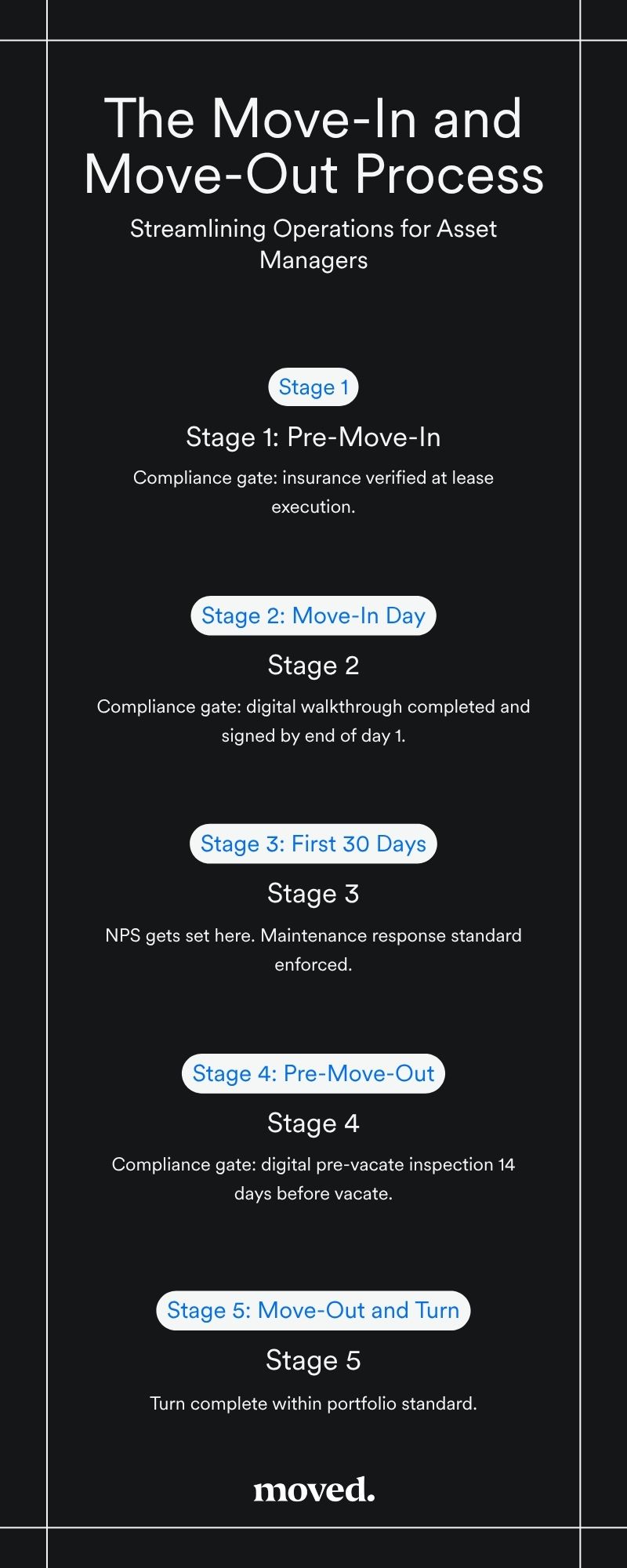
The move-out workflow re-verifies that insurance is in force through the last day, completes the digital pre-vacate inspection with photos, and closes the resident record using the same documentation standard as when the move-in file was opened.

What this compounds into at a 10,000+ unit affordable portfolio

A standardized compliance-first workflow run consistently across 10,000+ affordable units captures the compliant ancillary revenue that lives in the move window through movers, packing, storage, utilities setup, and insurance placement, produces a clean audit trail at the asset management layer, and reduces the exposure that comes from missing or late documentation. The sizing for any specific portfolio depends on program mix, asset class, and baseline performance. The framing of how these outcomes flow into NOI and asset value at the portfolio scale appears in the Moved CEO’s RevGen newsletter on the third pillar of residential real estate.

How Moved fits

Moved is the move-in and move-out infrastructure platform that runs this workflow at portfolio scale. Traditional tools focus on task tracking and administrative coordination. Moved embeds revenue-generating services, including movers, packing, storage, utilities, internet, and insurance verification, directly into the resident workflow, and surfaces the compliance gates and documentation to the asset management team. Resident perks and rewards run on Paylode, a Moved company that Moved acquired in November 2025 to advance ancillary revenue automation, per the Moved announcement. For 10,000+ unit affordable operators, the property management system stays the system of record, and Moved adds the resident-facing experience and the compliance verification on top. Moved is built on flexible commercial structures designed to align with property financial goals.

To see how this compliance-first workflow runs at portfolio scale, book a walkthrough with our team or visit the Moved multifamily product page.

FAQs

When does LIHTC compliance risk begin in the resident lifecycle? Before keys are released. Income eligibility has to be certified at initial occupancy and documented in the file, so the move-in workflow is the first compliance gate.

How often do housing finance agencies review LIHTC files? They review at least 20% of a project’s low-income units and re-check income certification at least once every three years, with the first review due by the end of the second year after the last building is placed in service, per the IRS regulations.

Why verify renters’ insurance at move-in for affordable housing? Unverified renters insurance is a financial risk at every property, and the historical baseline for proper verification is near 55%, per Foxen.

Who owns the compliance workflow at a 110,000+-unitaffordable operator? The workflow sits at the asset management and compliance layer. On-site teams execute it, and the reporting rolls up to operations and compliance leadership.

Does a compliance-first workflow require replacing the property management system? No. The property management system remains the system of record. The move-in and move-out workflow adds the resident-facing experience and the compliance verification on top.

The bottom line

For affordable housing operators, a compliance-first move-in and move-out workflow captures the move-window revenue and reduces audit risk without adding headcount. Putting income certification, insurance verification, documentation, and recertification into hard gates that run the same way across every property turns the move moment from the biggest source of findings into a clean, audit-ready, revenue-generating record.

For the full operator playbook, see our breakdown of how move-in and move-out workflows have become a property management revenue engine, as well as our ultimate guide to resident onboarding automation. For the resident view, browse the Moved resident experience.

Revenue Idea vs Revenue System: Why Most Ancillary Programs Fail at Scale

Most multifamily operators do not have a revenue problem. They have a system problem.

Ask any 10,000+ unit operator for a list of ways to grow non-rent revenue, and the list comes fast: parking, pets, storage, utilities, internet, insurance, and partnerships. The ideas are not the constraint. The constraint is the infrastructure that turns an idea into revenue that shows up reliably, every quarter, across every property in the book.

This article draws the line between a revenue idea and a revenue system, explains why programs built as ideas fail at scale, and lays out what a revenue system actually requires. The distinction comes from the Moved CEO’s RevGen newsletter on the third pillar of residential real estate and the RevGen leak map.

A revenue idea versus a revenue system

A revenue idea is a thing you can sell. Reserved parking is a revenue idea. A pet program is a revenue idea. A renter’s insurance partnership is a revenue idea.

A revenue system is the process that makes the right offer visible, valuable, measurable, and repeatable across the entire portfolio. The system is what makes the idea show up as actual dollars on actual operating statements, property after property, quarter after quarter.

Most operators are rich in ideas and poor in systems. That gap is why ancillary programs that look great in a launch deck quietly underperform six months later.

Why programs built as ideas fail

The typical failure pattern starts the same way every time. A partner shows up with a pitch. Internal momentum builds. Projections get baked into the budget. The program launches. And it underperforms, often badly.

The reason is rarely the offer itself. The reason is that the offer was deployed without a supporting system in place. It went out at the wrong moment, through the wrong channel, and framed the wrong way. To the resident, it landed as friction rather than value. Conversion stayed low, the partner pulled back, and the operator concluded the category was weak. The category was fine. The deployment had no system behind it.

A revenue system solves what the idea cannot solve on its own: alignment. A program that grows reliably has to work for three parties at once. The resident has to get convenience, control, savings, or a measurably better experience. The operator has to get margin, retention, and brand reinforcement. The partner has to get efficient acquisition and durable scale. When any one of the three is losing, the program is on borrowed time, even when the early numbers look acceptable. Programs built for extraction stall. Programs built for alignment compound.

Revenue Idea

What a revenue system requires

Turning an idea into a system requires four components to work together.

  1. Clear ownership. Someone has to own the non-rent revenue number, with a target, a dashboard, the authority to act, and compensation tied to the result. When no single person is accountable, the number drifts. Ownership is the foundation on which everything else sits.
  2. Embedded workflow. Revenue that depends on a leasing agent remembering to mention something during a busy tour is already broken. A system makes the offer default-visible inside the workflows residents are already moving through, with digital purchase flows and lifecycle-triggered prompts. Automation does more than lift revenue. It stabilizes the number so it does not reset every time a team member turns over.
  3. Lifecycle timing. Resident intent is not static. The same offer that converts at move-in falls flat during the quiet middle of a lease. A system presents the right offer at the right moment: friction-reducing services at application; logistics and time-sensitive services at move-in and move-out; convenience and recurring offers during tenancy; and loyalty and rewards at renewal. The move-in and move-out window is where intent peaks, which is why it carries the highest-margin opportunities in the entire lifecycle.
  4. Category-level reporting. A system reports non-rent revenue broken out by category, attach rate, margin, and resident impact, rather than bundling everything into a single “other income” line. You cannot compound what you cannot measure. We cover this reporting problem in depth in our companion article on why “other income” is the wrong way to manage non-rent revenue.

The move-in and move-out lifecycle is the backbone of the system.

Four of those components converge on a single point in the resident lifecycle. The move-in and move-out window is where workflow, lifecycle timing, the highest-intent decisions, and the largest uncaptured revenue all meet. It is the natural backbone of a revenue system because it is the moment when residents are actively deciding on movers, packing, storage, utilities, internet, and insurance, and when a property that is present captures revenue that would otherwise walk out the door.

This is why operators who get serious about RevGen start by building the system around move-in and move-out rather than bolting on isolated programs elsewhere. We walk through that mechanism in our piece on how move-in and move-out workflows became a property management revenue engine, and in our guide to ancillary revenue in multifamily, which covers the underlying category economics.

A system compound where a set of ideas leaks

A set of disconnected ideas captures a fraction of the available move-related revenue inconsistently, depending on which on-site team happens to push them. A system captures it reliably across the book, every move, every property, every quarter. The Moved CEO’s RevGen leak map sizes the typically uncaptured non-rent opportunity at roughly $15 per unit per month. It shows how a system recovers it while a set of ideas leaves it on the table. The difference between the two outcomes is not the idea. It is the system. For the full picture of NOI, see our breakdown on how to increase multifamily NOI without raising rent.

How Moved fits

Moved is the revenue system for the move-in and move-out lifecycle. It integrates with the property management system via an API, embeds the offers into the resident workflow, times them to the move moment, and reports the results back by category at the portfolio level. Traditional tools focus on task tracking and administrative coordination. Moved builds the four components of a revenue system, which is why operators reach for a move infrastructure platform rather than assembling a system from disconnected partner deals. Resident perks, rewards, and partnerships run on Paylode, a Moved company that Moved acquired in November 2025 to advance ancillary revenue automation, per the Moved announcement. For the mechanics of onboarding, see our ultimate guide to resident onboarding automation.

To turn your ancillary ideas into a revenue system, book a walkthrough with our team or visit the Moved multifamily product page.

FAQs

What is the difference between a revenue idea and a revenue system? A revenue idea is a service you can sell, such as parking or a pet program. A revenue system is the process that makes the right offer visible, valuable, measurable, and repeatable across the whole portfolio. Ideas are common. Systems are rare, and they produce reliable revenue.

Why do ancillary programs fail even when the offer is good? Because they are deployed without a system. The offer goes out at the wrong moment, through the wrong channel, framed as extraction rather than value. Conversion remains low, and the operator wrongly concludes that the category is weak.

What does a revenue system require? Four components: clear ownership of the number, an embedded workflow so revenue does not depend on memory, lifecycle timing so offers hit at peak intent, and category-level reporting so the results can be measured and compounded.

Why are move-in and move-out the backbone of the system? Because workflow, lifecycle timing, peak resident intent, and the largest uncaptured revenue all converge there. It is the one moment when a present property captures revenue that would otherwise leave.

How is a revenue system different from the property management system? The property management system is the system of record. A revenue system is the operating workflow that uses it as the data layer and adds the resident-facing experience, partnership economics, and category-level reporting on top of it.

The bottom line

The operators who outperform on non-rent revenue are not the ones with the longest list of partner programs. They are the ones who built a system beneath the ideas of ownership, embedded workflow, lifecycle timing, and category-level reporting, anchored in the move-in and move-out lifecycle. Ideas are everywhere. The system is the moat.

For the reporting half of the problem, see our guide to ancillary revenue in multifamily, and for the resident view, browse the Moved resident experience.

Why “Other Income” Is the Wrong Way to Manage Non-Rent Revenue at 10,000+ Unit Operators

Open almost any multifamily operating statement, and you will find a line called “other income.” Underneath it sits parking, pet rent, storage, amenity fees, late fees, application fees, termination fees, utility partnerships, insurance partnerships, and a long tail of smaller items. One line, a dozen distinct revenue streams, each with its own economics. That single bundled line is the reason most operators underperform on non-rent revenue.

This article explains why the “other income” framing fails at 10,000+ unit scale, what it hides, and how to restructure the reporting. Hence, non-rent revenue becomes something you can actually manage. The framing draws on the Moved CEO’s RevGen newsletter on the third pillar of residential real estate, as well as the RevGen leak map.

The average hides the variance.

A single “other income” average tells you what a typical property earns across all non-rent categories combined. It tells you nothing about which categories at which properties are overperforming, underperforming, or leaking entirely.

Two properties can report identical “other income” per unit, while one captures strong parking and pet revenue and misses move-related partnerships entirely, and the other does the reverse. The bundled line makes those two properties look the same, even though they need opposite interventions. The average is a useful headline and a useless management tool.

What the bucket actually contains

The “other income” line bundles revenue streams that behave nothing alike:

  • Punitive fees (late fees, NSF fees, termination fees) that regulators and residents are actively pushing back against
  • Recurring service fees (parking, pet rent, storage, amenity access) that compound month over month
  • One-time partnership revenue (movers, packing, utility activation, insurance placement) tied to the move-in and move-out window
  • Cost-recovery programs (utility reimbursement through RUBS or sub-metering) that reduce expense rather than add income

Managing these as a single number is like managing rent, parking, and laundry as a single number. The streams have different margins, resident-satisfaction effects, growth ceilings, and operational requirements. Bundling them guarantees that the high-margin opportunities get the same attention as the low-margin ones, which means the best opportunities go under-resourced.

The reporting fix: break the bucket into a scorecard

At 10,000+ units, non-rent revenue must be reported the same way as rent: broken out, compared across properties, and tracked over time. A workable RevGen scorecard tracks four things per category, per property:

  1. Non-rent revenue per unit, so that you can compare properties on a like-for-like basis
  2. Attach rate by category, so you can see what share of residents actually take each service
  3. Margin by stream, so high-flow-through partnership revenue is not hidden behind low-margin fees
  4. Resident satisfaction impact, so you can separate value-add revenue from friction that erodes retention

Once non-rent revenue is reported this way, the asset management team can finally answer the questions that the bundled line makes impossible to answer. Which properties are leaving move-related revenue uncaptured? Where is parking underpriced relative to demand? Which fees drag on resident satisfaction without adding meaningful margin? Those answers drive interventions. The bundled “other income” line drives nothing.

Breaking the bundled other income line into a four-metric RevGen scorecard by category for 10,000+ unit multifamily operators.

Where the biggest uncaptured share hides

When operators break the bucket apart, the largest uncaptured opportunity almost always sits in move-related partnership revenue. The reason is structural. Parking, pet rent, and storage are usually already on the books because they are billed monthly through the property management system. Move-related revenue differs because it operates within a narrow window around move-in and move-out and requires the property to be present at the exact moment the resident is booking movers, setting up utilities, or buying insurance. Without infrastructure at that moment, the revenue defaults to a third party and never appears on any line, bundled or otherwise.

This is the category the “other income” framing hides most completely, because revenue that was never captured does not show up as a miss. It simply does not exist in the reporting. We cover the full mechanism in our piece on how move-in and move-out workflows became a property management revenue engine and the category economics in our guide to multifamily ancillary revenue.

What is the bucket hiding at the portfolio scale?

The Moved CEO’s RevGen leak map sizes the typically uncaptured non-rent revenue at roughly $15 per unit per month, much of it concentrated in the move-related category that no infrastructure currently captures. At a 10,000+ unit portfolio, the bundled “other income” line makes that recurring opportunity invisible, because a category that was never measured cannot be missed. The newsletter walks through how that recovered revenue converts to NOI and asset value at scale. The value was always there. The bundled line just made it impossible to see. For the full NOI argument, see our breakdown of increasing multifamily NOI without raising rent.
How Moved fits

Moved is a move-in and move-out infrastructure platform that captures the move-related category that the “other income” line hides, and reports it back at the portfolio level by category, attach rate, and margin. Traditional tools focus on task tracking and administrative coordination. Moved embeds revenue-generating services and insurance verification directly into the resident workflow, integrating alongside the property management system via API. Resident perks, rewards, and partnerships run on Paylode. This Moved company Moved acquired in November 2025 to advance ancillary revenue automation, per the Moved announcement, for the asset management team, which turns the most invisible part of “other income” into a measured, managed RevGen stream.

To see your non-rent revenue broken out the way it should be, book a walkthrough with our team or visit the Moved multifamily product page.

FAQs

What is wrong with the “other income” line? It bundles a dozen distinct revenue streams, each with different margins, growth ceilings, and resident effects, into a single number. That makes category-level optimization impossible, so the highest-margin opportunities receive the same attention as the lowest-margin ones.

How should non-rent revenue be reported instead? As a scorecard broken out by category, with non-rent revenue per unit, attach rate by category, margin by stream, and resident satisfaction impact tracked per property.

Which non-rent category is most often uncaptured? Move-related partnership revenue, because it lives in the move-in and move-out window and requires infrastructure at the exact moment the resident is deciding. Without it, the revenue defaults to a third party and never appears in the reporting at all.

How much is the bucket hiding? The Moved CEO’s RevGen leak map puts the typically uncaptured non-rent revenue at roughly $15 per unit per month, much of it in the move-related category.

Does breaking out the reporting require new software? It requires a way to capture and measure each category. For the move-related category specifically, that means infrastructure at the moment of the move, which most property management systems do not provide on their own.

The bottom line

“Other income” is an accounting convenience that has become a management liability. At 10,000+ unit scale, bundling a dozen distinct non-rent revenue streams into one line hides the variance that actually matters and conceals the move-related revenue that is most often left uncaptured. Break the bucket into a category-level scorecard, put infrastructure at the move-in and move-out moment, and the revenue that was always there becomes visible and manageable.

For the category detail, see our guide to ancillary revenue in multifamily, and for the resident view, browse the Moved resident experience.

Resident Retention Programs That Actually Work in Multifamily

Resident retention has moved from a property-level concern to a portfolio-level discipline at 10,000+ unit operators in 2026. The reason is structural. Yardi Matrix’s December 2025 report shows flat rent growth, ApartmentIQ flagged concessions returning to four to six weeks of free rent in primary markets, and the industry-wide retention rate sits at 58% against a 63% target, per CRE Daily’s mid-2025 survey. When residents have more options at similar rents, the operators with measurable retention programs win.

This guide covers the seven resident retention programs that consistently move the renewal number at 10,000+ unit operators, ranked by impact.

Why most retention programs fail

Three reasons retention programs underperform.

They are unmeasured. Most “retention programs” are activities (welcome boxes, holiday parties, renewal letters) without a measurement layer that ties activity to renewal rate. Activity without measurement is theater.

They are inconsistent across the portfolio. A welcome program that one community manager runs and another ignores produces lottery-level results at the asset management layer. Standardization is the multiplier.

They focus on the wrong stage of the lease. Most renewal investment happens in months 10-12, when the resident has already decided. The data make it clear that the renewal decision is shaped most heavily by the first 30 days and the maintenance experience throughout the lease, per Premier Placements’ onboarding research.

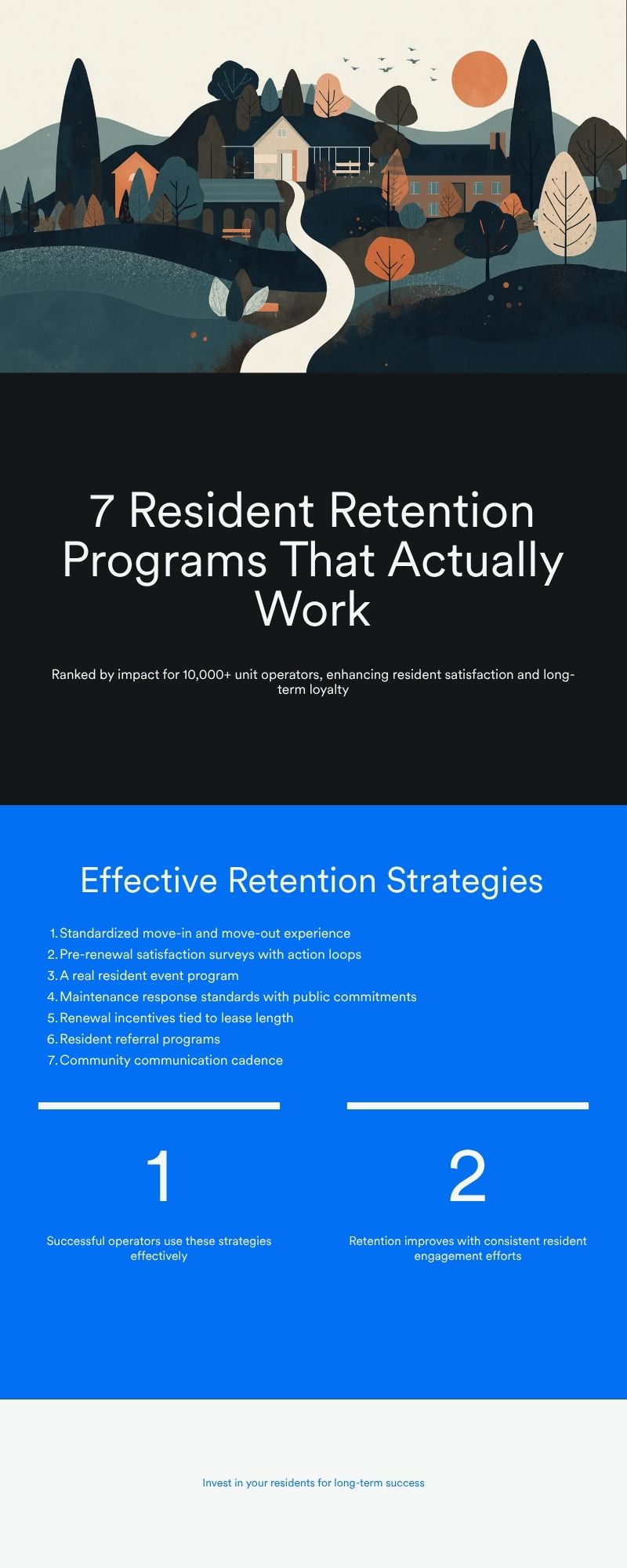
The 7 retention programs that actually work

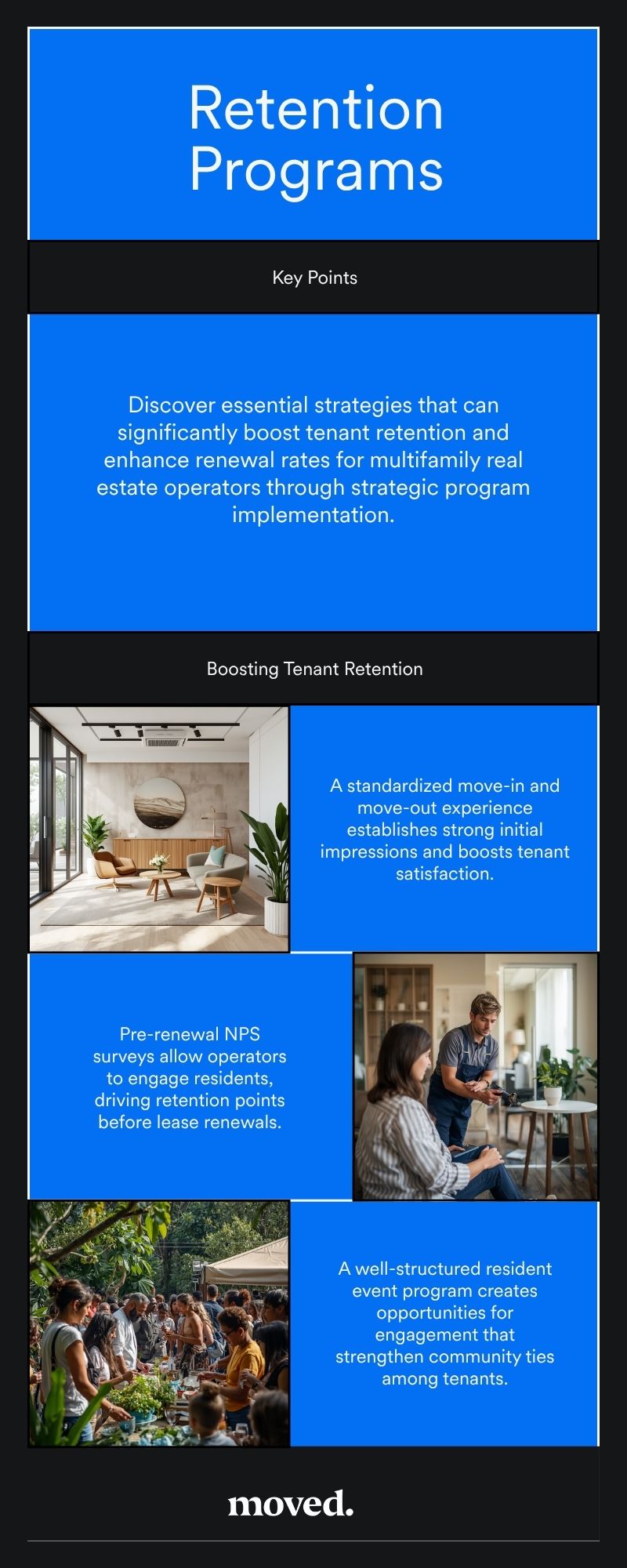
  1. Standardized move-in and move-out experience

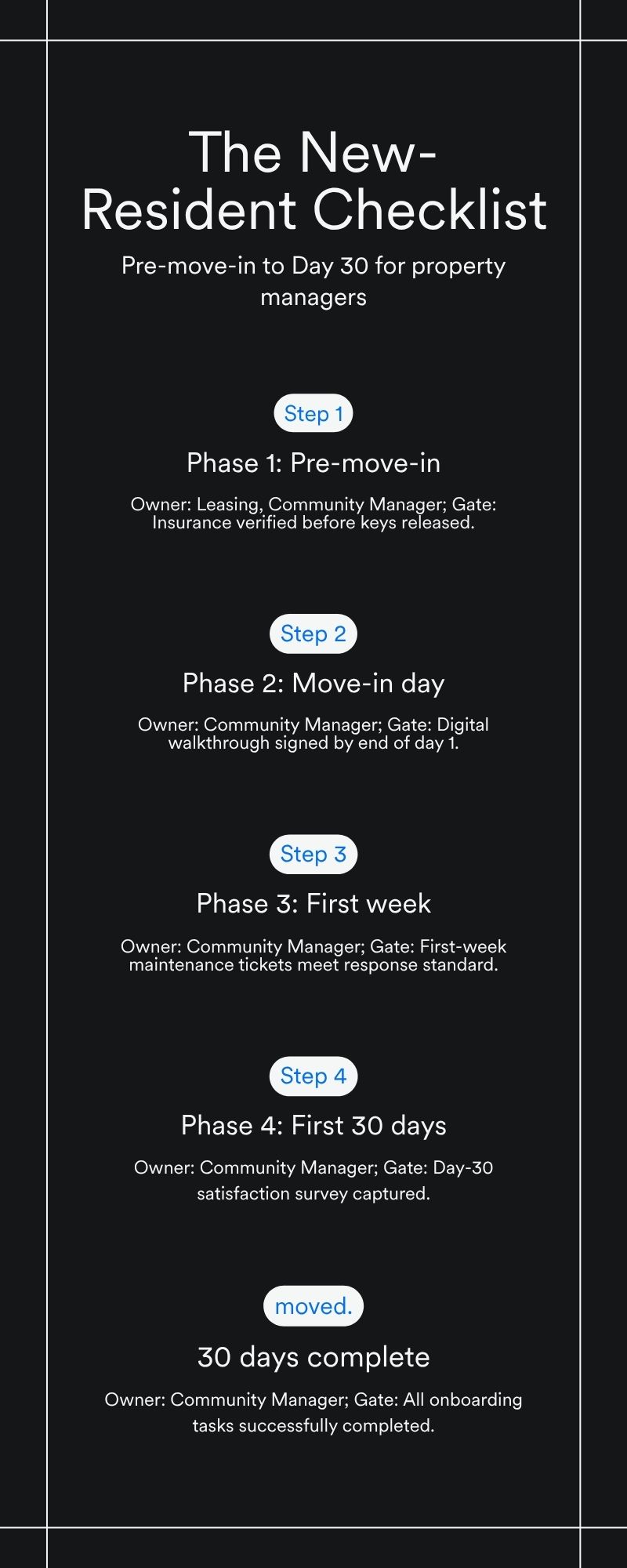
The single highest-impact retention program. NPS is set in the first 30 days of a lease, and BubbleGum BI’s multifamily NPS research shows that residents scoring 9-10 renew at 70-80%, versus less than 30% for those scoring 0-6.

A standardized move-in and move-out workflow that runs every resident through the same task orchestration, communication cadence, and service activation produces NPS scores 4 to 8 points higher than property-by-property improvisation. The compounding effect at a 10,000+ unit operator is meaningful: a 4-point NPS improvement translates to 4-6 retention points, and the resulting avoided turn cost and retained rent across the lease cycle is the largest single retention contribution available to the operator.

For the full operating model, see our breakdown of how move-in and move-out workflows became a property management revenue engine, as well as our ultimate guide to resident onboarding automation.

  1. Pre-renewal NPS surveys with action loops

Most operators run NPS surveys, but few run them at the right time. The right time is 90 days before renewal. Surveys sent 30 days before renewal arrive after the decision has been made.

A pre-renewal NPS survey at day 270 of a 12-month lease gives the property team 90 days to act on detractor feedback before the renewal letter goes out. Operators who do this consistently outperform peers by 3-5 retention points, because they close maintenance, communication, and amenity gaps while the resident still has time to update their renewal decision.

The action loop matters more than the survey. Capture the score, escalate detractors to the community manager within 48 hours, document the resolution, and re-survey 30 days later. Without the loop, the survey is just a number.

  1. A real resident event program

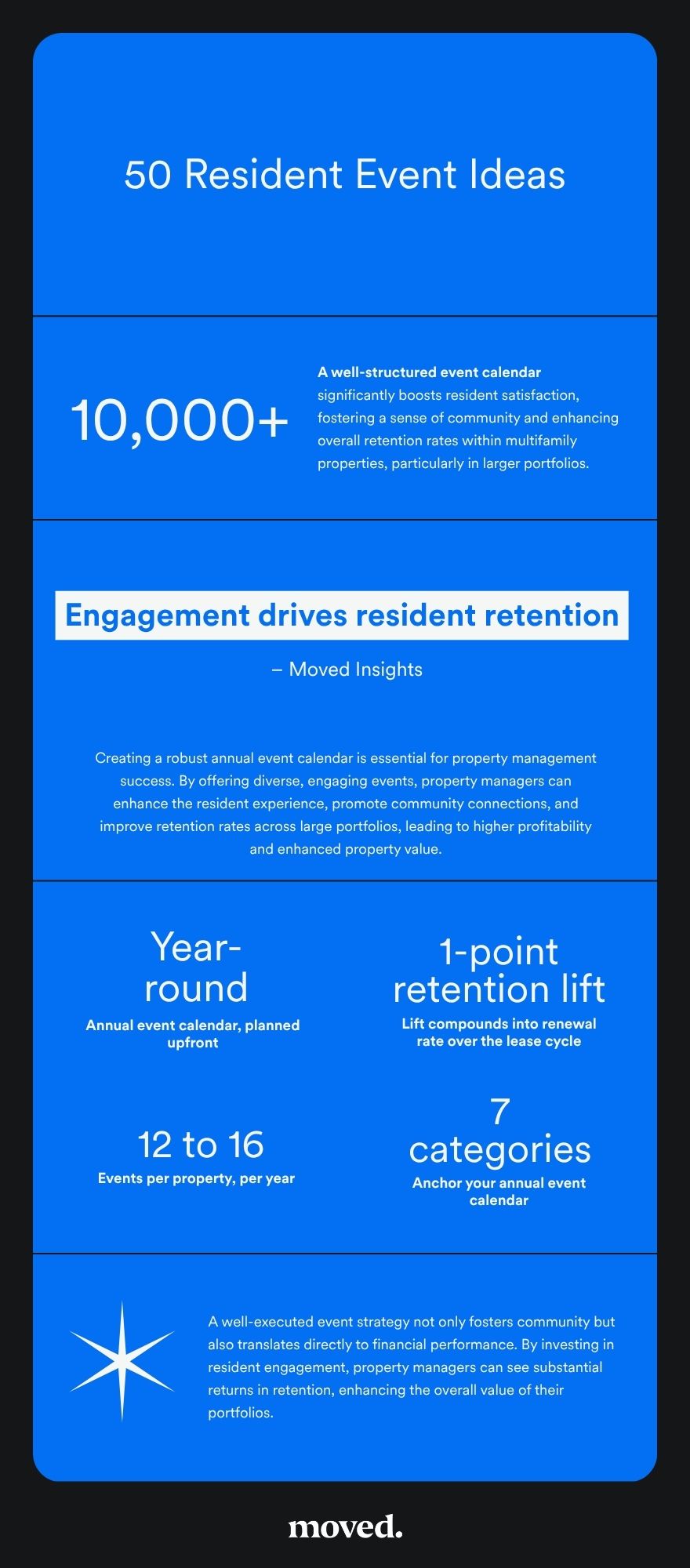
12 to 16 events per property per year, programmed across welcome events, quarterly anchors, seasonal events, wellness, education, amenity-driven events, and resident appreciation. Budget at a 10,000+ unit operator is sized against expected retention lift and avoided turn cost, rather than a fixed dollar figure, and pays back through retention alone.

  1. Maintenance response standards with public commitments

Maintenance experience is the second-largest driver of churn after rent, per Zego’s 2025 Resident Experience Report summarized by NAA. Publish a 24-hour response standard for non-emergency tickets and a 4-hour standard for emergencies. Measure compliance per property. Tie a portion of the community manager bonus to the metric.

Operators who meet the response standard 90%+ of the time score 6-10 points higher on NPS than those who meet it 70% of the time. The bar matters less than the public commitment and the measurement.

  1. Renewal incentive structure tied to lease length

The default renewal incentive (a small rent concession for a 12-month renewal) leaves money on the table. Tier the incentive by lease length: small concession on 12 months, larger concession on 18 months, larger still on 24 months. Pair with a refreshed apartment perk (carpet clean, paint touch-up, smart-home device).

This shifts the renewal mix toward longer leases and reduces churn frequency at the portfolio level. Operators using a tiered renewal structure see 10-15% of renewals shift to 18-month or longer terms, which reduces turn frequency proportionally.

  1. Resident referral programs

Word of mouth is the highest-converting lead source in multifamily. A formal referral program with a clear payout (one month’s rent split between the referrer and the new resident, or equivalent) consistently produces 5-8% of new leases in portfolios that run it well.

The mechanics matter. Make the referral form a single field, pay out within 30 days, and surface it within the Moved residents experience so existing residents see it whenever they log in to the portal.

  1. Community communication cadence

Most operators undercommunicate during the quiet months of the lease (months 4-9) and overcommunicate in the renewal window. Flip the curve. A monthly community newsletter with maintenance updates, event reminders, and short personal notes from the community manager during months 4-9 keeps residents engaged when retention investment is at its lowest cost.

Operators with a consistent monthly cadence score 3-5 points higher on NPS than operators with sporadic or renewal-window-only communication.

What this stack compounds into at a 10,000+ unit portfolio

Stacking the seven programs at a 10,000+ unit operator compounds into measurable retention lift, additional renewals per year, avoided turn cost, retained rent, and NOI uplift across the lease cycle. The sizing for any specific portfolio depends on baseline retention, asset class, rent profile, and program execution.

For the operator framing of how retention uplift converts into NOI and asset value at a portfolio of this size, the two definitive references are the Moved CEO’s RevGen newsletter on the third pillar of residential real estate and the RevGen leak map. Both walk through the structural argument for why retention investment is one of the highest-return categories available to a multifamily operator.

Retention Programs

How Moved fits

The first program on the list (a standardized move-in and move-out experience) runs on Moved infrastructure. The other six (NPS surveys, events, maintenance standards, renewal incentives, referrals, communication) reside within the property management organization and the resident experience team, with the Moved resident portal serving as the operational layer that residents actually log in to.

For 10,000+ unit operators, the operational reality is that residents will not log into two or three different portals. Consolidating the resident-facing experience within the Moved resident experience is what enables the rest of the retention programs to reach the resident at all.

To see how this works at portfolio scale, book a walkthrough with our team or visit the Moved multifamily product page.

FAQs

Which retention program has the highest ROI for a 10,000+-unit operator?

A standardized move-in and move-out experience. NPS is set in the first 30 days, and directly predicts renewal. A multi-point NPS lift across a portfolio of this size compounds into the largest single retention contribution available to the operator.

When should we run the pre-renewal NPS survey?

Day 270 of a 12-month lease (90 days before renewal). This gives the property team time to act on detractor feedback before the renewal decision locks in.

Do resident referral programs actually drive renewals?

They drive new leases more directly than renewals, but the indirect effect on resident pride of place and renewal intent is measurable. Properties with active referral programs score 2-4 points higher on NPS.

How long does it take to see an improvement in retention after deploying these programs?

The first measurable lift typically appears 60-90 days into deployment, as new residents move through the standardized move-in and move-out flow. Full retention improvement compounds over 12-18 months as the renewal cycles turn over.

Can a property run these programs without changing the property management system?

Yes. Five of the seven programs are operational. Only the move-in and move-out workflow depends on dedicated software at portfolio scale.

The bottom line

Resident retention at 10,000+ unit operators is built on standardization, measurement, and timing. The seven programs above have the cleanest evidence base. Stacked together at a portfolio of this size, they generate measurable retention lift, avoided turn cost, and retained rent, with the largest single contribution from a standardized move-in and move-out workflow.

For the full operator playbook, see our breakdown of ancillary revenue in multifamily and our guide on how property managers automate the resident move-in and move-out process.

What Is RevGen? The Third Pillar of Multifamily Performance (After Rent and Expenses)

For two decades, multifamily performance came down to two variables. Grow rent. Control expenses. Every pro forma, every asset management review, and every quarterly investor update was built on those two numbers moving in the right direction. In 2026, both are constrained simultaneously, and a third variable has moved to the center of the conversation.

That third variable is RevGen: the revenue a property generates beyond base rent, managed as a discipline rather than a leftover line. The framing comes from the Moved CEO’s RevGen newsletter, which focuses on the third pillar of residential real estate.

This article defines RevGen, explains why it has become the third pillar of multifamily performance alongside rent growth and expense control, and shows where the largest uncaptured revenue lies for a 10,000+-unit operator.

The two-pillar model has run out of room.

Rent growth has stalled. National multifamily rent growth was roughly flat year-over-year heading into 2026, per Yardi Matrix’s December 2025 report, and concessions returned to four to six weeks of free rent in many supply-heavy primary markets, per ApartmentIQ’s Q1 2025 analysis.

Expenses have not cooperated. Property insurance premiums rose 14%, 22%, and 45% over the past three years, per NAA’s Premium Pulse research, putting steady pressure on the expense line.

When both traditional pillars are under pressure simultaneously, NOI growth must come from elsewhere. That somewhere is RevGen.

What RevGen actually is

RevGen is the income a property earns from everything residents do beyond paying for the unit itself. It includes parking, pet rent, storage, amenity fees, utility partnerships, renters insurance partnerships, internet and connectivity revenue, and partnership income from move-related services such as movers, packing, and storage.

The industry has historically filed all of this under a single accounting line called “other income.” That framing is the problem, and we cover it in depth in our companion guide on multifamily ancillary revenue. The short version is that “other income” treats a portfolio of distinct revenue streams as a single undifferentiated bucket, making the category impossible to manage with any precision.

Why RevGen is now a structural pillar

Three forces moved RevGen from optional to structural.

Rent growth is flat, so the first pillar cannot carry NOI alone. Operating costs keep climbing, so the second pillar is a defensive game rather than a growth one. And capital is disciplined, so refinancing windows and distributions depend on NOI that operators can actually produce without a market-cycle tailwind.

RevGen addresses all three at once. It grows income without raising rent, which sidesteps resident affordability ceilings and concession blowback. It requires far less capital than a renovation. And partnership-based RevGen carries minimal incremental operating cost, so it flows almost entirely to the bottom line. A dollar of partnership-based ancillary income is worth closer to a dollar of NOI than a dollar of rent, which is exactly why asset managers now treat it as a pillar rather than a footnote. For the full NOI argument, see our breakdown of how to increase multifamily NOI without raising rent.

Where RevGen concentrates: the move-in and move-out lifecycle

RevGen is not evenly distributed across the resident lifecycle. The highest-intent, highest-margin revenue clusters in the days surrounding move-in and move-out, when residents are actively making decisions about movers, packing, storage, utility activation, internet, and insurance. If the property is present at that moment, the partnership revenue is captured. If it is absent, a third party captures it instead.

This is why the move-in and move-out lifecycle keeps surfacing as the single highest-margin place to invest in RevGen infrastructure. Most ancillary categories are monetized once. Move-related revenue is monetized at every turn of every unit. We walk through the full mechanism in our piece on how move-in and move-out workflows became a revenue engine for property management.

What RevGen looks like at a 10,000+ unit portfolio

At portfolio scale, RevGen compounds across the lease cycle as every move event becomes a captured revenue moment rather than a missed one. The Moved CEO’s RevGen newsletter sizes the typically uncaptured non-rent opportunity at roughly $15 per unit per month and walks through how that recurring revenue translates into NOI and asset value for a portfolio of this scale. The companion RevGen leak map maps where that revenue leaks today and how operators close the gap. Both are the operator references for building the RevGen case.

The exact result for any portfolio depends on asset class, geography, and existing baseline performance. The pattern holds: RevGen captured consistently across the book is the cleanest source of NOI growth available without raising rent.
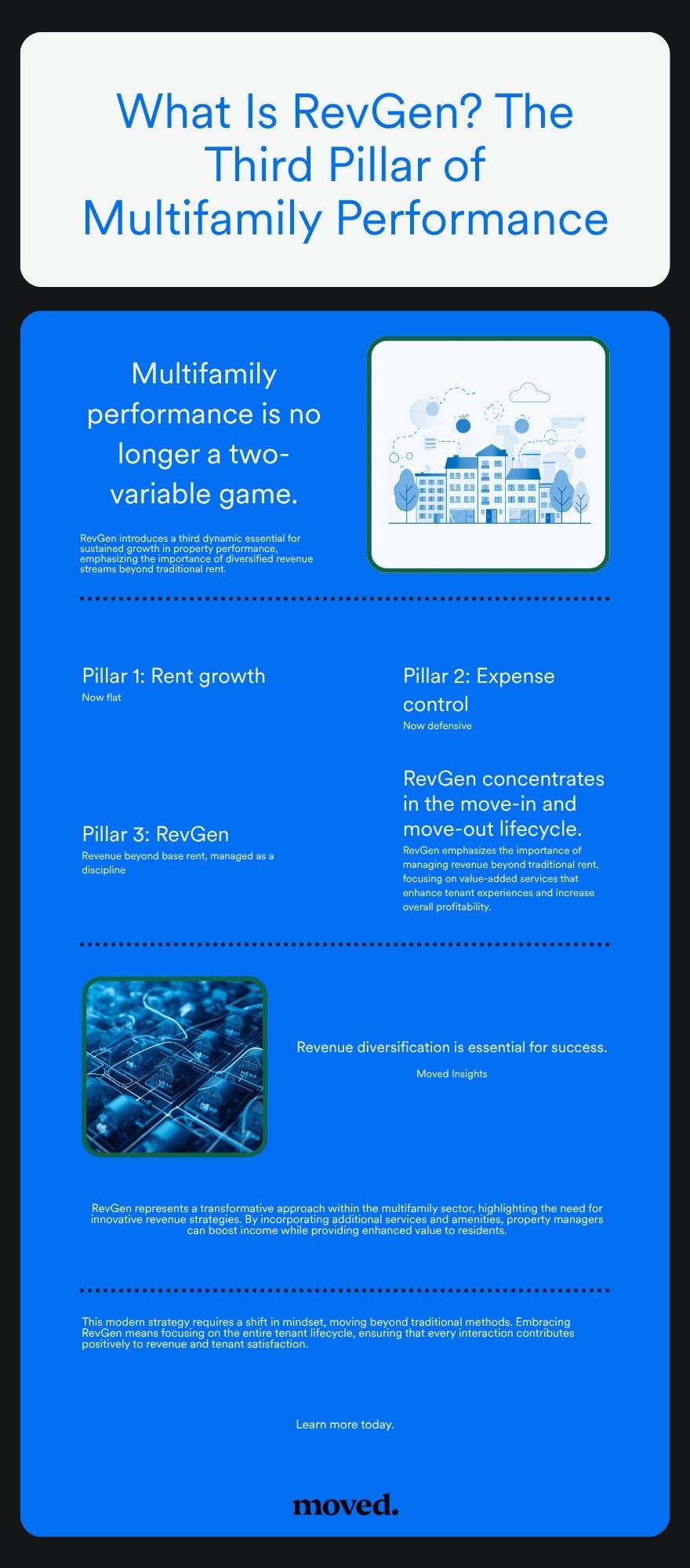
RevGen as the third pillar of multifamily performance after rent growth and expense control, concentrated in the move-in and move-out lifecycle for 10,000+ unit operators.

RevGen is infrastructure, and infrastructure has to be built.

The operators capturing RevGen consistently treat it as portfolio infrastructure managed at the asset management layer. The systems that capture it, including the move-in and move-out workflow, the partner network, the verification gates, and the reporting layer, live above any single property and stay consistent across the book. Operators who treat RevGen as a set of one-off property-level projects underperform because a pilot at one asset never changes the portfolio number.

For most operators in the 10,000+ unit range, the practical path is to partner with a move infrastructure platform rather than build the entire stack in-house. The platform runs the resident-facing experience, and the partner network, and the asset management team owns the strategy and the standards. Moved is built on flexible commercial structures designed to align with property financial goals.

How Moved fits

Moved is a move-in and move-out infrastructure platform built for the resident lifecycle. Traditional tools focus on task tracking and administrative coordination. Moved embeds revenue-generating services and insurance verification directly into the workflow, integrates alongside the property management system via API, and returns clean RevGen data to the asset management team. Resident perks, rewards, and partnerships run on Paylode. This Moved company Moved acquired in November 2025 to advance ancillary revenue automation, per the Moved announcement, for 10,000+ unit operators, which turns the highest-intent revenue moment in the resident experience into a managed, partnership-economics workflow.

To see what RevGen looks like across your specific portfolio, book a walkthrough with our team or visit the Moved multifamily product page.

FAQs

What does RevGen mean in multifamily? RevGen is revenue generation from sources beyond base rent, managed as a strategic discipline. It spans parking, pet rent, storage, amenity fees, utility and insurance partnerships, connectivity, and move-related partnership income.

Why is RevGen called the third pillar? Because the two traditional pillars of multifamily performance, rent growth and expense control, are both constrained in 2026. Rent is flat, and expenses are climbing, so NOI growth increasingly depends on the third pillar: revenue generated without raising rent.

Is RevGen the same as ancillary revenue? RevGen is the discipline of managing non-rent revenue as a pillar. Ancillary revenue is the category of income itself. RevGen is how you run it.

Where does RevGen concentrate? In the move-in and move-out lifecycle, where residents make the highest-intent decisions about movers, packing, storage, utilities, internet, and insurance inside a narrow window.

Who owns RevGen at a 10,000+ unit operator? It sits at the asset management layer, with on-site teams executing the workflow and the reporting rolling up to operations leadership.

The bottom line

Multifamily performance is no longer a two-variable game. Rent growth is constrained, and expense control is defensive, leaving RevGen as the third pillar that will determine whether NOI grows in 2026. The operators who treat it as infrastructure, concentrated in the move-in and move-out lifecycle and managed at the portfolio level, are the ones who will outperform.

For a deeper look at the revenue mechanics, see our breakdown of ancillary revenue in multifamily, and for the resident view, browse the Moved resident experience.

Resident Retention Programs That Actually Work

Seven resident retention programs ranked by impact for 10,000+ unit multifamily operators, led by a standardized move-in and move-out experience.

Resident retention has moved from a property-level concern to a portfolio-level discipline at 10,000+ unit operators. The reason is structural. Average resident retention sits at 57%, down from 60% in 2024, per Zego’s 2026 Resident Experience Management Report summarized in Retently’s analysis, and the industry-wide retention rate is running below the 63% target operators set for themselves, per CRE Daily’s survey. When residents have more options at similar rents, the operators with measurable retention programs win. We cover the broader operating model in our guide to ancillary revenue in multifamily.

This guide covers the seven resident retention programs that consistently move the renewal number at 10,000+ unit operators, ranked by impact.

Why most retention programs fail

Three reasons retention programs underperform at portfolio scale.

The first is that they are unmeasured. Most retention activities (welcome boxes, holiday parties, renewal letters) run without a measurement layer that ties the activity to renewal rate. Activity without measurement is theater.

The second is that they are inconsistent across the portfolio. A welcome program that one community manager runs and another ignores produces lottery-level results at the asset management layer. Standardization is the multiplier.

The third is timing. Most renewal investment lands in months 10 through 12, after the resident has effectively decided. The evidence shows the renewal decision is shaped most heavily by the first 30 days and the maintenance experience across the lease, per Premier Placements’ onboarding research.

The 7 retention programs that actually work

1. Standardized move-in and move-out experience

This is the single highest-impact retention program. Satisfaction is set in the first 30 days of a lease, and residents scoring 9 to 10 on NPS renew at 70 to 80% versus under 30% for those scoring 0 to 6, per BubbleGum BI’s multifamily NPS research. The 30-day move-in survey is also where resident sentiment first breaks down, with an average rating of 3.7 out of 5, per Retently’s 2026 CX Gap study.

A standardized move-in and move-out workflow that runs every resident through the same task orchestration, communication cadence, and service activation produces a more consistent first 30 days than property-by-property improvisation. Because satisfaction predicts renewal directly, consistency is the largest single retention contribution available to the operator, and it carries avoided turn cost and retained rent across the lease cycle. For the full operating model, see our breakdown of how move-in and move-out workflows became a property management revenue engine.

2. Pre-renewal satisfaction surveys with action loops

Most operators run surveys, but few run them at the right time. The strongest operators survey 60 to 90 days before lease expiry, which gives the team room to act before the decision locks in, per Retently’s 2026 study. A survey is sent 30 days before renewal, after the resident has decided.

The action loop matters more than the survey. Capture the score, route detractors to the community manager as an alert within 48 hours, document the resolution, and re-survey 30 days later. Without the loop, the survey is just a number.

3. A real resident event program

A consistent calendar of welcome events, quarterly anchors, seasonal gatherings, wellness sessions, education, and resident appreciation builds the sense of community that residents who renew consistently cite. Budget at a 10,000+ unit operator is sized against expected retention lift and avoided turn cost rather than a fixed figure, and the program pays back through retention alone. Consistency across the portfolio is what separates an event program from a set of one-off parties.

4. Maintenance response standards with public commitments

Maintenance issues are among the most common reasons residents decline to renew, per NAA’s summary of the Zego resident experience data. Publish a 24-hour response standard for non-emergency tickets and a 4-hour standard for emergencies, measure compliance per property, and tie a portion of the community manager bonus to the metric. Public commitment and measurement matter more than the specific number on the clock.

5. Renewal incentive structure tied to lease length

The default renewal incentive, a small rent concession on a 12-month renewal, leaves value on the table. Tier the incentive by lease length: a small concession on 12 months, a larger one on 18 months, larger still on 24 months. Pair it with a refreshed-apartment perk such as a carpet cleaning, a paint touch-up, or a smart-home device. This shifts the renewal mix toward longer terms and reduces turn frequency at the portfolio level.

6. Resident referral programs

Word-of-mouth is among the highest-converting lead sources in multifamily, with referrals from friends or co-workers still used by 39.6% of renters in their apartment search, per the 2025 SatisFacts Online Renter Study. A formal referral program with a clear payout and a single-field form, paid out promptly and surfaced within the Moved resident experience, keeps the program in front of residents whenever they log in to the portal.

7. Community communication cadence

Most operators undercommunicate during the lease’s quiet months and overcommunicate during the renewal window. Flip the curve. A monthly community update with maintenance news, event reminders, and a short personal note from the community manager during mid-lease months keeps residents engaged when retention investment is at its least expensive. This matters because text is the most preferred resident channel across all generations, at 68 to 76%, while the portal alone ranks lowest, at 8.4 to 12.8%, per the 2025 SatisFacts study.

Infographic - 7 Resident Retention Programs That Actually Work

What this stack compounds into at a 10,000+ unit portfolio

Stacking the seven programs at a 10,000+ unit operator compounds into measurable retention lift, additional renewals per year, avoided turn cost, retained rent, and NOI uplift across the lease cycle. The sizing for any specific portfolio depends on baseline retention, asset class, rent profile, and program execution.

For the operator framing of how retention uplift converts into NOI and asset value at a portfolio of this size, the two definitive references are the Moved CEO’s RevGen newsletter on the third pillar of residential real estate and the RevGen leak map. Both walk through why retention investment is one of the highest-return categories available to a multifamily operator.

How Moved fits

The first program on the list, a standardized move-in and move-out experience, runs on Moved infrastructure. The other six live in the property management organization and the resident experience team, with the Moved resident portal as the operational layer residents actually log into.

Traditional tools focus on task tracking and administrative coordination. Moved embeds revenue-generating services, including movers, packing, storage, utilities, internet, and insurance, directly into the workflow, while verifying insurance at the front door. For 10,000+ unit operators, residents will not log into two or three portals, so consolidating the resident-facing experience within the Moved resident experience is what enables the rest of the retention programs to reach the resident at all. Moved is built on flexible commercial structures designed to align with property financial goals.

Resident loyalty and rewards now run on Paylode, a Moved company. Moved acquired Paylode in November 2025 to bring its perks, rewards, and partnerships platform into the Moved resident portal, deepening resident retention through personalized perks and action-based rewards already trusted by operators such as Equity Residential and FirstKey Homes. For a 10,000+ unit operator, that means the loyalty and redemption layer of every retention program above runs natively inside the same resident experience. 

To see how this works at portfolio scale, book a walkthrough with our team or visit the Moved multifamily product page.

FAQs

Which retention program has the highest ROI for a 10,000+-unit operator? A standardized move-in and move-out experience. Satisfaction is set in the first 30 days. It directly predicts renewal, per BubbleGum BI, so a satisfaction lift across a portfolio of this size is the largest single retention contribution available.

When should we run the pre-renewal survey? 60 to 90 days before lease expiry, so the team can act on detractor feedback before the renewal decision is locked in.

Do resident referral programs actually help retention? They drive new leases more than renewals directly, but referrals remain a top-used search source at 39.6% per SatisFacts, and a resident who refers a friend is signaling renewal intent.

How long does it take to see retention improvement? The first measurable lift typically appears 60 to 90 days into deployment, as new residents move through the standardized move-in and move-out flow. Then compounds as renewal cycles turn over.

Can a property run these programs without changing the property management system? Yes. Five of the seven programs are operational. Only the move-in and move-out workflow depends on dedicated software at portfolio scale.

The bottom line

Resident retention at 10,000+ unit operators is built on standardization, measurement, and timing. The seven programs above have the cleanest evidence base. Stacked together at a portfolio of this size, they generate measurable retention lift, avoided turn cost, and retained rent, with the largest single contribution from a standardized move-in and move-out workflow.

For the full operator playbook, see our ultimate guide to resident onboarding automation.

The New Resident Onboarding Checklist for Property Managers

New-resident onboarding checklist for property managers, showing four phases from pre-move-in to day 30, with owner and compliance gating for 10,000+ unit operators.

The first 30 days of a lease are the most financially significant stretch of the entire resident relationship, and at 10,000+ unit operators, they are also the most variable. Onboarding that runs cleanly at one property and loosely at the next shows up in satisfaction scores, ancillary revenue, insurance compliance, and renewal rate. This checklist is the standardized new-resident onboarding workflow that 10,000+ unit operators apply across every property, from lease signing through day 30. We cover the broader operating model in our guide to ancillary revenue in multifamily.

The stakes are concrete. Residents scoring 9 to 10 on NPS renew at 70 to 80% versus under 30% for those scoring 0 to 6, and satisfaction is set in the first 30 days, per BubbleGum BI’s multifamily NPS research. The 30-day move-in mark is also where resident sentiment first breaks down, with an average of 3.7 out of 5, per Retently’s 2026 Property Management CX Gap study. Onboarding is the operator’s one chance to bend that curve before it costs a renewal.

Why onboarding needs a standardized checklist

At portfolio scale, onboarding that lives in individual managers’ heads does not travel. The checklist must deliver the same new-resident experience across markets, asset classes, and on-site teams.

A standardized checklist does three things at once. It captures the ancillary revenue that concentrates in the move window, as residents book movers, packing, storage, utilities, internet, and renters insurance through a single flow. It closes the largest financial-risk gap in the resident relationship by verifying insurance at the front door, where the industry baseline of correctly verified renters insurance has historically sat near 55% against a 90%+ achievable standard, per Foxen’s renters insurance compliance research. And it sets the satisfaction trajectory that decides renewal. The pressure on the insurance gate has only grown, with property insurance premiums up 14%, 22%, and 45% over the past three years, per NAA’s Premium Pulse research.

The onboarding checklist: pre-move-in to day 30

The workflow runs in four phases. Each phase has an owner and a compliance gate that produces a clean record at the asset management layer.

Phase 1: Pre-move-in (lease signing to the day before keys)

Owner: Leasing team during application, then community manager once the lease is signed.

Resident tasks, all orchestrated through a single resident portal:

  • Sign the lease and pay the security deposit
  • Upload the renter’s insurance certificate with the property named as an additional interested party
  • Set up utilities (power, gas, water, internet)
  • Book movers, packing services, and storage if needed
  • Schedule the key pickup window
  • Complete address-change tasks (USPS forwarding, DMV, employer)
  • Acknowledge community rules and the pet policy
  • Receive welcome materials and amenity access information

Property tasks:

  • Verify insurance compliance against lease minimums before keys are released
  • Confirm the unit is rent-ready 72 hours before move-in
  • Send move-in day instructions 48 hours before
  • Prepare the welcome box for hand-off

Compliance gate: Keys are released only after renters insurance is verified, with the correct liability limit, the property named as additional interested party, and valid coverage dates. When mail forwarding and address updates are part of onboarding, moving services come first in the sequence because that is where resident value and operator economics converge.

Phase 2: Move-in day (move-in plus 24 hours)

Owner: Community manager with on-site team support.

Resident tasks:

  • Complete the move-in walkthrough digitally, with photos and timestamped damage notes
  • Acknowledge the unit condition report
  • Confirm utilities are live before signing off
  • Confirm move-in checklist completion in the portal

Property tasks:

  • Hand off keys or activate the smart lock
  • Walk the resident through the unit and amenities
  • Deliver the welcome box
  • File the move-in inspection report into the resident record
  • Trigger the day-one satisfaction touchpoint

Compliance gate: The walkthrough is completed and signed digitally before the end of day 1, so any unit-condition issue is logged at the front of the lease rather than disputed at move-out.

Phase 3: First week (day 1 to day 7)

Owner: Community manager.

This is the most fragile stretch of the relationship, because move-in is where the gap between what was toured and what was delivered becomes the resident’s daily reality, per Retently’s 2026 study.

Resident touchpoints:

  • Day 1: Welcome message from the community manager
  • Day 3: Check-in on any open move-in issues
  • Day 7: Invitation to the new-resident welcome event

Property tasks:

  • Resolve any unit-condition disputes by day 7
  • Confirm utility transfers are progressing
  • Open and track every maintenance ticket against the published response standard (commonly 24 hours for non-emergency, 4 hours for emergency)

Compliance gate: Every first-week maintenance ticket meets the published response standard, since slow maintenance response is one of the most common reasons residents later decline to renew, per NAA’s summary of the Zego resident experience data.

Phase 4: First 30 days (day 8 to day 30)

Owner: Community manager.

Resident touchpoints:

  • Day 14: Two-question satisfaction survey (anything broken, anything missing)
  • Day 21: Reminder of amenity access and the community events calendar
  • Day 30: First satisfaction survey

Property tasks:

  • Confirm all utility transfers are complete
  • Complete first community event participation if possible
  • Route any detractor score to the community manager as a same-day alert for action

Compliance gate: All maintenance tickets opened in the first 30 days are resolved within the published response standard, and the day-30 survey is captured for every new resident.

The onboarding verification checklist

Five gates produce a clean compliance trail at the asset management layer:

  1. Insurance verified against lease requirements at execution before keys are released
  2. Move-in walkthrough completed digitally with photos by end of day 1
  3. First-week maintenance tickets resolved within the response standard
  4. Day-30 satisfaction survey captured for every new resident
  5. Revenue-generating services activated through one resident portal

Text should anchor time-sensitive onboarding messages, as it is the most preferred resident channel across all generations, at 68-76%. At the same time, the portal ranks lowest on its own, at 8.4% to 12.8%, per the 2025 SatisFacts Online Renter Study.

Infographic - The New-Resident Checklist

What this checklist compounds into at a 10,000+ unit portfolio

A standardized onboarding workflow run consistently across 10,000+ units compounds into four operator outcomes: stronger ancillary revenue capture in the move window, reduced financial exposure from insurance verified at the front door, lower turn cost from issues caught early, and a higher renewal rate from satisfaction managed in the first 30 days.

The sizing for any specific portfolio depends on baseline performance, asset class, rent profile, and market mix. The framing of how these outcomes flow into NOI and asset value at the portfolio scale is in the Moved CEO’s RevGen newsletter on the third pillar of residential real estate and the RevGen leak map.

How Moved fits

Moved is the move-in and move-out infrastructure platform that runs this onboarding checklist at portfolio scale. Traditional tools focus on task tracking and administrative coordination. Moved embeds revenue-generating services, including movers, packing, storage, utilities, internet, and insurance, directly into the onboarding workflow, while verifying insurance at the front door.

For 10,000+ unit operators, residents will not log in to two or three portals, so consolidating the resident-facing experience within the Moved resident experience ensures the onboarding checklist reaches the resident at all. At the same time, the asset management team uses the same platform as its reporting layer. Moved is built on flexible commercial structures designed to align with property financial goals.

To see how this onboarding workflow runs at portfolio scale, book a walkthrough with our team or visit the Moved multifamily product page.

FAQs

What is the single most important onboarding step? Insurance verification at lease execution. Unverified renter’s insurance is the largest single financial risk exposure in the resident relationship, and the industry baseline has historically sat near 55%, per Foxen.

Why does the first 30 days matter so much? Satisfaction is set there and directly predicts renewal, per BubbleGum BI, and the 30-day mark is where sentiment first breaks, per Retently.

What maintenance response standard should we hold during onboarding? A common operator benchmark is 24 hours for non-emergency tickets and 4 hours for emergencies, measured per property.

Who owns the onboarding checklist at a 10,000+ unit operator? The checklist sits at the asset management layer. On-site community managers execute it. The reporting layer rolls up to operations leadership.

How is this different from the property management system’s built-in onboarding? The property management system is the system of record. This checklist is the operating workflow that uses it as the data layer and adds the resident-facing experience, revenue service activation, and compliance verification on top.

The bottom line

A standardized new-resident onboarding checklist from pre-move-in through day 30 is one of the highest-return operational changes available to a 10,000+-unit operator without raising rent or adding headcount. The four-phase workflow captures the ancillary revenue in the move window, verifies insurance at the front door, and sets the satisfaction trajectory that decides renewal, consistently across the portfolio.

For the full operator playbook, see our breakdown of how move-in and move-out workflows have become a property management revenue engine, as well as our ultimate guide to resident onboarding automation.

The Multifamily Resident Communication SOP

The multifamily resident communication SOP outlines five lifecycle stages, the primary channel, and the message owner for 10,000+ unit operators.

Resident communication is the connective tissue of the move-in and move-out experience, and at 10,000+ unit operators, it is also the most uneven part of the operation. The same portfolio can run a polished communication flow at one property, and an improvised one at the next, and the difference shows up in satisfaction scores, ancillary revenue capture, insurance compliance, and renewal rate. We cover the broader operating model in our guide to ancillary revenue in multifamily.

This guide is the standardized communication SOP used by 10,000+ unit operators across all properties. It defines the channels, cadence, message owners, and compliance touchpoints that turn resident communication into a reliable revenue- and risk-management workflow rather than a property-by-property guess.

Why resident communication needs an SOP

At portfolio scale, communication that lives in individual managers’ heads does not travel. The standard has to produce the same resident experience across markets, asset classes, and on-site teams with different tenures.

The renter data makes the stakes concrete. Text messaging is the most preferred channel across all generations, at 68-76%, while the community portal ranks lowest, at 8.4-12.8%, per the 2025 SatisFacts Online Renter Study. Residents also expect speed: 63.3% expect a response within two business days or less, per the same study. And poor communication carries a direct reputation cost, with 56.4% of renters leaving a negative review after unexpected fees or weak communication on price changes.

The financial picture is just as direct. Property managers post an NPS of 35 with the owners who pay them and only 10 with the residents who live in the units, a 25-point gap that is structural to the business, per Retently’s 2026 Property Management CX Gap study. Resident sentiment declines most sharply at two communication-driven moments: the 30-day move-in mark, where satisfaction averages 3.7 out of 5, and the renewal window, where it can drop to 3.0 out of 5, per the same study. Both moments are won or lost on communication.

The communication SOP framework

Every resident communication flow at a 10,000+-unit operator spans five lifecycle stages. Each stage has a primary channel, a message owner, and a defined cadence. The standard below is the minimum viable version.

Stage 1: Pre-move-in communication

Window: Lease signing through the day before move-in.

Owner: Leasing team at application, then community manager once the lease is signed.

Primary channel: Text for time-sensitive nudges, email for documents and confirmations, all surfaced inside a single resident portal so residents have one place to act.

This is the highest-value revenue window in the entire lifecycle, and the communication has to do double duty. Alongside the lease and deposit, the resident sees and books the revenue-generating services that accompany every move: movers, packing, storage, utility setup, internet activation, and renters insurance. When mail forwarding and address updates are part of the welcome flow, the moving services remain first in the sequence because that is where both resident value and operator economics are concentrated.

The pre-move-in flow also conveys the lease’s most important compliance message. The communication makes clear that keys are released only after renter’s insurance is verified against the lease minimums, with the property named as an additional interested party. Framing insurance verification as a non-negotiable front-door step is the single largest reduction of financial risk in the workflow.

Stage 2: Move-in day communication

Window: Move-in day plus the following 24 hours.

Owner: Community manager with on-site team support.

Primary channel: In-person handoff plus portal confirmations.

Move-in day is the first satisfaction cliff, so the communication is concrete and immediate: key handoff or smart-lock activation, a guided walkthrough, a digital condition report with timestamped photos, and confirmation that utilities are live. A short day-one satisfaction touchpoint goes out before the end of the day so any unit-condition issue is logged at the front of the lease rather than disputed at move-out.

Stage 3: First 30 days communication

Window: Move-in day through day 30.

Owner: Community manager.

This stretch sets the resident’s view of the property for the rest of the lease, which is why the 30-day move-in score is the first place sentiment breaks in Retently’s 2026 study. A defined touchpoint schedule keeps the relationship from drifting:

  • Day 1: Welcome message from the community manager
  • Day 3: Check-in on any open move-in issues
  • Day 7: Invitation to the new-resident welcome event
  • Day 14: Two-question satisfaction survey
  • Day 21: Reminder of amenity access and the events calendar
  • Day 30: First satisfaction survey

The cadence works because it is consistent and because the team acts on what it hears. A low score routes to the community manager as a same-day alert for action.

Stage 4: Mid-lease communication

Window: Day 31 through the start of the renewal window.

Owner: Community manager.

Most operators undercommunicate during the quiet months and overcommunicate in the renewal window. The SOP flips that curve. A monthly community update with maintenance news, event reminders, and a short note from the community manager keeps residents engaged when retention investment is at its least expensive. Maintenance communication carries a published response standard, typically 24 hours for non-emergency tickets and 4 hours for emergencies, because slow maintenance response is one of the most common reasons residents decline to renew, per NAA’s summary of the Zego resident experience data.

Stage 5: Renewal and move-out communication

Window: 90 days before lease end through the resident’s last day.

Owner: Community manager with leasing support on turnover.

The renewal window is the second satisfaction cliff, so communication starts early. A pre-renewal satisfaction survey 60 to 90 days before expiry gives the team time to close gaps before the renewal decision is locked in, a practice that the strongest operators run deliberately, per Retently’s 2026 study. For residents who move on, the move-in and move-out flow stays symmetrical: re-verify renters insurance is in force through the last day, schedule the digital pre-vacate inspection, send the move-out instructions packet, and confirm the forwarding address for the deposit return.

Infographic - The Multifamily Resident Communication SOP

The communication channel and compliance standard

A standardized flow produces a clean record at the asset management layer. Five communication standards hold across every property:

  1. Text for time-sensitive items, email for documents, portal as the single source of truth
  2. A response standard published to residents and measured per property
  3. Insurance verification messaged as a hard gate at move-in and re-confirmed at move-out
  4. Lifecycle surveys at the 30-day and pre-renewal moments, with detractor alerts routed to a person
  5. Revenue-generating services surfaced inside the same portal residents already use

What this SOP compounds into at a 10,000+ unit portfolio

A standardized communication SOP run consistently across 10,000+ units compounds into four operator outcomes across the lease cycle: stronger ancillary revenue capture as residents book movers, packing, storage, utilities, internet, and insurance through one flow; reduced financial exposure from insurance verified correctly at the front door; lower turn cost from issues caught and resolved early; and a higher renewal rate from sentiment managed at the moments that decide it.

The sizing for any specific portfolio depends on baseline performance, asset class, rent profile, and market mix. The framing of how these operational outcomes flow into NOI and asset value at the portfolio scale is in the Moved CEO’s RevGen newsletter on the third pillar of residential real estate and the RevGen leak map. Both are operator references for building the case for standardized communication.

How Moved fits

Moved is the move-in and move-out infrastructure platform that runs this communication SOP at portfolio scale. Traditional tools focus on task tracking and administrative coordination. Moved embeds revenue-generating services and insurance verification directly into the resident communication flow, turning the move into structured revenue infrastructure.

For 10,000+ unit operators, residents will not log into two or three portals. Consolidating the resident-facing experience within the Moved resident experience is what enables the communication cadence to reach the resident at all. At the same time, the asset management team uses the same platform as its reporting layer. Moved is built on flexible commercial structures designed to align with property financial goals.

To see how this SOP runs at portfolio scale, book a walkthrough with our team or visit the Moved multifamily product page.

FAQs

Which channel should anchor resident communication? Text for time-sensitive items, as it is the most preferred channel across all generations at 68 to 76%, per the 2025 SatisFacts study. Email handles documents, and the portal holds the single source of truth.

What response time should we commit to? Most residents expect a response within 2 business days. For maintenance, the published 24-hour non-emergency and 4-hour emergency standards are the common operator benchmarks.

When should the renewal conversation start? 60 to 90 days before lease end, with a pre-renewal satisfaction survey so the team can act on feedback before the decision is locked in.

Who owns the communication SOP at a 10,000+ unit operator? The SOP sits at the asset management layer. On-site community managers execute it. The reporting layer rolls up to operations leadership.

How is this different from the property management system’s messaging? The property management system is the system of record. This SOP is the operating workflow that uses it as the data layer and adds the resident-facing experience, revenue service activation, and compliance verification on top.

The bottom line

A standardized resident communication SOP at 10,000+ unit operators is one of the highest-return operational changes available without raising rent or adding headcount. The five-stage framework produces a consistent resident experience across the portfolio, captures ancillary revenue in the move window, verifies insurance at the front door, and manages sentiment at the two moments that determine renewal.

For the full operator playbook, see our breakdown of how move-in and move-out workflows have become a property management revenue engine, as well as our ultimate guide to resident onboarding automation.

Pre-renewal NPS Surveys: The Operator Template for 10,000+ Unit Portfolios

Renewal decisions at 10,000+ unit operators get locked in earlier than most teams assume. By the time a resident receives the formal renewal offer, the decision they will make is largely already formed by the operational experience of the preceding nine months. Pre-renewal NPS surveys catch detractors with time to act. Run on the right cadence, with the right structure and a real action loop, they become the single highest-yield retention input outside of a standardized move-in and move-out workflow.

This article gives the operator template. Timing, structure, questions, action loop, anti-patterns, and how the survey integrates with the rest of the resident lifecycle.

Why pre-renewal NPS surveys move the renewal number

NPS predicts renewal directly. Residents who score a property 9 or 10 renew at 70 to 80%. Residents who score 0 to 6 renew at less than 30%. The gap is the operational target. The further ahead of the renewal decision you can catch a detractor and intervene, the larger the share you can move from the lower band into the higher band before the renewal offer goes out.

The pre-renewal window is when the survey is operationally useful. The 30-day window before the renewal offer is too late. A fixed-date trigger pegged to the move-in and move-out anniversary misses the residents whose lease is shorter or longer than the standard 12 months. The 90-day-before-renewal window is the sweet spot. It gives the property team enough time to act, but it is close enough to the renewal decision that the feedback reflects the resident’s actual lived experience of the property.

When to run the survey

For a standard 12-month lease, the right trigger is Day 270, exactly 90 days before the lease end date. The survey goes out automatically through the resident portal and follows up by email if not opened within 72 hours. The trigger is calendar-based, not workflow-based, so it runs reliably regardless of what else is happening at the property.

For shorter leases (six or nine months) the trigger shifts to 60 days before renewal to keep the action window proportional. For 24-month leases the trigger moves to 120 days. The principle holds across lease length: a fixed share of the lease remaining when the survey lands.

The single-question vs multi-question structure

The base survey is a single-question NPS. “On a scale of 0 to 10, how likely are you to recommend living here to a friend or colleague?” That one question carries the bulk of the predictive signal and produces the cleanest comparable score across properties.

Anything more than the single question reduces completion rate and adds operational complexity. The right structure adds at most two follow-up fields, surfaced only after the resident provides the score:

  • **For detractors (scores 0 to 6):** “What is the single biggest thing we could fix to make your experience better?” Open text field. Resident input is qualitative and feeds the action loop directly.
  • **For passives (scores 7 or 8):** “What would move you from a 7 to a 9?” Same open text field structure. Passives are where most operators leave the largest amount of value on the table because the feedback is constructive rather than complaint-driven.
  • **For promoters (scores 9 or 10):** “What is the one thing about living here you would tell a friend?” Captures word-of-mouth signal and feeds the resident referral and marketing program directly.

Three response paths, one question each, gated by the NPS score itself. Total survey completion time under sixty seconds. Completion rates consistently sit in the 35 to 55% range when the survey is delivered through the resident portal during a normal portal session.

The action loop that turns the survey into renewal

An NPS survey without an action loop is a vanity metric. The survey is valuable only to the extent that the property team acts on detractor feedback before the renewal decision locks in. The standard action loop has three parts:

  • **Same-day routing.** Every detractor response routes automatically to the property manager and the regional or asset manager. Same-day notification, not weekly digest.
  • **Seven-day response window.** The property manager makes contact with the detractor (call or in-person) within seven calendar days of the survey response. The contact is not a service ticket. It is a structured conversation that confirms the operational gap, commits to a remedy where possible, and documents the conversation in the resident record.
  • **Thirty-day remedy window.** The remedy itself, where one is possible, closes within 30 days. If the gap is structural (rent ceiling, unit constraint), the property manager documents why the remedy is not possible and shifts the conversation toward a different unit or a different conversation altogether.

The action loop is what converts the survey into a renewal lift. Properties that run the survey but skip the loop produce the data without the result.

Sample question library

Beyond the single core NPS question and the three response paths above, a small library of optional follow-up questions can be rotated quarterly to capture specific operational signals.

  • “How would you rate the responsiveness of the maintenance team over the past six months?” One to five scale.
  • “How would you rate the experience of moving into your unit?” One to five scale. (This question is particularly valuable because it ties directly back to the move-in and move-out workflow.)
  • “How well does the property communicate with you about events, maintenance, and community updates?” One to five scale.
  • “If you could change one thing about the building itself, what would it be?” Open text.

Rotate one or two of these in each quarterly survey wave to capture a deeper operational signal without lengthening the core survey.

Anti-patterns to avoid

Several common patterns reduce or eliminate the value of the pre-renewal NPS survey.

  • **Bundling the survey with the renewal offer itself.** The two are entirely different. Bundling forces the resident to interpret the survey as part of the renewal negotiation and distorts the response.
  • **Running the survey only once per resident, on a fixed schedule that ignores the move-in and move-out cycle.** Pre-renewal timing is what makes the survey actionable. A schedule pegged to a calendar month rather than the lease cycle misses the renewal window for residents on shorter leases and runs late for everyone.
  • **Skipping the action loop.** As above. The survey produces the data, but the action produces the renewal lift.
  • **Treating passives as promoters.** Passives are not loyal. They are uncommitted, and they convert to detractors faster than promoters. The structured question for passives is the highest-yield part of the survey for most operators.

How the survey fits the rest of the resident lifecycle

The pre-renewal NPS survey is one of three structured resident-feedback moments in a well-run lease lifecycle. The other two are the move-in and move-out experience surveys, which capture the first-30-days NPS that sets the baseline for the rest of the lease, and the post-renewal pulse check that confirms the renewal decision held. The three together produce a coherent lease-cycle NPS curve that asset managers can read property by property.

The first 30 days, where NPS is set and where the standardized move-in and move-out workflow has the largest single impact, is the most important of the three. The pre-renewal survey is where that initial NPS work gets defended. The post-renewal pulse is where it gets confirmed.

How Moved fits

Moved is the move-in and move-out infrastructure that runs the workflow underneath the NPS curve. The 30-day window where NPS is initially set runs through the Moved residents experience. The pre-renewal NPS survey then defends the score the move-in window established. Asset management teams that operate both pieces together see the cleanest NPS curve and the cleanest renewal data.

To see what the lifecycle NPS curve looks like at portfolio scale, book a walkthrough with our team or visit the Moved multifamily product page.

50 Resident Event Ideas

FAQs

When should the pre-renewal NPS survey go out? Day 270 of a 12-month lease, exactly 90 days before the lease end date. For shorter or longer leases, the trigger shifts proportionally.

Should the survey ask more than one question? Yes. One core NPS question, plus one gated follow-up depending on the score (detractor, passive, or promoter). Three response paths, one question each. Completion under 60 seconds.

What is the action loop? Same-day routing of detractor responses to the property manager and asset manager, seven-day response window, thirty-day remedy window. Without the loop, the survey produces data but no renewal lift.

Why are passives the highest-yield band? Because passive feedback is constructive rather than complaint-driven, and passives convert into detractors faster than promoters. A small structural fix at a passive often moves them into the promoter band.

Where does the survey sit in the resident lifecycle? It is the defensive layer on top of the initial 30-day NPS established by the move-in and move-out workflow. The pre-renewal survey catches drift before it converts into non-renewal.

The bottom line

Renewal decisions at 10,000+ unit operators are formed long before the renewal offer goes out. The pre-renewal NPS survey is the operational input that catches detractors with time to act. Run on a Day 270 trigger, structured as one core question plus one gated follow-up, paired with a real action loop, it is the highest-yield retention input outside of a standardized move-in and move-out workflow itself. Build it correctly and run it consistently, and the renewal number moves.

For the full retention operating model, see our companion guide to resident retention programs and our breakdown of how move-in and move-out workflows became a property management revenue engine. To deploy the survey and the action loop across your portfolio, reach out to our team.

The Move-In and Move-Out Window: Why It Is the RevGen Backbone at 10,000+ Unit Operators

RevGen is the third pillar of multifamily performance after rent and expenses. The structural argument is established in our companion piece on RevGen as the third pillar. What is less appreciated is where the pillar concentrates inside the resident lifecycle. RevGen is not evenly distributed across twelve months of a lease. It clusters tightly inside the move-in and move-out window.

This article makes the operator case for why the move-in and move-out window is the structural backbone of any serious RevGen program at a 10,000+ unit operator. Three forces converge there at the same time, and no other moment in the lease cycle puts the property in the same position to capture revenue at partnership economics.

Three forces converge in the move-in and move-out window

  1. Peak resident intent

The move is the single highest-intent moment in the resident lifecycle. Residents are actively shopping for movers, packing services, storage, utility activation, internet, and renters insurance. The decisions get made within a narrow window of days, often within hours. Intent is not constant during a lease. Intent peaks at the move, drops sharply once the resident is settled in, and stays low through the quiet middle of the lease until the renewal window reopens.

Offers that convert at the move moment fall flat in month four of the lease. The window is not a marketing convenience. It is a structural feature of how residents behave.

  1. Peak workflow

The move is also where every operational workflow converges. The property management system is running the lease activation. The resident is going through onboarding tasks. The on-site team is preparing the unit for arrival. The insurance verification gate is active. The utility activation is happening. If the property has infrastructure at the move moment, every one of those workflows can carry an offer. If the property does not, the workflows run anyway and the offers default to whichever third party the resident finds on their own.

The workflow concentration is what makes the window operationally efficient. Adding a category to capture at the move moment is largely free because the workflow is already in motion. Adding the same category at month six requires building a workflow that does not otherwise exist.

  1. Peak revenue

The convergence of peak intent and peak workflow produces peak revenue density. Most non-rent revenue categories are monetized once, at one moment. Move-related revenue is monetized at every turn of every unit, by definition. That is what makes the window unique. The same property captures revenue at the move-in window of a new resident and again at the move-out window months later when the resident leaves and someone else moves in.

What sits inside the window

The move-in and move-out window contains the four categories operators most commonly leave uncaptured at scale.

  • **Movers and packing partnership revenue.** Almost every resident hires a mover or coordinates packing. If the property is not present at the booking moment, that revenue defaults to a third party.
  • **Insurance partnership revenue.** Renters insurance is required by lease, but most operators verify it after the fact rather than partnering with a carrier at the moment of the activation.
  • **Utility activation partnership revenue.** Electricity, gas, and bulk internet are activated inside the move-in and move-out window. The property can either be present at that moment or watch the revenue go to whichever utility provider the resident finds first.
  • **Storage partnership revenue.** A meaningful share of moving residents need short-term or transitional storage. The decision gets made within the move window.

Each of these is a RevGen category in its own right. Together, the move-in and move-out window concentrates more partnership-economics revenue per resident than any other moment in the lease cycle.

Why this matters for the 10,000+ unit operator specifically

At a single property, missing the move window is a minor leak. At 10,000 units and above, the leak compounds across every turn of every unit, every quarter, every year. The portfolio-level math is what makes the window structurally important. A 10,000+ unit operator that captures the move-related category turns the highest-intent, highest-margin moment in the resident lifecycle into a managed RevGen stream. A 10,000+ unit operator that does not capture it watches the same revenue go to a third party at every turn.

The operator framing for how that capture compounds into NOI and asset value at portfolio scale is the Moved CEO’s third pillar of residential real estate newsletter and the RevGen leak map. Both are required reading for any asset manager building the RevGen argument for portfolio infrastructure.

Why bolt-on programs cannot substitute for the backbone

Many operators try to grow non-rent revenue by adding programs around the edges. A parking optimization here. A pet program revision there. Those programs help, but they cannot substitute for the window. The reason is that parking, pet rent, and storage are already billed monthly through the property management system. The opportunity in those categories is incremental optimization on revenue you are already capturing.

The opportunity in the move-in and move-out window is fundamentally different. The revenue is not currently captured at all. Adding programs around the edges grows the captured part of the line. Building the backbone closes the largest uncaptured gap in the book. The structural reason this asymmetry exists is in the RevGen leak map.

What the backbone actually requires

Building the move-in and move-out window as a RevGen backbone requires four pieces working together.

  • **A workflow the resident actually uses.** Resident-facing infrastructure at the moment of the move, integrated with the property management system so it lives inside the onboarding flow rather than alongside it.
  • **A partner network with portfolio-scale economics.** Movers, insurance carriers, utility providers, and connectivity partners that can deliver service consistently across every market in the portfolio.
  • **Compliance gates in the same flow.** Insurance verification, lease documentation, and digital walkthrough running through the same workflow that carries the partnership offers.
  • **Reporting back at the category level.** Attach rate, margin, and revenue per unit returned to the asset management team in the same scorecard structure used for the rest of the non-rent line.

When all four are in place, the move window stops being an operational chore and becomes the highest-margin moment in the asset’s revenue cycle.

How Moved fits

Moved is the move-in and move-out infrastructure platform built for this exact backbone. We integrate alongside the property management system via API, run the resident-facing experience for movers, packing, storage, insurance verification, utilities, and connectivity, and return category-level RevGen data to the asset management team. For 10,000+ unit operators, the platform is the workflow, the partner network, and the reporting layer in one piece of infrastructure.

To see what your move window could capture at portfolio scale, book a walkthrough with our team or visit the Moved multifamily product page.

The Move-In and Move-Out Process

FAQs

Why is the move-in and move-out window called the RevGen backbone? Because three forces converge there simultaneously. Resident intent peaks, the operational workflow concentrates, and the highest-margin partnership revenue clusters in the same days. No other moment in the resident lifecycle puts the property in the same position.

What categories sit inside the window? Movers and packing, renters insurance, utility activation, and storage partnerships. Each is a RevGen category in its own right, and the window concentrates all four into the same moment.

Why cannot parking and pet programs substitute for the backbone? Because those categories are already captured monthly through the property management system. The opportunity there is incremental optimization on revenue already on the books. The move window opportunity is closing a structural gap where the revenue is not currently captured at all.

What does the backbone require operationally? A resident-facing workflow at the move moment, a partner network with portfolio-scale economics, compliance gates inside the same flow, and category-level reporting back to the asset management team.

Where does the operator framing for the structural argument sit? In the Moved CEO’s third pillar of residential real estate and the RevGen leak map.

The bottom line

RevGen at portfolio scale rises and falls on what happens in the move-in and move-out window. Operators who treat that window as the backbone of the RevGen program capture revenue at partnership economics at every turn of every unit. Operators who treat it as an operational chore watch the same revenue default to third parties for the life of the asset. The structural argument for why this is the case sits in the Moved CEO’s third pillar of residential real estate and the RevGen leak map.

To build the backbone for your portfolio, reach out to our team.