A notice of rent increase is a written notice from the property telling a resident that the rent will go up, by how much, and on what date. State law decides how much notice is required, how often rent can rise, and in some states, how large the increase can be. For multifamily operators, the notice works best when the rule for each property is checked before the letter is drafted and the letter is sent on a fixed schedule.
Across a 10,000+ unit portfolio, every rent increase notice is also the moment a resident decides whether to renew or move. This guide covers the notice periods and caps in three states, what the notice should include, a template your team can adapt, and how to run increases inside a structured move-in and move-out process in residential real estate.
Why The Rent Increase Notice Shapes Move-Out Decisions
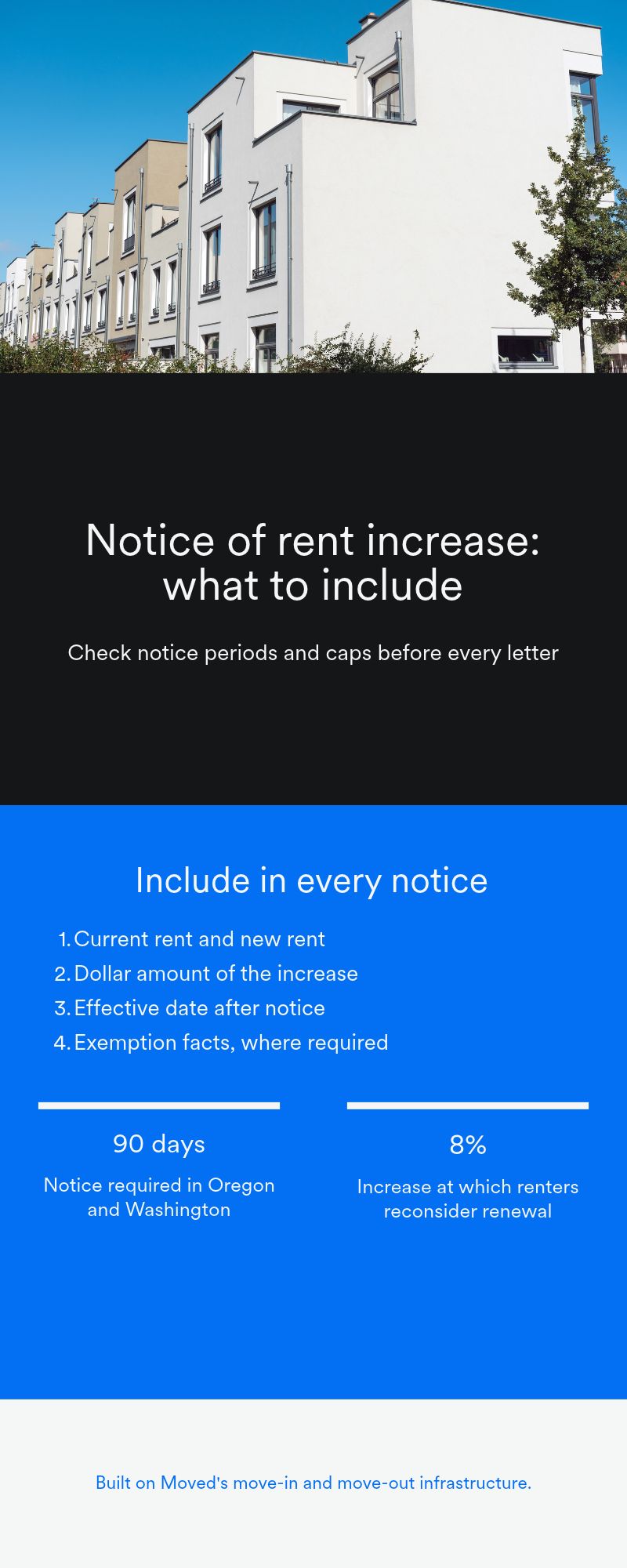
Residents read a rent increase notice as a renewal decision. Zego’s 2026 Resident Experience Management Report found that renters begin reconsidering renewal at an average rent increase of 8 percent, with monthly increases of $90 to $150 triggering hesitation.
The same report found that average retention fell to 57 percent, down from 60 percent in 2024. Each resident who leaves after a rent increase creates a turn, and turnover has cost about $3,872 per resident, according to an earlier Zego report covered by Multifamily Dive, including marketing, repairs, concessions, and lost rent.
That makes the notice both a legal document and a retention tool. A notice that arrives late, misstates the amount, or exceeds a cap can be unenforceable, and a notice with no context can push a resident who would have stayed toward a move.
Notice Periods And Caps In Three States
Notice and cap rules vary by state and city. The table below summarizes California, Oregon, and Washington, three states with statewide caps for many older buildings.
| State | Notice required | Cap and frequency |
|---|---|---|
| California | For month-to-month and shorter tenancies, 30 days for an increase of 10 percent or less in 12 months, and 90 days for a larger increase (Civil Code section 827) | For covered units, no more than 5 percent plus the change in the cost of living, or 10 percent, whichever is lower, over any 12 months, in no more than two increments (Civil Code section 1947.12) |
| Oregon | At least 90 days’ written notice, and no increase during the first year of the tenancy (ORS 90.323) | One increase in any 12-month period, up to the annual maximum the state publishes: 9.5 percent for 2026 and 10 percent for 2027 |
| Washington | At least 90 days’ written notice, and the increase may not take effect before the rental agreement term ends (RCW 59.18.140) | No increase during the first 12 months, then up to 7 percent plus CPI or 10 percent, whichever is less, in any 12-month period: 9.683 percent for 2026 and 10 percent for 2027 |
Each rule has exemptions, local rent ordinances can be stricter, and the details below should be confirmed with counsel for every property before notices are sent.
California
California Civil Code section 827 requires written notice delivered personally or by mail. The 30-day or 90-day period depends on whether the increase, alone or combined with other increases in the prior 12 months, exceeds 10 percent, and a longer notice period applies if another statute, regulation, regulatory agreement, or contract requires one.
Civil Code section 1947.12 caps increases for covered units, measured from the lowest gross rent charged in the prior 12 months. Housing issued a certificate of occupancy within the previous 15 years is exempt, along with some deed-restricted affordable housing and other listed categories, and the section is set to be repealed on January 1, 2030.
The section also requires the gross monthly rent and any concessions to be listed separately in the lease. An owner who collects rent above the cap can be liable for the overcharge and, where the owner acted willfully, up to three times that amount.
Oregon
ORS 90.323 requires the notice to state the amount of the increase, the new rent, the date it takes effect, and, if the increase exceeds the cap under an exemption, the facts that support the exemption. A unit whose first certificate of occupancy was issued less than 15 years before the notice is exempt from the cap.
The state’s Office of Economic Analysis publishes the maximum each year, and its rent stabilization page lists 9.5 percent for 2026 and 10 percent for 2027. A landlord who raises rent above the cap can owe three months’ rent plus actual damages.
Washington
RCW 59.18.140 sets the 90-day notice rule, with a 30-day notice for subsidized tenancies where rent is based on the resident’s income. RCW 59.18.710 exempts units whose first certificate of occupancy was issued 12 or fewer years before the notice, along with certain public, nonprofit, and tax credit housing.
The Department of Commerce publishes the annual cap on its HB 1217 landlord resource center, which lists 9.683 percent for 2026 and 10 percent for 2027. The exemption section, RCW 59.18.710, is set to expire on July 1, 2040.
What To Include In A Notice Of Rent Increase
- The date of the notice and the names of every adult resident on the lease.
- The unit address and the current monthly rent.
- The new monthly rent and the amount of the increase in dollars.
- The date the new rent takes effect, counted from the notice period the state requires.
- Any exemption facts the state requires, such as Oregon’s statement supporting an increase above the cap.
- Any change to recurring fees, listed separately from rent.
- Renewal options, if the increase is tied to a lease renewal.
- A contact name and phone number for questions.
When the increase comes with a renewal offer, Moved’s lease renewal letter template shows how to present term options alongside the new rent.
Notice Of Rent Increase Template
Adapt this template to each state and city, and have counsel approve the final version before it is used.
[Date]
Dear [Resident names],
This letter is notice that the monthly rent for [unit address] will change from [current rent] to [new rent], an increase of [dollar amount], effective [effective date].
[If required by law: This increase is permitted because [exemption facts].]
[If tied to renewal: You may renew your lease on the following terms: [term options and rents]. Please let us know your choice by [response date].]
If you have questions about this notice, please contact [name] at [phone and email]. Thank you for living at [community name].
Sincerely, [Name, title]
How To Schedule Increases Across A Portfolio
- List every lease ending or eligible for an increase at least 120 days ahead.
- Identify the notice period, cap, and exemption status for each property.
- Calculate the allowed increase from the rent history the state uses, including prior increases in the last 12 months.
- Approve the increase and the renewal terms in one review.
- Send the notice by a delivery method the state allows, and record the date served.
- Track responses, and open the renewal or move-out path for each resident.
For month-to-month tenancies, Moved’s guide to month-to-month lease policy covers how notice and renewal decisions differ from fixed-term leases.
Common Rent Increase Notice Mistakes
- Using one notice period for every state, or the wrong period for the size of the increase.
- Calculating a cap from the current rent instead of the lowest rent the state’s rule requires.
- Raising rent twice in a 12-month period in a state that allows only one increase.
- Leaving out a required element, such as Oregon’s exemption facts or the effective date.
- Applying an exemption based on building age without checking the certificate of occupancy date.
- Sending the notice with no renewal context, so the resident starts planning a move.
The Revenue Case: Every Increase Notice Opens A Renewal Or A Move
A rent increase notice gives the resident a deadline and a decision. Some will renew, and others will start planning a move, which means they will need movers, packing, and storage within weeks.
The move-in and move-out revenue workflow puts those services in front of the resident at the moment the decision is made. If the resident gives notice to vacate, the property already knows the move date and can schedule the inspection and make-ready.
If the resident renews, the same workflow keeps insurance and resident services current for the next term. Either way, the notice date becomes the start of a planned process instead of a surprise.
Renewal Without A Concession: Paylode, a Moved Company
Many operators offset an increase with a concession. A rewards program gives residents value that does not reduce the rent roll.
Paylode is a Moved company. Moved acquired Paylode in November 2025, adding a perks and rewards platform that helps brands increase loyalty and retention through personalized perks and action-based rewards. Zego’s 2026 report found that 31 percent of renters would be much more likely to renew if their community offered a renter rewards program.
Introducing rewards months before the increase notice gives residents a reason to stay that the notice alone cannot provide. Moved’s guide to rent concessions covers when a concession still makes sense.
Disclosure And Insurance At Renewal
Recurring fees should be shown separately from rent and disclosed in the same notice. The Federal Trade Commission’s advance notice of proposed rulemaking on rental housing fees asks how fees are presented to renters, and Moved’s guide to the FTC rental fee rulemaking covers how to present every charge in one place.
A renewal is also the right time to confirm the resident’s coverage for the next term. Moved’s guide to capturing renters insurance requirements at move-in explains how to verify a policy before it lapses.
Running Rent Increase Notices Across A 10,000+ Unit Portfolio
- One notice template per state and city, with the required elements and exemption language built in.
- A property list that records the certificate of occupancy date and cap status for every building.
- Annual cap updates added to the calendar each year when Oregon and Washington publish new rates.
- Rent histories that show every increase in the prior 12 months for each unit.
- Notices generated 120 days before each lease end, with service dates recorded.
- Renewal rates and move-outs after each notice cycle reported by property.
Traditional tools focus on task tracking and administrative coordination. Moved embeds revenue-generating services and insurance verification directly into the workflow, transforming move coordination into structured revenue infrastructure.
Moved is a move infrastructure platform that embeds revenue-generating services, including movers, packing, storage, insurance, utilities, and connectivity, directly into the resident onboarding workflow. It helps property operators increase ancillary income while mitigating compliance risk, and the guide to resident onboarding automation shows how that workflow is built.
For residents, a clear and timely notice is part of the resident experience. For operators, Moved for multifamily operators shows how the same process runs across a portfolio.
Frequently Asked Questions
How much notice is required for a rent increase?
It depends on the state and the size of the increase. California requires 30 days for an increase of 10 percent or less on a month-to-month tenancy and 90 days for a larger one, while Oregon and Washington require at least 90 days.
Can rent be increased in the middle of a lease?
That depends on the lease and state law. Washington, for example, does not allow an increase to take effect before the end of the rental agreement term.
What is the maximum rent increase in Oregon and Washington for 2027?
Both states have published a 10 percent maximum for 2027 for covered units. Oregon’s maximum for 2026 was 9.5 percent, and Washington’s was 9.683 percent.
What should a rent increase letter include?
It should state the current rent, the new rent, the amount of the increase, and the effective date. Some states require more, such as Oregon’s statement of exemption facts when an increase exceeds the cap.
Is a rent increase notice the same as a lease renewal letter?
They are different documents that often travel together. The notice states the new rent and effective date, and the renewal letter offers the terms for the next lease.
Send Every Increase On Time And On The Record
A compliant notice protects the property, and a planned response protects the renewal. To see how notices, renewal decisions, and move services run as one move-in and move-out workflow across a 10,000+ unit portfolio, book a walkthrough with the Moved team.